Don't Panic! Here is How to Repair Your Diamond Ring Safely
What You Need to Know Before You Repair a Diamond Ring
When you need to repair a diamond ring, here is what most people want to know right away:
Quick answers:
- Is it safe to leave your diamond ring with a jeweler? Yes — if you choose a reputable jeweler and document your ring beforehand.
- How do you make sure you get your original diamond back? Check for a laser-inscribed serial number, inspect the stone under a microscope, and get a written repair agreement.
- What should you do before dropping off your ring? Take detailed photos, request a plotting diagram, and confirm all stone details in writing.
- How long do diamond ring repairs take? Most common repairs (prong retipping, resizing, shank repair) take anywhere from a few days to two weeks.
- Can a jeweler switch your diamond during a repair? It is extremely unlikely — established jewelers risk their entire reputation over a single stone.
Leaving your engagement ring at a jewelry store for repairs can feel unsettling. You have something irreplaceable in someone else's hands — and the worry of "what if it comes back different?" is real, even if the risk is very low.
The good news? That anxiety is almost always preventable. With the right documentation and a few simple verification steps, you can drop off your ring with total confidence and pick it up with complete peace of mind.
At White Diamonds, we specialize in custom rings, wedding bands, and jewelry repair — and we know how much trust it takes to hand over something so meaningful. Our team is here to make the process of repairing your diamond ring as transparent and stress-free as possible.
Why You Need to Repair Diamond Ring Settings and Stones
Even though diamonds are famous for their unmatched hardness, the rings that hold them are still pieces of metal subject to daily wear and tear. Over time, active hands, accidental knocks against countertops, and simple friction can compromise your ring's structure.
If you ignore minor wear, you risk losing your precious stones entirely. Here are the most common reasons why you might need to repair a diamond ring:
Loose or Damaged Prongs
Prongs are the tiny metal claws that grip your diamond and hold it securely in place. Because they stick out, they bear the brunt of everyday impacts. Over time, prongs can snag on sweaters, wear down thin, or pull away from the stone. If you can wiggle your center diamond or hear a faint clicking sound when you tap the ring near your ear, your prongs are dangerously loose.
Cracked or Thinning Shanks
The shank is the band portion of your ring. Daily wear slowly wears away the metal on the bottom of the band. If your ring was sized improperly in the past, or if it has been worn alongside another heavy band for years, the metal can wear down until it is paper-thin. Eventually, a thin shank can crack or warp out of round, making it uncomfortable to wear and prone to snapping.
Can Diamonds Actually Break or Get Damaged?
A common misconception is that diamonds are completely indestructible. While they are the hardest natural substance on Earth, hardness only measures resistance to scratching.
- Scratches: If you have ever wondered can diamond rings get scratched, the answer is yes, but only by another diamond. However, the metal setting surrounding them can easily get scratched and dull over time.
- Chipping and Breaking: Can they actually crack under pressure? Absolutely. If you want to dive deeper into the physical limits of these gemstones, you can read our guides on can diamonds break and can a diamond chip or break. A hard blow at just the right angle—especially along the diamond's natural cleavage planes—can chip or fracture the stone. If your center stone has sustained a chip, it must be repaired or reset promptly to prevent the damage from spreading.
Resizing and Band Repairs
Our fingers change size over time due to weather, weight fluctuations, or life milestones. If your ring is sliding off too easily or cutting off your circulation, you need a professional resizing.
If you are wondering can engagement rings be resized, yes they can, but the process requires precision to ensure the structural integrity of the side stones is not compromised. Similarly, gentlemen's rings also require upkeep; we offer specialized mens wedding band repair to fix deep gouges, resize bands, or restore original textures and finishes.
How To Choose a Trustworthy Jeweler for Your Repair
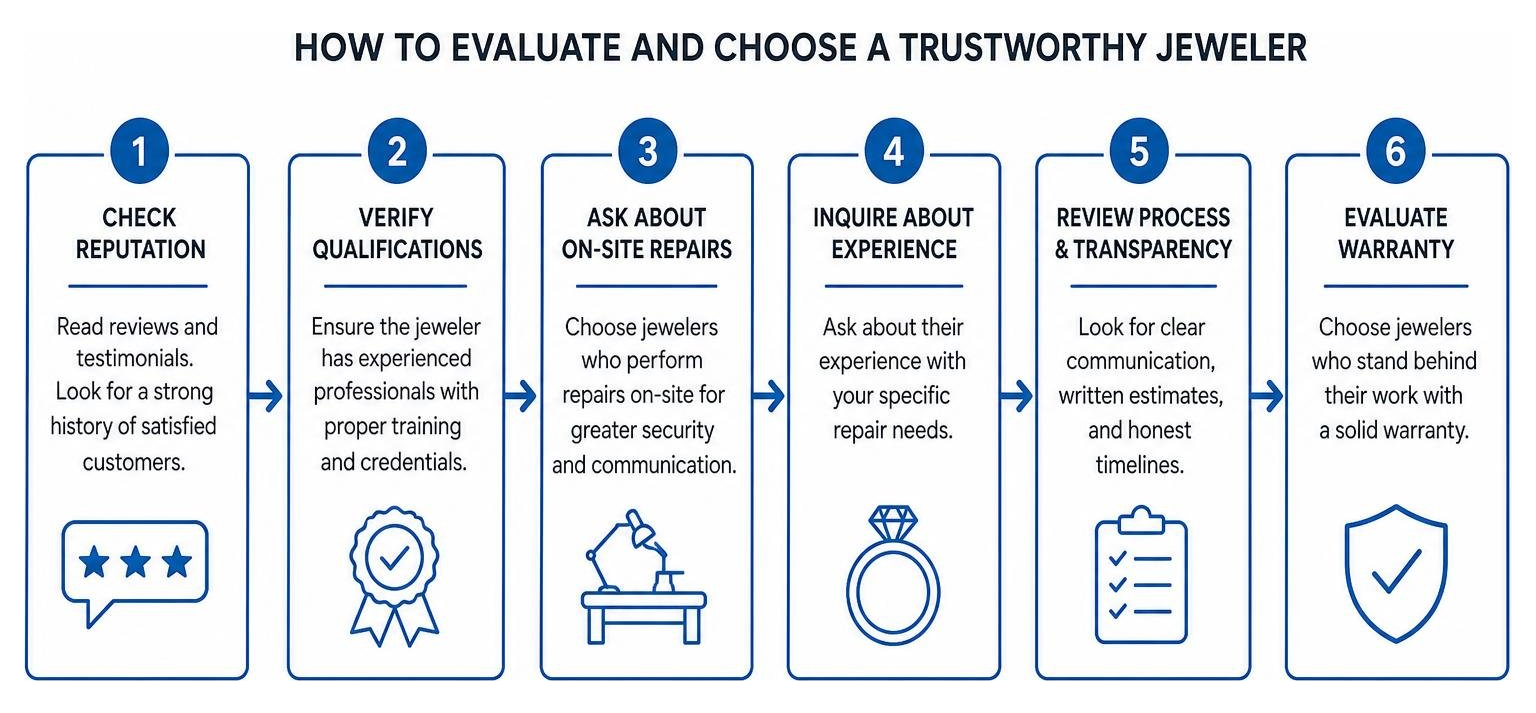
The single most effective way to eliminate anxiety when you repair a diamond ring is to choose the right jeweler. You are not just paying for a service; you are choosing a custodian for your most sentimental possession.
Look at Long-Term Reputation and Reviews
A jeweler's reputation is their most valuable asset. For an established jewelry store, the cost of a single diamond is nothing compared to the millions of dollars in business lost if they were ever caught swapping a stone. Look for local jewelers in Utah with a long history of positive, authentic reviews. Check platforms like Google and Yelp to see how they handle repairs and customer service.
Ask About On-Site Repairs
Whenever possible, work with a jeweler who performs repairs on-site rather than shipping your ring out to a third-party trade shop. When your ring stays in-house, there is a much lower risk of shipping delays, loss in transit, or miscommunication. If you want to know what to look for locally, read our comprehensive guide on jewelry repair in utah what to expect where to go.
Evaluate Their Transparency and Credentials
A trustworthy jeweler will always be happy to walk you through their repair process. They should have gemologists on staff (credentialed by organizations like the GIA) and have the necessary tools—like gemological microscopes—readily available to inspect your ring in front of you. To help you navigate this process safely, we have compiled our top recommendations in our jewelry repair tips guide 2026.
Essential Steps Before You Repair Diamond Ring Accents or Center Stones
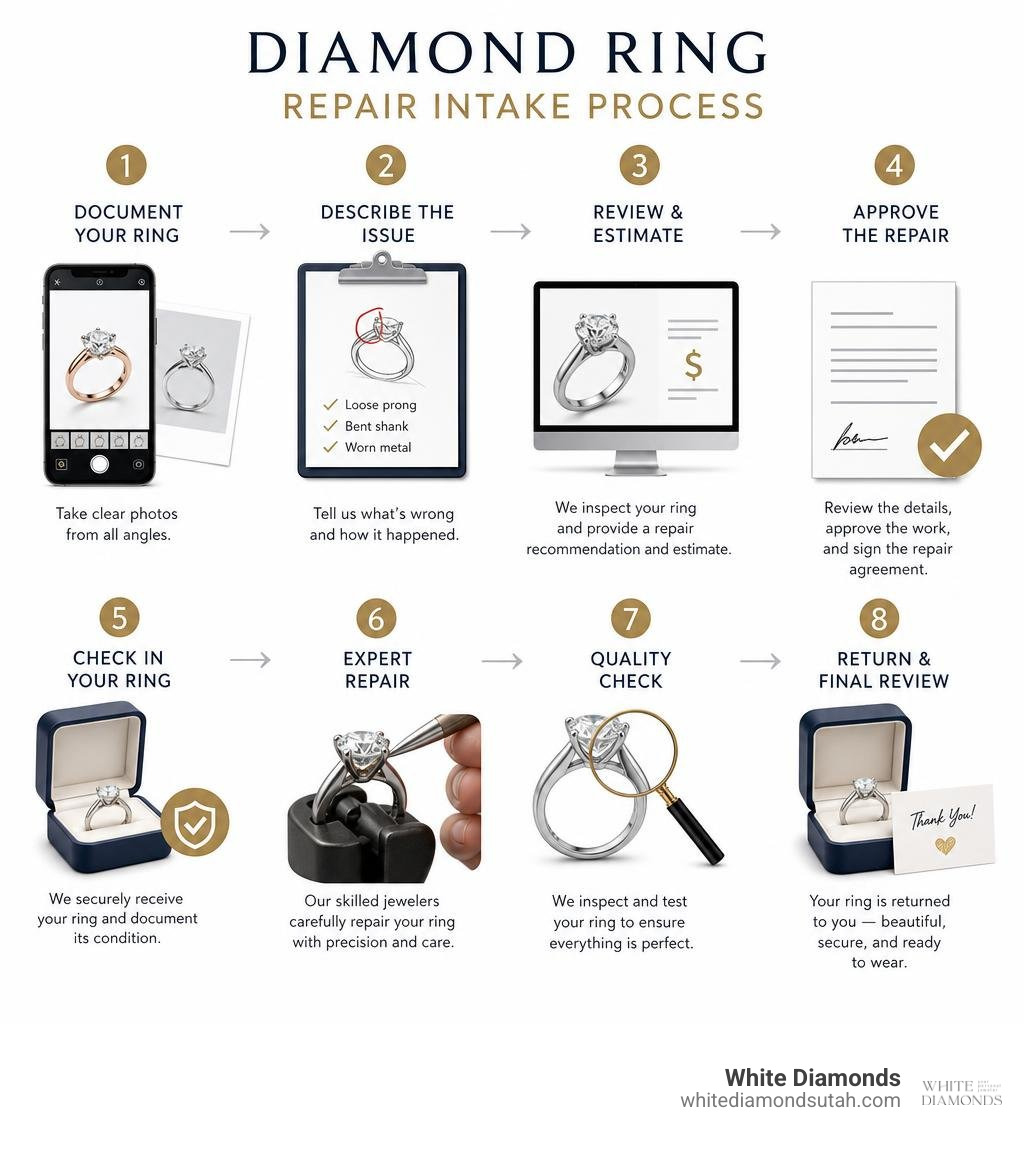
Before you hand your ring over to any jeweler, taking a few proactive steps can safeguard your investment and give you absolute peace of mind.
1. Document Everything with High-Resolution Photos
Use your smartphone to take clear, close-up photos of your ring from multiple angles. Capture the top view of the center stone, side profiles of the prongs, any hallmarks or stamps inside the band, and any visible scratches or unique features. These photos serve as a visual record of your ring's condition prior to the repair.
2. Get Your Ring Cleaned Professionally First
Dirty diamonds can hide unique characteristics, inclusions, and even structural damage. Before checking your ring in, ask the jeweler to clean it.
While you might be tempted to clean it at home beforehand, make sure you avoid damaging home remedies. For example, read can i clean my diamond ring with toothpaste the surprising truth to learn why toothpaste can actually scratch your precious metals. Instead, rely on professional services like our jewelry cleaning utah experts to safely prep your ring for inspection.
3. Know What Is Safe for Your Ring Daily
Many people accidentally damage their settings or weaken their prongs during everyday activities without realizing it. For instance, you might wonder can a diamond ring be worn in the shower or can diamond rings get wet safely. While clean water won't hurt a diamond, soaps, body washes, and hard water can leave a thick film on your diamond or degrade certain metal alloys over time, leading to loose settings that eventually require repair.
Verification Methods to Ensure You Get Your Original Diamond Back
The fear of "stone switching" is a common theme in jewelry folklore, but modern technology makes it incredibly easy to prove your diamond's identity. No two diamonds are exactly alike—virtually all of them have unique internal and external characteristics that act like a fingerprint.
By using objective verification methods, you can ensure you receive the exact same diamond back after your repair a diamond ring service.
Use a Gemological Microscope
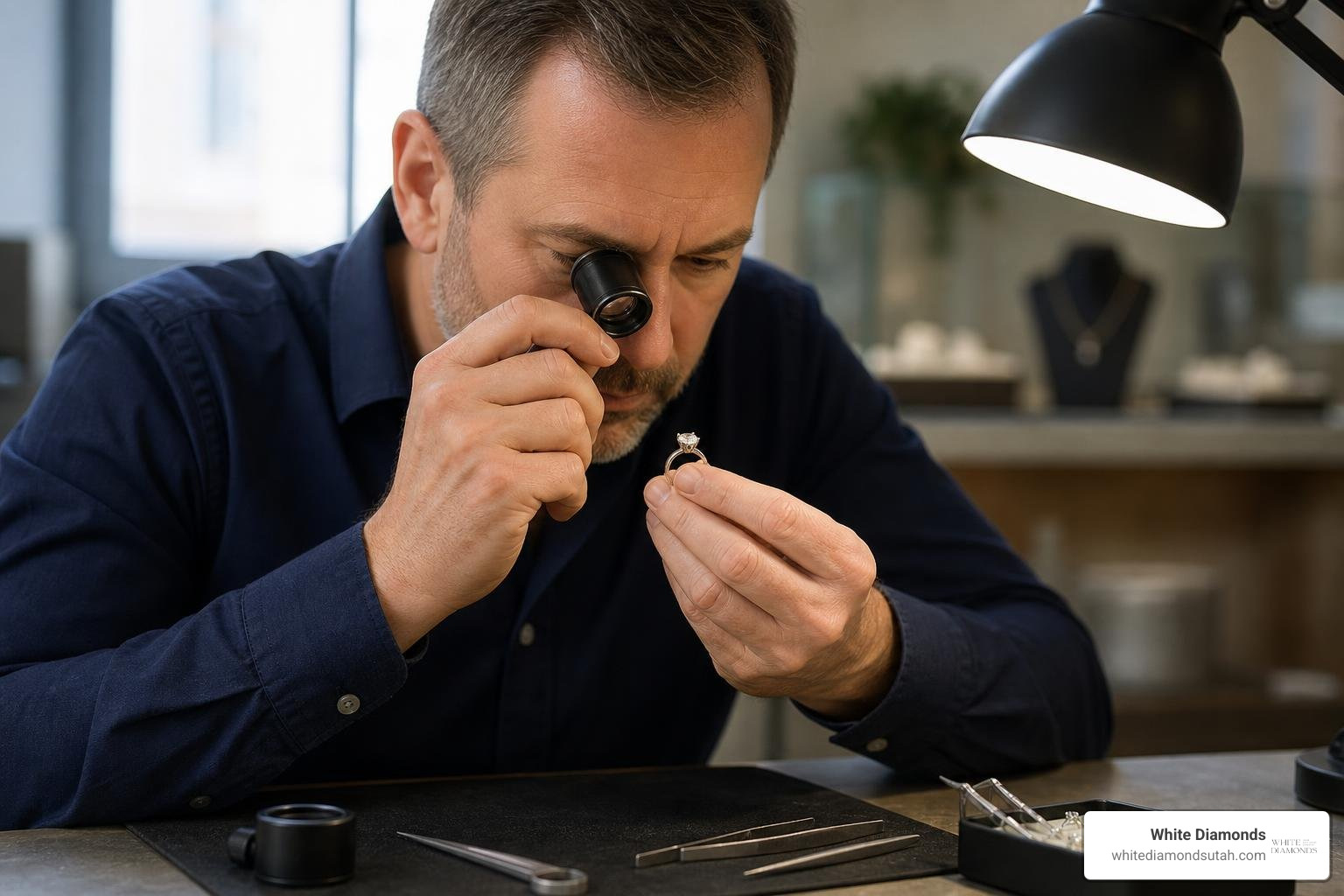
When you drop off your ring, a professional jeweler should place it under a gemological microscope or a high-powered loupe and invite you to look through it. They will point out your diamond’s unique "birthmarks"—known as inclusions—such as tiny crystals, feathers, or pinpoints. When you pick up the ring, you should look through the microscope again to verify those exact same inclusions are present in the same locations.
Check for Laser Inscriptions
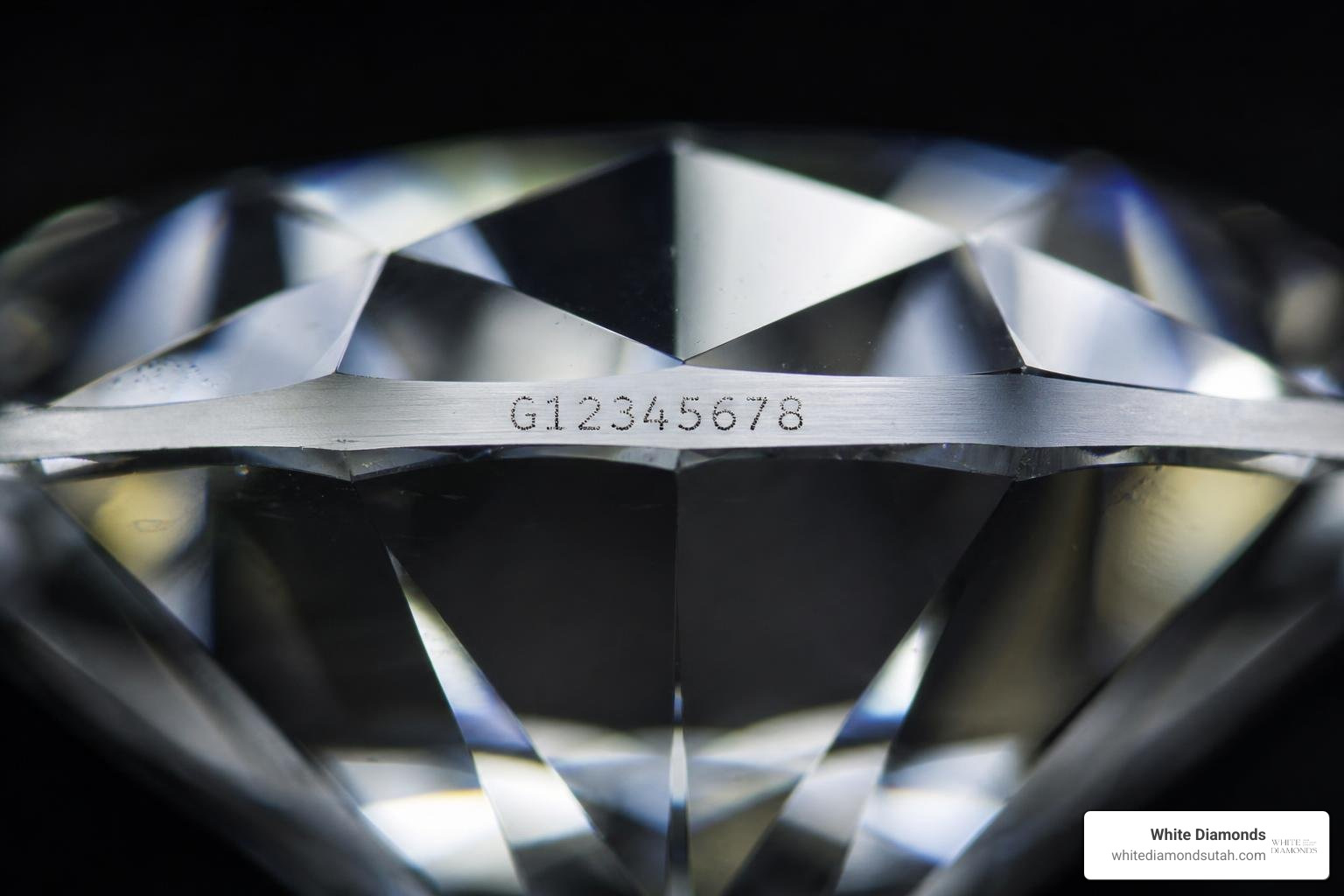
If your diamond was graded by a major laboratory like the GIA (Gemological Institute of America) or AGS (American Gem Society), it likely has a microscopic serial number laser-inscribed on its outer edge (the girdle). This number is completely invisible to the naked eye but can easily be read under 10x magnification.
Always verify this number with your jeweler during drop-off and pick-up. You can verify the grading details anytime using the official GIA Report Check tool online.
Request a Plotting Diagram
If your diamond has a grading report, it will include a "plotting diagram." This is a graphic map of your diamond showing the exact shape, type, and location of its internal and external characteristics. Showing this diagram to your jeweler beforehand shows them that you are fully aware of your diamond’s unique anatomy, eliminating any room for error or misunderstanding.
How to Safely Repair Diamond Ring Inclusions and Verify Laser Inscriptions
When we perform a repair a diamond ring procedure, our jewelers take extreme care not to obscure or damage your stone's unique identifiers.
- Preserving the Laser Inscription: During repairs that involve high heat—such as soldering a cracked shank or retipping prongs—the laser inscription can sometimes be temporarily obscured by polishing compounds or boric acid coatings used to protect the stone. A professional jeweler knows how to safely clean and acid-bathe the ring after repair to ensure the laser inscription is perfectly visible and readable upon pick-up.
- Mapping Your Stone's Inclusions: If your stone does not have a laser inscription, don't worry. We can help you draw a simple plot of your diamond's natural inclusions. Carbon spots, feathers, and cloud formations are entirely unique to your stone. Think of them as a natural security system that can never be replicated by a synthetic stone or another diamond.
What to Do During the Drop-Off and Pick-Up Process
To make your repair experience completely seamless and stress-free, follow this structured checklist during your store visits.
| Drop-Off Verification Steps | Pick-Up Verification Steps |
|---|---|
| Clean the Ring: Have the jeweler clean the ring to reveal all inclusions clearly. | Inspect Under Magnification: Look through the microscope before accepting the ring back. |
| Verify Laser Inscription: Read and record the GIA/AGS serial number on your receipt. | Confirm Serial Number: Match the inscribed number to your drop-off receipt. |
| Map the Inclusions: Identify and note at least two unique internal inclusions. | Verify Inclusion Map: Confirm those exact inclusions are in the same locations. |
| Get a Detailed Receipt: Ensure the receipt states the stone's carat weight, color, and clarity. | Check the Metalwork: Inspect the prongs, shank, and overall finish for quality. |
By following this simple protocol, you establish a clear, documented chain of custody. It protects you, and it protects the jeweler from any false accusations—creating a relationship built on absolute transparency.
Frequently Asked Questions About Diamond Ring Repairs
How do you ensure you receive the same diamond back after a repair?
You can ensure you get your original diamond back by inspecting the stone under a microscope with your jeweler both before and after the repair. Check for a GIA or AGS laser-serialized inscription on the girdle, map the stone's natural internal inclusions on a plotting diagram, and get a detailed receipt outlining the diamond's exact specifications.
What documentation should I request before leaving my ring?
Before leaving your ring, request a detailed intake receipt or repair agreement. This document should include:
- A detailed description of the ring (metal type, setting style, and stone count).
- The exact measurements, carat weight, color, and clarity of the center diamond.
- The GIA/AGS certificate number (if applicable).
- Clear notes on any pre-existing wear or damage.
- A description of the exact repair work to be performed.
Can a jeweler easily swap a diamond without the owner noticing?
It is virtually impossible for a jeweler to swap a diamond without an observant owner noticing, especially if the stone is documented. Every diamond has a unique internal fingerprint of inclusions. Furthermore, doing so would require a jeweler to risk their entire business reputation, licensing, and livelihood for a single stone—a risk that no established, professional jeweler would ever take.
Conclusion
At the end of the day, getting your jewelry fixed shouldn't be a source of stress. When you need to repair a diamond ring, taking a few simple steps—like choosing a reputable local store, mapping your stone's unique inclusions, and verifying its laser inscription—will give you absolute confidence throughout the process.
At White Diamonds in Ogden, UT, we treat your precious jewelry with the utmost care, integrity, and respect. We offer personalized, pressure-free consultations where we walk you through every step of your repair or customization under the microscope.
If your ring is in need of some professional care, don't wait until a stone goes missing. Visit our diamond jewelry repair page today to learn more about our services, or stop by our store to let us restore your jewelry to its original, breathtaking brilliance safely and securely!