How to Rescue and Repair Your Men's Wedding Band
Why Men's Wedding Band Repair Matters More Than You Think
Men's wedding band repair is something most guys don't think about — until the ring is bent, scratched beyond recognition, or won't come off a swollen finger.
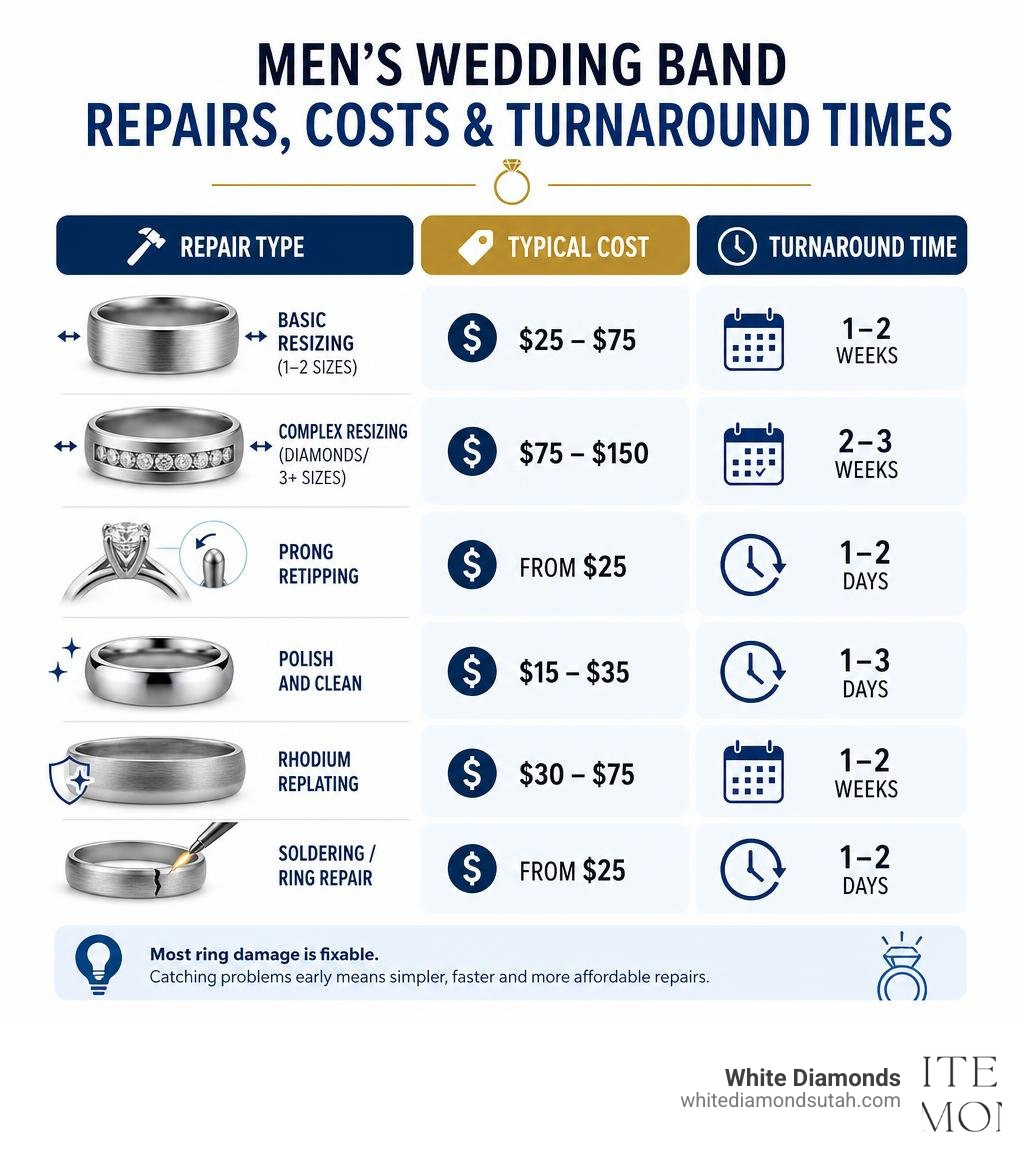
Here's a quick breakdown of the most common repairs and what to expect:
| Repair Type | Typical Cost | Turnaround Time |
|---|---|---|
| Basic resizing (1-2 sizes) | $25 – $75 | 1-2 weeks |
| Complex resizing (diamonds/3+ sizes) | $75 – $150 | 2-3 weeks |
| Prong retipping | from $25 | 1-2 days |
| Polish and clean | $15 – $35 | 1-3 days |
| Rhodium replating | $30 – $75 | 1-2 weeks |
| Soldering / ring repair | from $25 | 1-2 days |
Wedding bands take a beating. Daily wear — from typing to yard work to gym sessions — causes scratches, thinning metal, and loose stones over time. Most men wear their band every single day for decades, which means even a well-made ring will eventually need some attention.
The good news? Most damage is fixable. And catching problems early almost always means a simpler, cheaper repair.
At White Diamonds, we specialize in custom rings and wedding bands, and we offer professional cleaning and restoration services — making men's wedding band repair a core part of what we do for our clients every day. Whether your band needs a quick polish or a full reshank, we're here to help you get it back to its best.
Common Types of Damage and When to Seek Men's Wedding Band Repair
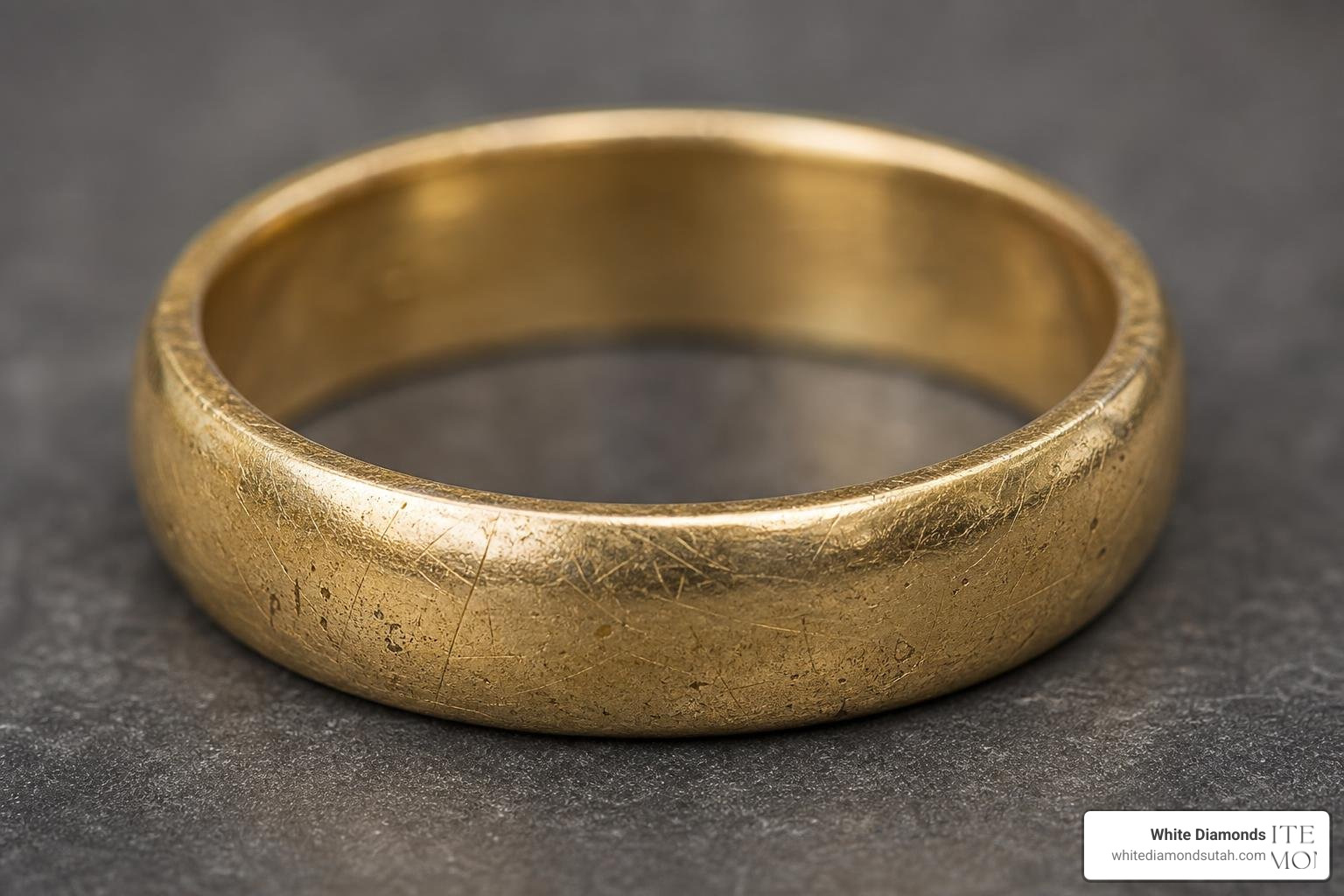
No matter how tough you think your wedding band is, gold, platinum, and even modern alternative metals are susceptible to wear. Over years of hard work, play, and daily habits, your ring will inevitably accumulate some battle scars.
The most common issues we see include:
- Surface Scratches and Scuffs: Daily contact with steel doors, weightlifting bars, tools, and even office desks will dull a polished surface or wear away specialized finishes.
- Dents and Nicks: Dropping your ring on concrete or hitting it hard against a solid object can leave deep gouges.
- Thinning Shanks: The "shank" is the back portion of the ring band. Constant friction against skin and everyday surfaces slowly rubs metal away over decades.
- Bent or Warped Bands: Gold and platinum are relatively soft. Gripping heavy objects or catching your hand in a tight spot can warp a perfectly round ring into an oval.
- Loose or Missing Stones: If your band features diamonds or gemstones, the metal holding those stones in place can wear down, bend, or snag, putting your stones at risk.
If your ring features textured finishes, such as those found on popular brushed wedding band styles, you might notice that the texture begins to look shiny or uneven over time. This is completely normal! A matte or brushed finish is achieved by creating microscopic grooves in the metal. As those grooves get rubbed smooth by daily wear, the ring loses its textured look.
Fortunately, a skilled jeweler can easily re-apply a textured finish, whether you have a classic gold band or a specialized brushed white gold mens wedding band.
Identifying Structural Wear and Thinning Shanks
Many men assume that because their ring hasn't cracked or lost a stone, it is perfectly fine. However, structural wear happens slowly and silently.
The back of the band (the shank) bears the brunt of everyday friction. As you wash your hands, hold tools, drive, and carry groceries, tiny amounts of metal are polished away. Over ten, twenty, or thirty years, a band that started at a healthy 2.0mm thickness can thin down to under 1.0mm.
When a shank drops below 1.0mm in thickness, it enters the danger zone. A thin shank is highly prone to:
- Warping: The ring will easily bend under pressure, such as when you grip a steering wheel or carry heavy boxes.
- Cracking: The metal becomes so brittle and thin that it simply snaps at the thinnest point.
- Stone Loss: If the bottom of the ring bends, it places stress on the top of the ring, which can cause the settings holding your diamonds to warp and drop their stones.
If you notice your ring is starting to feel sharp on the edges, looks visibly uneven in thickness when viewed from the side, or bends slightly when you squeeze it, it is time to bring it in for a men's wedding band repair evaluation.
To fix this, we perform a process called "reshanking." We cut away the worn, thin section of the band and solder or weld a brand-new, thick piece of matching metal in its place, blending the seams seamlessly so your ring looks and feels as solid as the day you bought it.
Loose Stones and Damaged Prongs in Men's Wedding Band Repair
While classic plain bands are incredibly popular, many modern men opt for rings featuring inset diamonds or gemstones. If your ring has stones, keeping them secure is a top priority.
Stones in men's bands are typically secured using one of three setting types:
- Prongs: Tiny metal claws that grip the edge of the stone.
- Bezel/Flush Settings: Metal that is rubbed directly over the edge of the stone, keeping it level with the surface of the band.
- Channel Settings: Stones set side-by-side between two parallel walls of metal.
Over time, prongs can wear flat, snag on clothing, or pull back from the stone. If you look at your ring under magnification and see that the prongs look flat like paper, or if you can hear a tiny "click" when you tap the stone with your fingernail, the stone is loose.
During a professional men's wedding band repair, we can "retip" worn prongs by adding a tiny drop of matching gold or platinum to the top of the prong and shaping it back over the stone. For flush or channel settings, we can carefully push the metal back into place or rebuild the channel walls to ensure total gemstone security. Preventive maintenance is key here — tightening a loose stone is incredibly affordable, while replacing a lost diamond is not!
The Resizing Process and Material Limitations
One of the most common reasons men seek out jewelry repair is a change in finger size. Our bodies change over time, and a ring that fit perfectly in our twenties might feel like a tourniquet by our forties. Alternatively, weight loss can make a beloved band slip off in the shower or cold weather.
The resizing process depends entirely on whether you need the ring larger or smaller, and what material the ring is made of.
- Sizing Down: The jeweler cuts a small section of metal out of the bottom of the band, brings the two open ends together, and uses a high-powered laser welder or a traditional torch to solder them back together. The seam is then polished until it is completely invisible.
- Sizing Up: For minor adjustments (less than a half-size), the jeweler may be able to stretch the ring slightly using a specialized mandrel. However, for larger adjustments, the jeweler must cut the band, pull it open to the correct size, insert a matching piece of metal into the gap, and weld or solder both sides.
Not all metals are created equal when it comes to resizing. Let's look at how different materials hold up to the process:
| Metal Type | Can It Be Resized? | Resizing Method | Limitations & Risks |
|---|---|---|---|
| Yellow Gold / Rose Gold | Yes | Cut, solder, and blend | Very easy to resize; rose gold can sometimes crack if not annealed properly. |
| White Gold | Yes | Cut, solder, and rhodium plate | Requires rhodium replating after resizing to restore the bright white finish. |
| Platinum | Yes | Laser weld with platinum wire | Requires high heat; laser welding is best to avoid visible dark seams. |
| Titanium | No (or extremely limited) | Special stretching only | Most jewelers cannot resize titanium; major size changes require replacement. |
| Tungsten Carbide | No | Cannot be resized | Extremely hard; will shatter if cut or stretched. Must be replaced. |
| Cobalt Chrome | No | Cannot be resized | Too hard for standard jewelry torches and tools. Must be replaced. |
Resizing Precious Metals vs. Alternative Metals
As shown in the table above, there is a massive divide between traditional precious metals (gold, platinum) and modern alternative metals (titanium, tungsten, cobalt).
Traditional metals are malleable, meaning they can be melted, bent, cut, and joined back together. If you buy a gold or platinum band, you can rest easy knowing that your local jeweler can resize it for you throughout your life.
Alternative metals, however, are prized for their extreme hardness and scratch resistance. These rugged materials have become highly popular in recent years. But that very same hardness makes them nearly impossible to alter. Tungsten, for example, is so hard that it cannot be cut with traditional jeweler's saws; it must be cut with diamond-tipped industrial tools. If you try to stretch a tungsten ring, it won't bend — it will simply shatter.
If you own an alternative metal ring and your finger size changes, your only real option is to replace the ring entirely. Fortunately, because these materials are less expensive than gold or platinum, replacement is often quite affordable, but you do lose the sentimental value of your original band.
If you are looking for a highly durable, modern look but still want the ability to resize your ring in the future, we highly recommend looking into custom precious metal designs, such as a striking black and purple mens wedding band designs made with black rhodium-plated gold or custom enamel.
How Resizing Affects Band Durability and Appearance
When done correctly by a master jeweler, resizing should have zero negative impact on your ring's durability or appearance. The seams should be completely invisible, and the ring should remain perfectly round.
However, there are a few scenarios where resizing can be tricky:
- Patterned or Engraved Bands: If your ring has an intricate pattern, a brushed texture, or an engraving running all the way around the band, cutting into it will interrupt that design. A skilled jeweler will do their best to blend the pattern, but a tiny "dead spot" in the design may be visible at the very bottom of the ring.
- Eternity Bands: If your ring has diamonds set all the way around the band, resizing is incredibly difficult (and sometimes impossible) because there is no plain metal to cut into without disturbing the stone settings.
- Weakened Joints: If a jeweler uses cheap solder with a low melting point rather than a high-quality laser weld, the seam can become a weak point that may crack under pressure years down the road. Always ensure you are working with an experienced custom shop that uses state-of-the-art laser technology.
Professional Maintenance, Costs, and Turnaround Times
Just like a luxury watch or a fine car, your wedding band requires regular maintenance to look its best and last a lifetime.
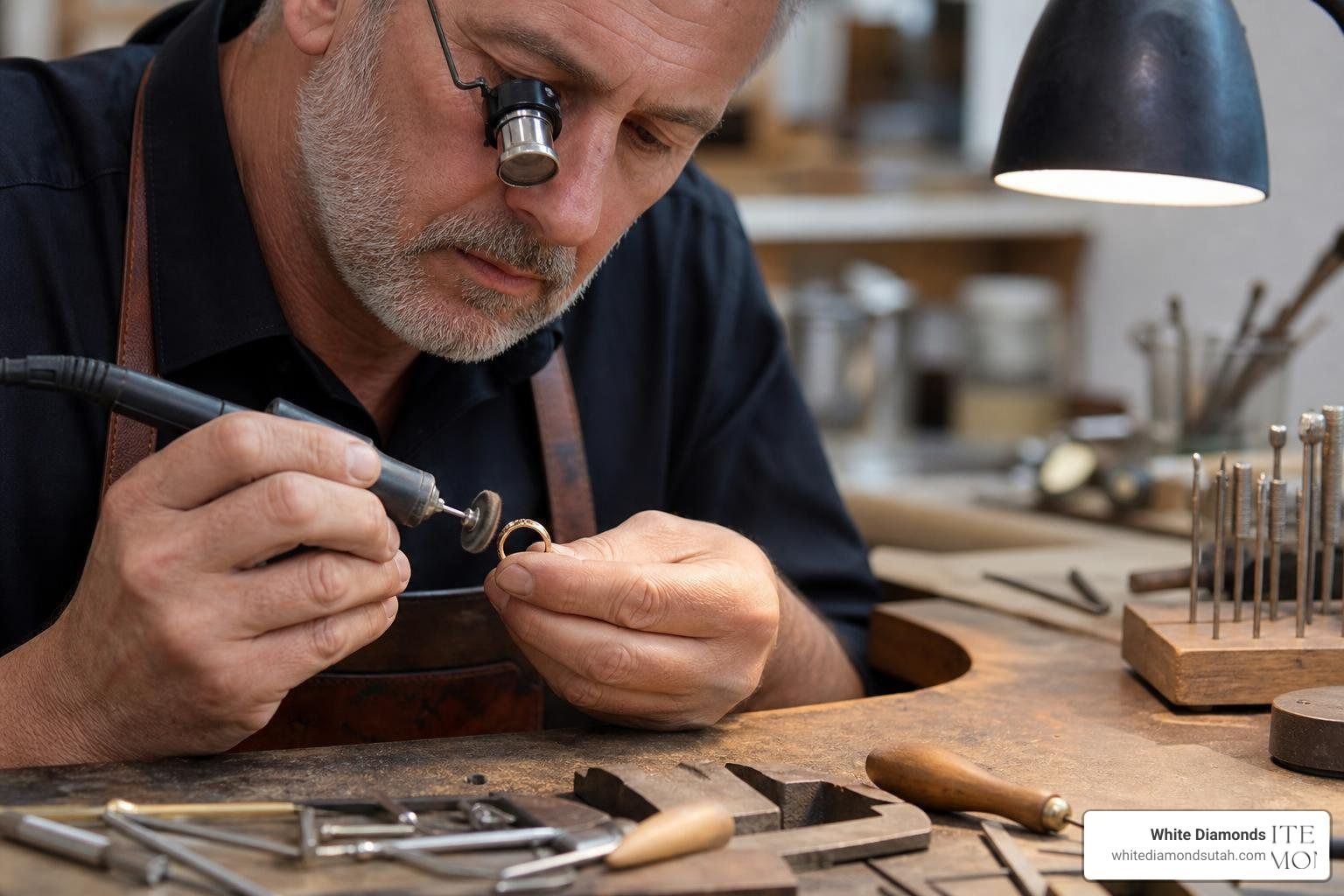
A professional maintenance appointment typically involves:
- Ultrasonic Cleaning: High-frequency sound waves create microscopic bubbles in a specialized cleaning solution, blasting away built-up dirt, lotion, and oils from hard-to-reach areas under stones.
- Steam Cleaning: High-pressure steam removes any remaining residue, leaving the metal and stones incredibly bright.
- Polishing and Buffing: Using specialized rotary polishing wheels and abrasive compounds, the jeweler gently removes surface scratches and restores a mirror-like shine.
- Rhodium Plating (for White Gold): White gold is naturally slightly yellowish because it is made of yellow gold mixed with white alloys. To get that bright, chrome-like white finish, it is electroplated with a rare metal called rhodium. This plating naturally wears off over 1–2 years, so replating is necessary to restore its original look.
Typical Costs for Common Men's Wedding Band Repair Services
When budgeting for a men's wedding band repair, it helps to know what to expect. While we always provide a precise, obligation-free quote in-store after physically examining your ring, here are the typical industry averages for common repairs in 2026:
- Basic Resizing (1-2 sizes): $25 to $75. This is for simple, solid yellow or white gold bands without stones.
- Complex Resizing (3+ sizes or with stones): $75 to $150. If the jeweler has to add a significant amount of new gold or carefully protect and reset diamonds during the process, the cost increases.
- Prong Repair / Retipping: $25 to $50 per prong. If you need all the prongs on a stone rebuilt, many jewelers will offer a package rate.
- Soldering / Crack Repair: $25 to $60. Joining a broken band or soldering two rings together.
- Polishing and Cleaning: $15 to $35. Many jewelers (including us!) will offer basic cleaning and inspection for free or a very nominal charge.
- Rhodium Plating: $30 to $75. This restores the bright white finish to white gold bands.
That factors like the metal's purity (10k vs 18k gold), the width of the band, and whether the jeweler has to work around delicate gemstones will influence the final cost.
Recommended Maintenance Schedules and Prevention Tips
To keep your wedding band in pristine condition and avoid costly emergency repairs, we recommend following these simple maintenance guidelines:
- Get a Professional Inspection Every 6 Months to 1 Year: A quick visit to a trusted local jeweler can catch microscopic issues — like a hairline crack in the gold or a loose prong — before they turn into a lost diamond or a snapped ring.
- Take Your Ring Off at the Gym: Heavy steel dumbbells and barbells will instantly gouge gold and platinum. Keep a silicone band in your gym bag to wear during workouts, or leave your ring safely at home.
- Avoid Harsh Chemicals: Chlorine (found in swimming pools and hot tubs) and household bleach can actually break down the molecular structure of gold alloys, making your ring brittle and prone to cracking.
- Store It Safely: When you aren't wearing your ring, store it in a soft fabric pouch or a dedicated slot in a jewelry box. Dropping it into a coin dish or drawer with other metal items will cause unnecessary scratches.
If you want to learn more about choosing the right ring for your lifestyle, check out our comprehensive Wedding Rings Utah Guide 2026 for expert local advice.
Frequently Asked Questions about Men's Wedding Band Repair
Navigating jewelry repair can raise a lot of questions. Here are the answers to some of the most common concerns we hear from our clients in Ogden and across Utah:
Can tungsten or titanium wedding bands be resized?
Generally, no. Tungsten is far too hard and brittle to be cut and soldered, and titanium requires highly specialized industrial equipment that standard jewelry shops do not possess. If your finger size changes and you own a tungsten or titanium band, your best option is to take advantage of the manufacturer's warranty (if available) or purchase a replacement ring in your new size. If you want a ring that can grow and change with you over a lifetime, we highly recommend choosing gold or platinum.
How often should a men's wedding band be professionally inspected?
We recommend having your ring professionally inspected and cleaned every 6 to 12 months. These inspections are usually quick, highly affordable, and can save you hundreds of dollars by catching loose stones, worn prongs, or thinning metal before they cause major damage.
Why does my white gold wedding band look yellowish over time?
Don't panic — this is completely normal! White gold is made by mixing pure yellow gold with white metals like palladium or nickel. Because the base metal is gold, it always retains a very slight warm, yellowish tint. To make it look bright silver, jewelers plate it with a thin layer of rhodium. Over 1 to 2 years of daily wear, this plating naturally rubs off, revealing the warmer white gold underneath. A quick, inexpensive professional rhodium replating service will make your ring look brand new again.
Conclusion
Your wedding band is more than just a piece of metal — it is a daily symbol of your commitment, your history, and your personal style. While it is built to last, a lifetime of daily wear means that eventually, every ring needs a little professional care.
Whether you need a simple polish, a rhodium replating, a complex resizing, or a full structural restoration, choosing a highly qualified local jeweler is the key to ensuring your ring remains beautiful and strong for decades to come.
If you're looking for local options in northern Utah, you can check out Yelp's guide to jewelry repair in Ogden, UT to compare local reviews and services.
However, when it comes to preserving the sentimental value and structural integrity of your fine wedding jewelry, nothing compares to working with a dedicated, local master jeweler.
At White Diamonds in Ogden, UT, we take immense pride in our pressure-free consultations, expert craftsmanship, and transparent service. We treat every ring that comes across our bench with the utmost care, ensuring your repairs are done quickly, correctly, and within your budget.
Ready to restore your ring to its original glory? Explore our stunning collection of men's wedding bands in Ogden, UT, or stop by our shop today for a complimentary inspection and cleaning!