A Comprehensive Guide to Engagement Ring Shopping
What You Need to Know Before Engagement Ring Shopping
Engagement ring shopping is one of the most exciting — and most overwhelming — purchases you'll ever make. There are hundreds of options, a lot of money on the line, and real pressure to get it right.
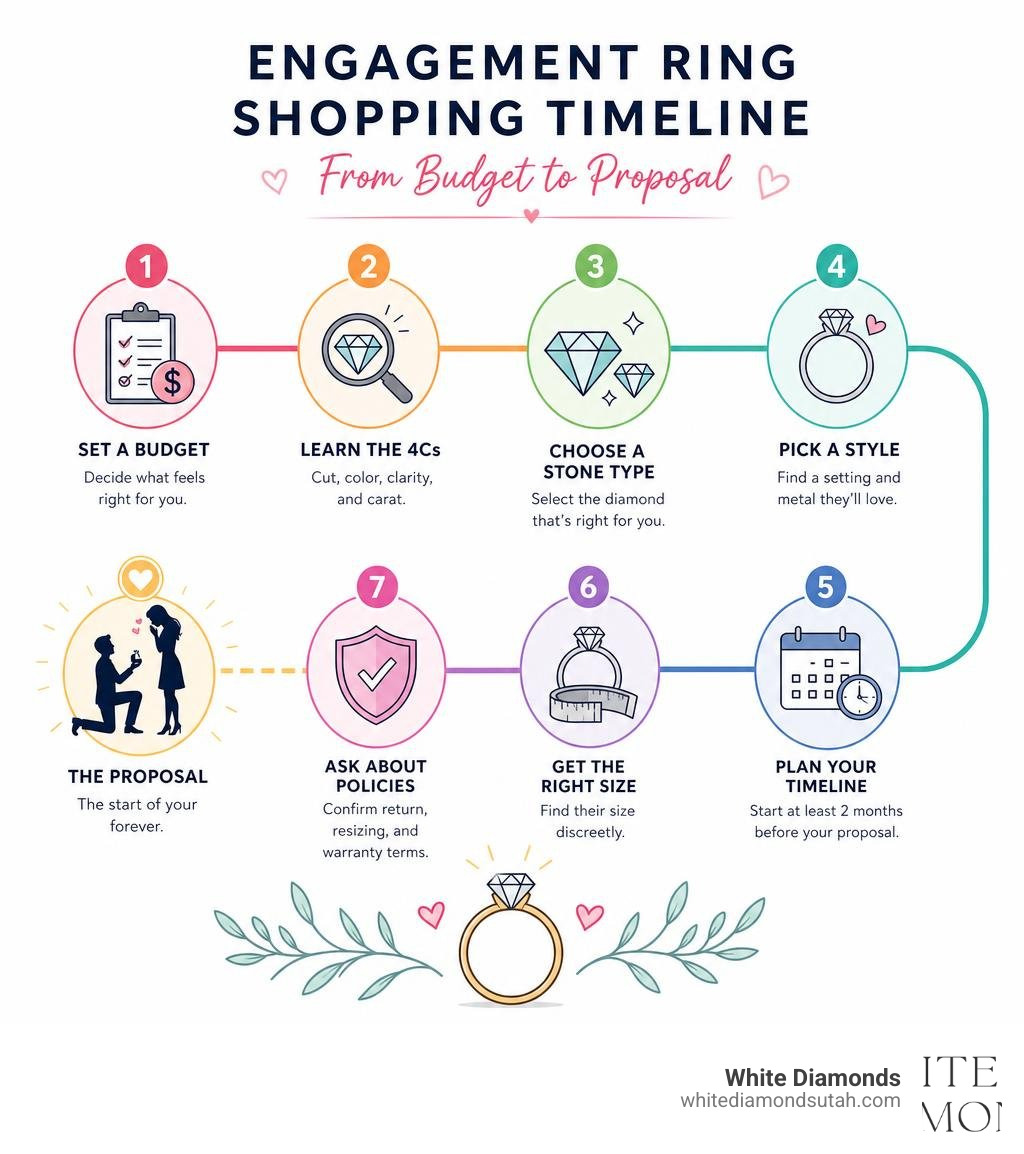
Here's a quick snapshot of what to know before you start:
| Step | What to Do |
|---|---|
| Set a budget | The U.S. average is around $5,500, but spend what you can comfortably afford |
| Learn the 4Cs | Cut, color, clarity, and carat determine a diamond's look and price |
| Choose a stone type | Lab-grown diamonds cost 20–40% less than natural diamonds |
| Pick a style | Consider your partner's existing jewelry for clues on setting and metal |
| Plan your timeline | Start at least 2 months before your proposal; custom rings take longer |
| Get the right size | Borrow a ring they already wear or ask a close friend or family member |
| Ask about policies | Always confirm return, resizing, and warranty terms before buying |
The process doesn't have to be stressful. Whether you're planning a surprise proposal or shopping together, knowing the basics upfront saves you time, money, and second-guessing.
At White Diamonds, we're a personal jeweler specializing in custom engagement rings, wedding bands, and cleaning services — we work closely with every couple to make engagement ring shopping feel personal and pressure-free. Let's walk you through everything you need to know.
The Essential First Steps of Engagement Ring Shopping

Before you step foot into a showroom or begin browsing online galleries, you need a plan. Walking into the process unprepared is a quick way to experience choice paralysis. If you try to look at thousands of loose stones and setting styles without a clear starting framework, you will likely leave feeling more confused than when you started.
For most couples, the best way to begin is to focus on your personal priorities. Are you looking to maximize the diamond's size, or is a highly intricate, custom-designed setting your main goal? Knowing what matters most to you will help you filter out the noise. To set yourself up for success, we recommend reading our expert advice on How to Start Engagement Ring Shopping. This initial groundwork lays the foundation for a smooth, enjoyable journey.
Determining a Realistic Budget and Timeline
The very first practical step in engagement ring shopping is establishing your budget. Despite what old-school marketing campaigns from the 20th century might have told you, there is no "three-month salary rule." That guideline was created by diamond advertisers during the Great Depression and has no relevance to your modern financial situation. Today, the average engagement ring cost in the U.S. sits around $5,500. However, we have helped couples design breathtaking rings for $800 and others for $80,000. True satisfaction has nothing to do with the price tag; it is about finding a ring that represents your love without putting you under financial strain.
Statistics show that 71% of proposers set a strict budget before shopping, and more than half report that current economic conditions directly influenced how much they chose to spend. When setting your own budget, we suggest building in a 20% flexibility buffer. This keeps you in control while giving you the freedom to make minor upgrades — such as choosing a slightly higher cut quality or a stronger metal like platinum — if the perfect opportunity arises. For a deeper dive into modern budgeting strategies, read our guide on How Much to Spend on an Engagement Ring.
Equally important is your timeline. Standard, pre-designed rings can sometimes be sourced quickly, but a custom-designed piece typically requires six to eight weeks to design, cast, set, and polish. In general, you should begin the shopping process at least two months before your targeted proposal date. This buffer ensures that you do not have to rush your decisions or stress over shipping delays.
How to Start Engagement Ring Shopping with Your Partner
The days of the proposer embarking on a top-secret, solo mission to buy a ring are changing. Today, more and more couples are choosing to shop together. It is an incredibly romantic way to connect, share preferences, and ensure that the final piece is something the wearer will love for a lifetime.
If you choose a collaborative approach, you can still keep the actual proposal a surprise. Your partner can help you narrow down the stone shape, metal type, and general design elements, leaving the final selection, the exact timing, and the proposal setting as a romantic mystery.
Even if you prefer a traditional, total-surprise proposal, you do not have to guess. Data shows that 31% of proposees research their own ring preferences for more than a year before the proposal actually happens. This means your partner likely has a secret Pinterest board, saved Instagram posts, or has dropped subtle hints to close friends and family.
To help narrow down your partner's specific aesthetic, ask yourself:
- Do they wear mostly yellow gold, rose gold, or silver-toned jewelry?
- Is their style minimalist and modern, or do they lean toward vintage, ornate designs?
- Do they work with their hands or live a highly active lifestyle? (This dictates how durable and low-profile the setting needs to be).
If you are still asking yourself, "Which Engagement Ring Should I Get", taking the time to observe these daily patterns will point you in the right direction.
Understanding Diamonds: The 4Cs and Stone Selection

Once you have a budget and a general aesthetic in mind, it is time to focus on the center stone. To navigate this part of the process like a professional, you need a basic understanding of diamond quality. We highly recommend reviewing How to Buy an Engagement Ring: A GIA Gemologist's Complete Guide to build a solid foundation before evaluating stones in person.
Decoding the 4Cs: Cut, Color, Clarity, and Carat
The 4Cs — Cut, Color, Clarity, and Carat weight — are the universal standards established by the Gemological Institute of America (GIA) to grade diamond quality. Understanding how these factors interact allows you to maximize your budget by spending money where it actually impacts the diamond's visual appearance.
- Cut: This is the most crucial of the 4Cs. Cut does not refer to the shape of the stone (like oval or pear), but rather how well the diamond's facets reflect light. A diamond with an "Excellent" or "Ideal" cut will sparkle intensely, masking lower color and clarity grades. A poorly cut diamond will look dull and glassy, no matter how perfect its other grades are. Never compromise on cut quality.
- Color: Graded on a scale from D (completely colorless) to Z (light yellow or brown). Colorless diamonds (D-F) command a massive premium. However, near-colorless diamonds (G-I) look completely white to the naked eye when set in a ring, especially when paired with yellow or rose gold settings. This is a fantastic area to save money.
- Clarity: This measures the internal characteristics (inclusions) and surface blemishes (blemishes) of the stone. While flawless diamonds are incredibly rare and expensive, the differences between a Flawless stone and a VS2 or SI1 grade are completely invisible without a jeweler's loupe. Always ask your jeweler if a stone is "eye-clean" — meaning it has no visible inclusions to the naked eye.
- Carat: This is the measure of a diamond's physical weight (one carat equals 0.2 grams), not its physical size. Because diamond prices jump sharply at "magic numbers" (like 1.0, 1.5, or 2.0 carats), you can save significantly by purchasing a stone just under these thresholds (for example, a 0.95-carat diamond). The average diamond size for an engagement ring in the U.S. is between 1.08 and 1.2 carats. For guidance on finding the perfect balance, explore What Diamond Carat Size is Right for You.
Lab-Grown vs. Natural Diamonds
One of the most important decisions modern couples face is choosing between lab-grown and natural diamonds.
Lab-grown diamonds are chemically, physically, and optically identical to natural, mined diamonds. They are real carbon diamonds; they are simply grown in a controlled laboratory environment that replicates the intense heat and pressure of the Earth's mantle.
The shift toward lab-grown options has been historic. In 2019, lab-grown diamonds made up only 3% of the engagement rings sold in the United States. By 2024, and continuing into 2026, over 50% of couples are choosing lab-grown center stones.
| Feature | Lab-Grown Diamonds | Natural Mined Diamonds |
|---|---|---|
| Composition | Pure carbon (identical structure) | Pure carbon (identical structure) |
| Price | 20% to 40% less than natural | Premium pricing due to rarity |
| Origin | Created in high-tech laboratories | Formed over billions of years deep underground |
| Resale Value | Minimal long-term resale value | Retains a higher portion of its initial value |
| Visual Appeal | Identical sparkle, fire, and scintillation | Identical sparkle, fire, and scintillation |
Choosing between the two comes down to your personal values. If your priority is getting the largest, highest-quality stone possible within a specific budget, lab-grown diamonds offer incredible value. If you value rarity, history, and long-term value retention, a natural diamond may be the right choice for you. For a comprehensive breakdown of this topic, read our comparison on Lab vs Mined Diamonds.
Selecting the Perfect Ring Setting, Shape, and Metal
While the center stone often gets the most attention, the setting is the architectural frame that holds the stone secure and defines the ring's overall character. To make an informed decision, you must choose a metal and a setting style that match both your partner's aesthetic and their daily activity level. For an in-depth look at your options, check out our guide on How to Choose a Diamond Ring Setting.
Choosing a Diamond Shape and Setting Style
The shape of your diamond is the first thing people notice. While the classic Round Brilliant remains the most popular choice due to its unmatched sparkle (featuring 58 facets designed to reflect maximum light), "fancy shapes" are highly sought after.
Fancy shapes include:
- Oval: An incredibly popular choice that elongates the finger. Because of their elongated shape, ovals often appear larger than round diamonds of the exact same carat weight.
- Emerald and Asscher: These are "step-cut" shapes featuring long, parallel facets. Because they behave like mirrors, they do not hide imperfections well. If you choose a step-cut, prioritize clarity over color.
- Cushion, Princess, and Radiant: These faceted cuts offer incredible brilliance and blocky, modern silhouettes.
Choosing a fancy shape can also be highly budget-friendly, as shapes like oval, pear, or cushion cuts typically cost 20% to 30% less than round diamonds of equal carat weight.
Once you have selected a shape, you can pair it with a trending setting. Solitaire settings feature a single, elegant center stone for a timeless look. Halo settings encircle the center stone with smaller accent diamonds, making the center stone appear much larger than it actually is. Three-stone settings represent a couple's past, present, and future, while vintage settings offer delicate, ornate details reminiscent of Victorian or Art Deco eras. To see what styles are capturing hearts locally, take a look at the Top 5 Engagement Ring Styles Trending in Utah This Year.
Custom vs. Ready-to-Ship Rings and Sizing Secrets
When engagement ring shopping, you will have to choose between a ready-to-ship ring and a custom-designed piece.
Ready-to-ship rings are pre-fabricated and can be purchased immediately. While convenient, they limit your ability to personalize the piece.
On the other hand, going custom allows you to create a one-of-a-kind ring that tells your unique love story. At White Diamonds, our Custom Ring Design Process is highly collaborative. We sit down with you for a personalized, pressure-free consultation where we use model rings, sketch out concepts, and create digital 3D renderings so you can see exactly what your ring will look like before it is cast. If you are local to the area, you can learn more about how we bring these designs to life by visiting Design Your Ring Ogden.
Of course, a custom ring is only perfect if it fits. If you are trying to keep the proposal a surprise, finding your partner's ring size can feel like a covert mission.
- Borrow a ring: Snatch a ring they already wear on their left ring finger and bring it to us to measure.
- The soap trick: Press one of their rings into a bar of soap to create an exact imprint of the inner diameter.
- Enlist help: Ask a close friend or family member to casually bring up jewelry or take them "just for fun" ring shopping to get sized.
If you are still unsure, always err on the larger side. It is much easier for a jeweler to resize a ring down than it is to stretch it larger.
Frequently Asked Questions about Ring Buying
What should I ask a jeweler when engagement ring shopping?
Before committing to a purchase, you should ask your jeweler several key questions to ensure you are protected:
- Is the diamond certified? Always insist on a grading report from a reputable, independent laboratory like GIA or IGI.
- What is your return and exchange policy? If your partner wants to make minor adjustments to the design after the proposal, you need to know your options.
- What warranties do you offer? Ask if they offer complimentary lifetime cleaning, inspection, and prong tightening.
- Is resizing included? Most reputable jewelers will resize your ring at least once for free post-proposal.
How do I pair an engagement ring with a wedding band?
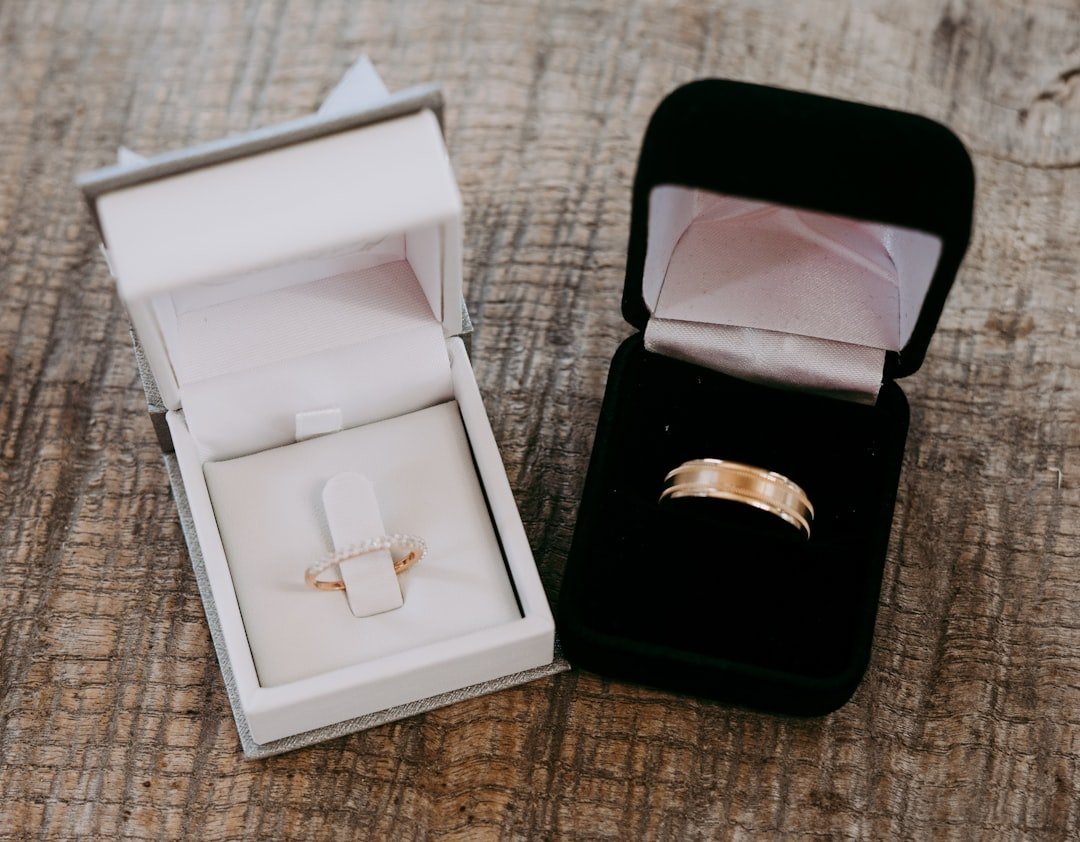
Many proposers forget that the engagement ring is only the first half of the equation; it will eventually be paired with a wedding band. When selecting an engagement ring, keep the future "bridal stack" in mind.
Most wearers prefer their wedding band to sit completely flush against the engagement ring with no gaps. If the engagement ring has a low-profile setting or a basket that extends outward, a standard straight wedding band will not sit flush. In these cases, you may need to look at curved or contoured wedding bands designed to wrap around the center stone's setting. Trying on potential wedding bands alongside the engagement ring before finalizing the design is the best way to ensure a seamless, beautiful stack.
Is it better to buy an engagement ring online or in-store?
Both options have distinct advantages, and many modern couples use a hybrid approach. Shopping online allows you to browse massive inventories, filter by precise specifications, and compare prices from the comfort of your home.
However, buying a ring is a deeply tactile experience. Diamonds that look identical on a grading report can look completely different in person. Seeing how a stone performs under natural light, feeling the weight of the metal on your finger, and working face-to-face with an expert who can guide you through the nuances is invaluable.
For local couples, shopping at a physical showroom in Utah provides a level of trust, ongoing maintenance, and personalized service that online-only retailers simply cannot replicate. You can learn more about navigating the local market in our Guide to Buying Diamond Engagement Rings in Utah.
Conclusion
At White Diamonds, we believe that engagement ring shopping should be an enjoyable, stress-free milestone in your love story. Our physical showroom in Ogden, Utah, is designed to be a comfortable, pressure-free space where you can ask questions, explore loose stones under magnification, and design a custom piece that perfectly fits your budget and timeline.
Once you have selected the perfect ring, we also recommend immediately securing specialized jewelry insurance to protect your investment against loss, theft, or accidental damage.
Ready to take the first step? Let us help you bring your dream ring to life. Book a personalized, one-on-one consultation with us today, or explore our step-by-step guide on How to Start Engagement Ring Shopping to begin your journey.