Why Lab-Grown Diamonds are Rocking the Jewelry World
The Diamond Debate That's Changing How People Shop in 2026
When comparing lab vs mined diamonds, here's what you need to know right away:
| Feature | Lab-Grown Diamond | Mined Diamond |
|---|---|---|
| Chemical composition | Pure carbon, identical | Pure carbon, identical |
| Hardness (Mohs) | 10/10 | 10/10 |
| Visible difference | None to the naked eye | None to the naked eye |
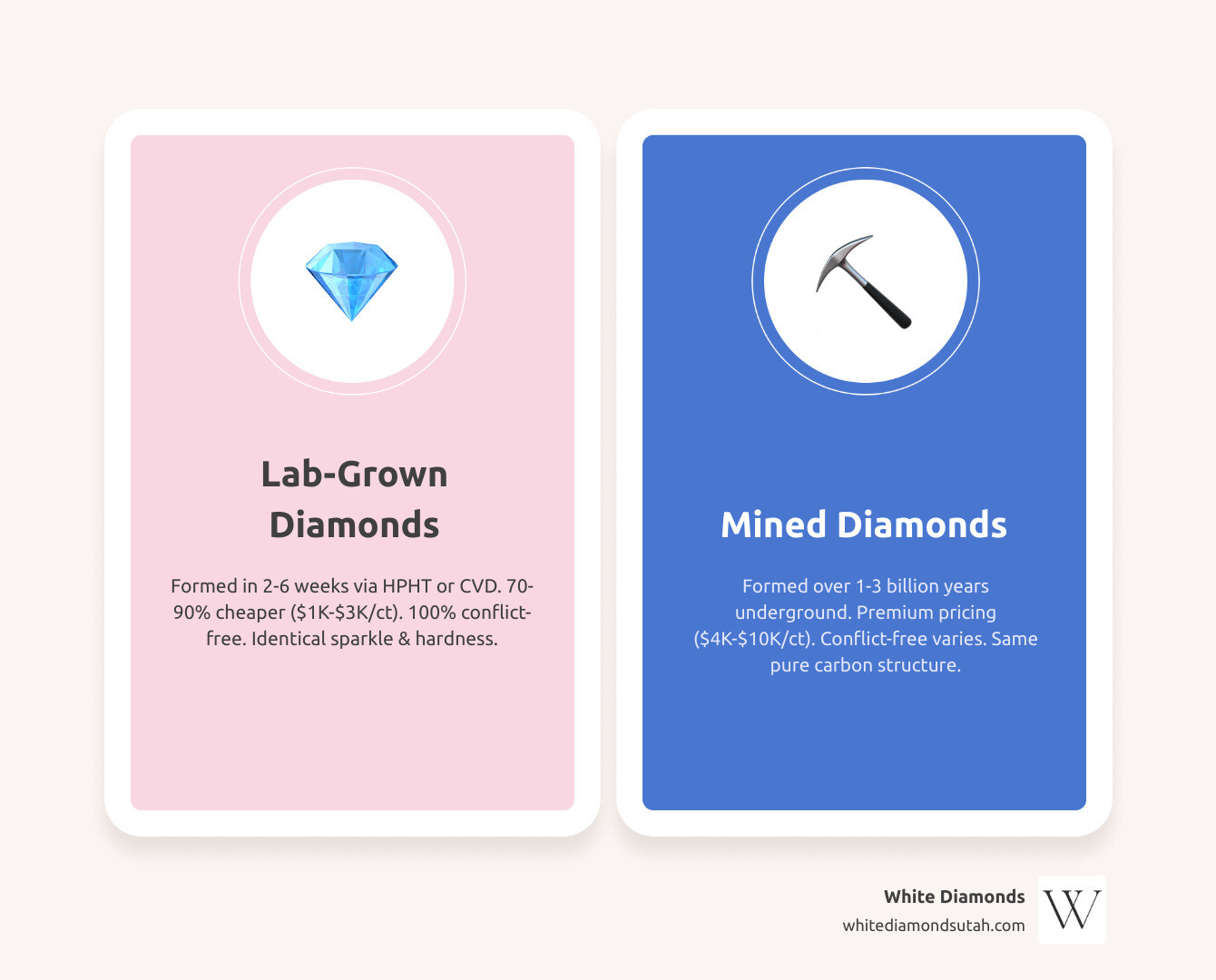
| Price (1-carat) | $1,000 - $3,000 | $4,000 - $10,000 |
| Price (2-carat) | ~$2,800 | ~$29,500 |
| Formation time | 2-6 weeks | 1-3 billion years |
| Resale value | Minimal | 25-50% of retail |
| Conflict-free | 100% guaranteed | Depends on sourcing |
The diamond world has shifted faster in the last five years than in the previous fifty. In 2019, lab-grown diamonds made up just 12% of engagement ring center stones. By 2024, that number had crossed 52%. More than half.
That's not a trend. That's a transformation.
And it's being driven by couples just like you — people who want something beautiful and meaningful without overpaying or compromising on quality.
This guide breaks down everything you need to know: how each diamond is made, why the prices are so different, what the environmental picture actually looks like, and which option makes the most sense for your situation.
At White Diamonds, we've spent years crafting custom rings and wedding bands and helping couples navigate exactly this choice — from understanding the real differences between lab vs mined diamonds to finding the perfect stone for their budget and values. We're here to make that decision feel simple, not stressful.
The Ultimate Comparison: Lab vs Mined Diamonds in 2026
When we talk about lab vs mined diamonds, the most important thing to establish is what they actually are. Despite what some old-school marketing might suggest, a lab-grown diamond is not a "fake" diamond. It isn't a cubic zirconia or a moissanite.
At the atomic level, they are identical. Both are made of pure carbon atoms arranged in a crystal lattice structure. This specific arrangement is what gives a diamond its world-famous sparkle and its unmatched durability. Whether that carbon was pressurized by the weight of the Earth's crust over three billion years or in a specialized reactor over three weeks, the result is the same mineral.
Both stones sit at a 10 on the Mohs scale of hardness, making them the hardest substances on Earth. They share the same refractive index (2.417–2.419), meaning they bend and reflect light in the exact same way. If you want to dive deeper into the technical side, you can check out our guide on What Are Lab Grown Diamonds.
Can you tell the difference between lab vs mined diamonds with the naked eye?
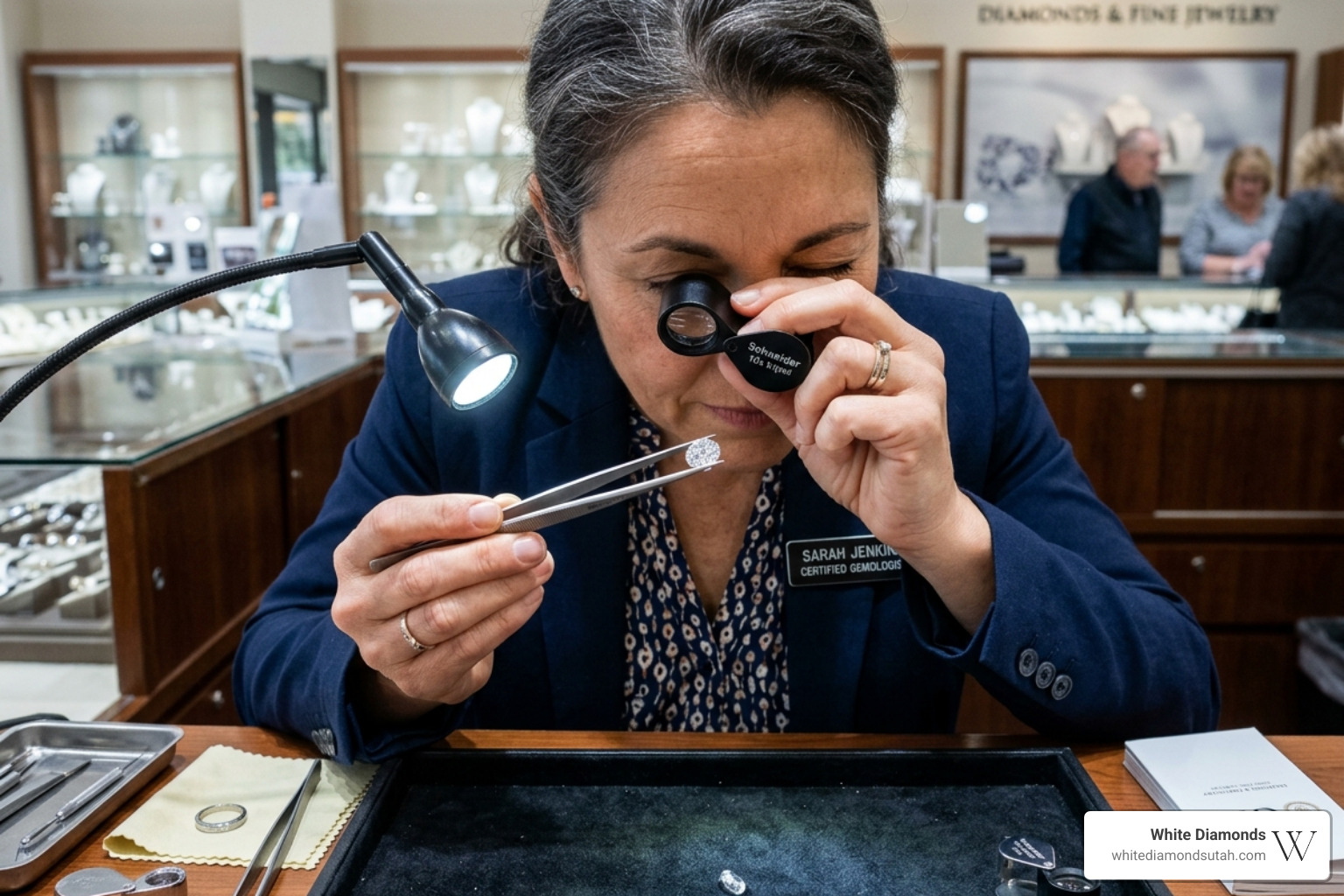
The short answer is: No. Not even we, as professional jewelers, can look at two loose diamonds on a tray and tell you which is which just by using our eyes or even a standard jeweler’s loupe.
Because they are optically and physically identical, they look exactly the same. They have the same fire, the same brilliance, and the same scintillation. To tell them apart, you need highly specialized laboratory equipment that can detect minute differences in growth patterns or the presence of trace elements like nitrogen.
Most mined diamonds contain tiny amounts of nitrogen (classified as Type Ia), while the vast majority of lab-grown diamonds are Type IIa—the chemically purest form of diamond, which accounts for only 1-2% of all mined diamonds. Ironically, this means lab diamonds are often "more perfect" than their mined counterparts. For a deeper dive into how experts view these stones, this Reddit discussion on the real differences offers some great community perspectives.
Furthermore, almost all lab-grown diamonds over 0.5 carats feature a microscopic laser inscription on the "girdle" (the outer edge) that identifies them as laboratory-grown. This ensures complete transparency for the buyer.
How the 4Cs apply to both diamond origins
Whether you are looking at lab vs mined diamonds, the standard for quality remains the same: The 4Cs (Cut, Color, Clarity, and Carat).
- Cut: This is the most important factor for sparkle. A poorly cut diamond will look dull regardless of its origin. Both lab and mined stones are cut using the same tools and techniques.
- Color: Diamonds are graded from D (colorless) to Z (light yellow). Lab diamonds excel here, with many reaching the coveted D-F colorless range.
- Clarity: Just like mined diamonds have "birthmarks" called inclusions, lab diamonds do too. They aren't perfectly clean; they grow with microscopic internal characteristics that gemologists use to grade them.
- Carat: This is the weight of the stone. Because lab diamonds are more affordable, we’re seeing the average center stone size in Ogden and across Utah jump from 1.5 carats in 2021 to 2.0 carats in 2026.
Both types of diamonds are graded by major gemological institutions. While the GIA (Gemological Institute of America) is the gold standard for mined stones, the IGI (International Gemological Institute) has become a leader in the lab-grown sector. You can see how these standards translate to everyday jewelry in our comparison of How Lab Diamond Stud Earrings Compare To Natural Diamonds.
The Great Price Divide: Why Lab-Grown Costs Less
The most striking difference in the lab vs mined diamonds debate is the price tag. As of 2026, lab-grown diamonds cost roughly 70% to 90% less than mined diamonds of equivalent quality.
| Diamond Type | 1-Carat (Excellent/VS1/F) | 2-Carat (Excellent/VS1/F) |
|---|---|---|
| Mined | $6,000 - $8,000 | $25,000 - $30,000 |
| Lab-Grown | $1,200 - $1,800 | $2,500 - $3,500 |
Why the massive gap? It’s not because one is "better" than the other. It comes down to the supply chain. Mined diamonds require massive infrastructure, geological exploration, heavy machinery, and a long chain of middlemen—from the mine to the distributor, the cutter, and the wholesaler.
Lab diamonds, on the other hand, are produced in controlled environments. The supply chain is shorter, more efficient, and scalable. You aren't paying for the rarity of finding a stone in the earth; you're paying for the technology and energy used to grow it.
Understanding the manufacturing processes
There are two primary ways we grow diamonds in a lab today:
- HPHT (High Pressure High Temperature): This method mimics the conditions inside the Earth. A tiny diamond "seed" is placed in carbon and subjected to intense pressure and heat (about 1,500°C). The carbon melts and starts to build upon the seed, layer by layer.
- CVD (Chemical Vapor Deposition): This is the more modern approach. A diamond seed is placed in a vacuum chamber filled with carbon-rich gas (like methane). A plasma reactor breaks down the gas, and the carbon atoms "rain" down onto the seed, crystallizing into a diamond.
CVD is currently the preferred method for high-quality colorless stones, while HPHT is often used to create or enhance fancy-colored diamonds. If you're looking for the Best Places To Buy Lab Grown Diamonds, it's important to work with a jeweler who understands these technical nuances.
Ethics and Environment: A Nuanced Comparison
For many of our clients at White Diamonds, the choice between lab vs mined diamonds comes down to their footprint.
Lab-grown diamonds are often marketed as the "eco-friendly" choice because they don't involve moving tons of earth or disrupting local ecosystems. A single carat of mined diamond can require the excavation of 250 tonnes of earth. In contrast, lab diamonds use a fraction of that land.
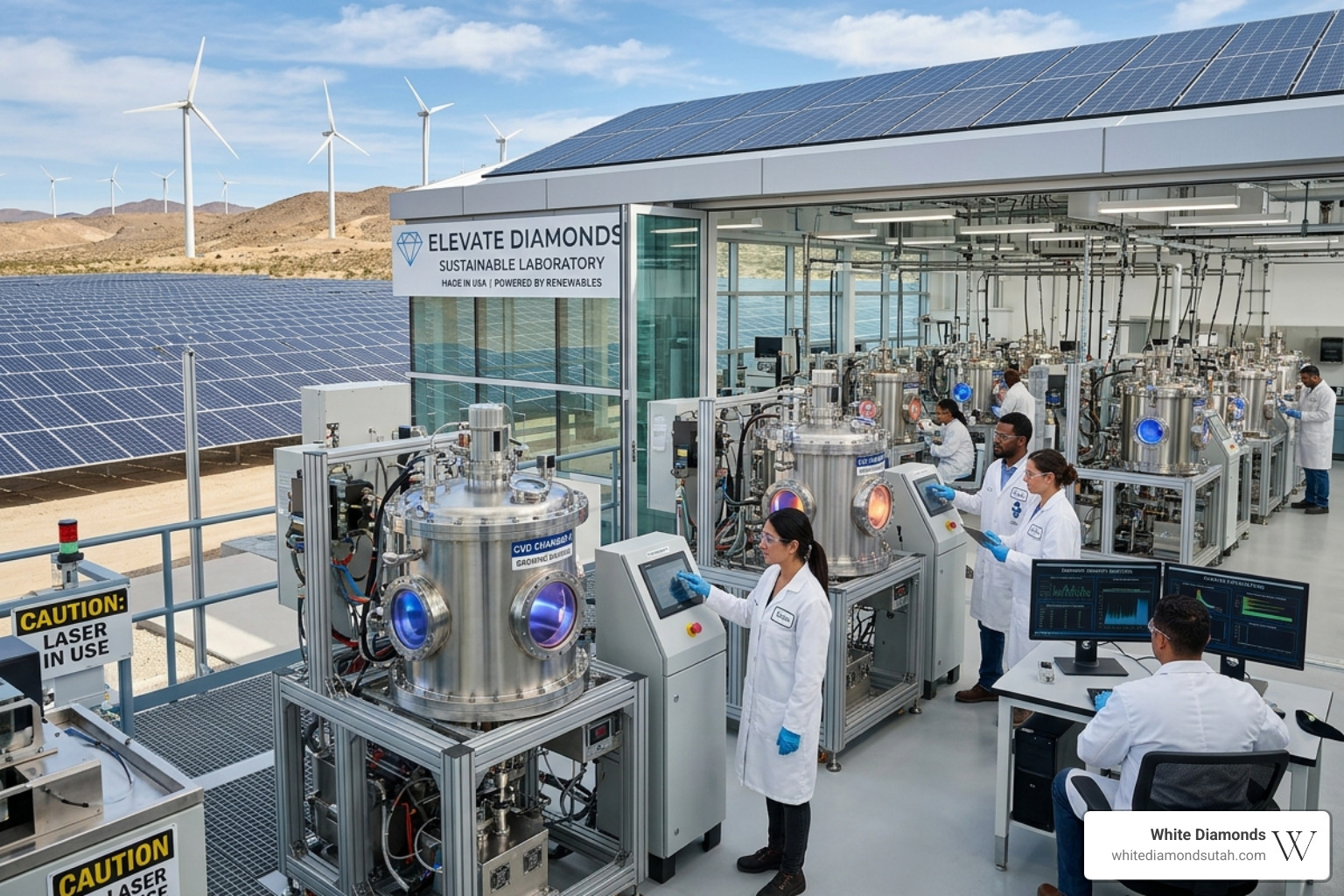
However, it's important to be nuanced. Growing diamonds requires a massive amount of electricity—anywhere from 250 to 750 kilowatt-hours per carat. If a lab is powered by coal (as many are in certain parts of the world), its carbon footprint can actually be higher than a mine. At White Diamonds, we encourage looking for labs that utilize renewable energy sources to truly maximize that environmental benefit.
On the ethical side, lab diamonds are 100% guaranteed conflict-free. While the Kimberley Process has done a lot to clean up the mined diamond industry since the early 2000s, lab-grown stones offer a level of traceability that is hard to beat.
Socioeconomic impacts of the diamond industry
While lab diamonds win on land preservation, mined diamonds play a massive role in the economies of developing nations. In countries like Botswana, diamond mining accounts for a huge portion of the GDP and funds schools, hospitals, and infrastructure.
Approximately 10 million people globally depend on the diamond mining sector for their livelihoods. When you choose a mined diamond that is ethically sourced (like those from Canada or Botswana), you are contributing to these local economies. This is a significant factor for those who view their purchase through a lens of global social impact.
Resale Value and Long-Term Investment Realities
We always tell our clients: Buy a diamond because you love it, not because you expect to get rich off it.
Historically, mined diamonds have held their value better than lab-grown diamonds. A mined diamond typically retains 25-50% of its retail value on the secondary market. Because they are finite and rare, there is a built-in floor for their price.
Lab-grown diamonds, however, currently have very little resale value. Because we can always make more of them, they don't have the "scarcity" factor that drives the secondary market.
But here is the "Depreciation Math" we think is important: If you buy a mined diamond for $30,000 and sell it later for $15,000, you have "lost" $15,000 in absolute dollars. If you buy a lab diamond for $3,000 and it eventually becomes worth $0, you have only "lost" $3,000.
For many couples, the $27,000 they saved upfront is a much better "investment" in their home, their honeymoon, or their future. We explore this further in our post on Which Makes A Better Holiday Gift.
Frequently Asked Questions about Diamond Origins
Are lab-grown diamonds real diamonds?
Yes. They are chemically, physically, and optically identical to mined diamonds. They are not fakes or simulants. The FTC (Federal Trade Commission) officially ruled in 2018 that a diamond is a diamond, regardless of whether it grew in the ground or a lab.
How do lab vs mined diamonds compare in terms of chemical composition?
Both are pure carbon. The main difference is that 98% of mined diamonds contain clusters of nitrogen (Type Ia), whereas most lab-grown diamonds are Type IIa (pure carbon with no nitrogen). This actually makes lab diamonds more chemically pure than almost all stones found in nature.
Do lab-grown diamonds cloud or fade over time?
No. Because they have the same crystal structure and hardness as mined diamonds, they are permanent. They will never cloud, fade, or change color. The sparkle you see on day one is the same sparkle that will be there 100 years from now.
Conclusion
The choice between lab vs mined diamonds isn't about right or wrong—it's about what matters most to you.
If you value the "miracle of nature," the billion-year history, and the long-term rarity of a stone formed by the Earth, a mined diamond is a beautiful choice. If you value modern technology, ethical transparency, and getting the largest, most stunning stone possible for your budget, a lab-grown diamond is likely your winner.
At White Diamonds in Ogden, we specialize in helping you make this choice in a pressure-free environment. We offer personalized consultations where we use model rings to help you visualize your custom design before we ever set a stone. We work within your budget and your timeline to ensure your "forever ring" is exactly what you dreamed of.
Ready to see the difference for yourself? Shop the White Diamonds Lab-Grown Collection today and start designing a piece that reflects your unique love story and your values.