The Definitive Guide to Emerald Cut Diamonds
What Are Emerald Cut Diamonds? A Quick Answer
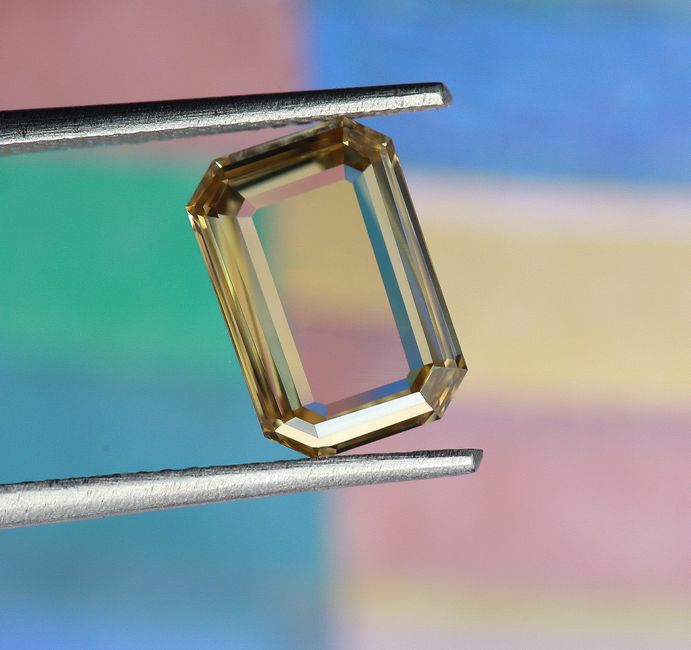
Emerald cut diamonds are rectangular step-cut diamonds with trimmed corners and long, parallel facets that create a dramatic "hall of mirrors" effect — broad flashes of light rather than the rapid sparkle you'd see in a round brilliant.
Here's a quick summary of what makes them stand out:
| Feature | Detail |
|---|---|
| Shape | Rectangular with beveled corners |
| Facet style | Step-cut (parallel rows) |
| Light effect | "Hall of mirrors" — bold, slow flashes |
| Rarity | Only 3% of the world's diamonds are emerald cut |
| Popularity | Fourth most popular diamond shape (4.5% of searches) |
| Price vs. round | Typically ~33% less expensive |
| Clarity requirement | Higher than brilliant cuts — inclusions are easier to spot |
| Best clarity grade | VS2 or higher |
| Best color grade | G–H for great value |
| Ideal L/W ratio | 1.35–1.45 |
When Angelina Jolie stepped out with her emerald cut engagement ring, it reminded the world why this shape has been the choice of royalty and icons — from Grace Kelly to Beyoncé — for generations. There's something about its clean lines and quiet confidence that feels timeless rather than trendy.
Yet despite that glamour, the emerald cut remains surprisingly rare. Only about 3% of the world's diamonds are cut this way, and it takes a more discerning eye to choose one well — because what makes it beautiful also makes it unforgiving of low quality.
At White Diamonds, we're a Utah-based custom jeweler with hands-on experience helping couples find and set the perfect emerald cut diamonds for their engagement and wedding rings. This guide covers everything you need to know to shop with confidence, without the pressure.
Understanding the Appeal of Emerald Cut Diamonds
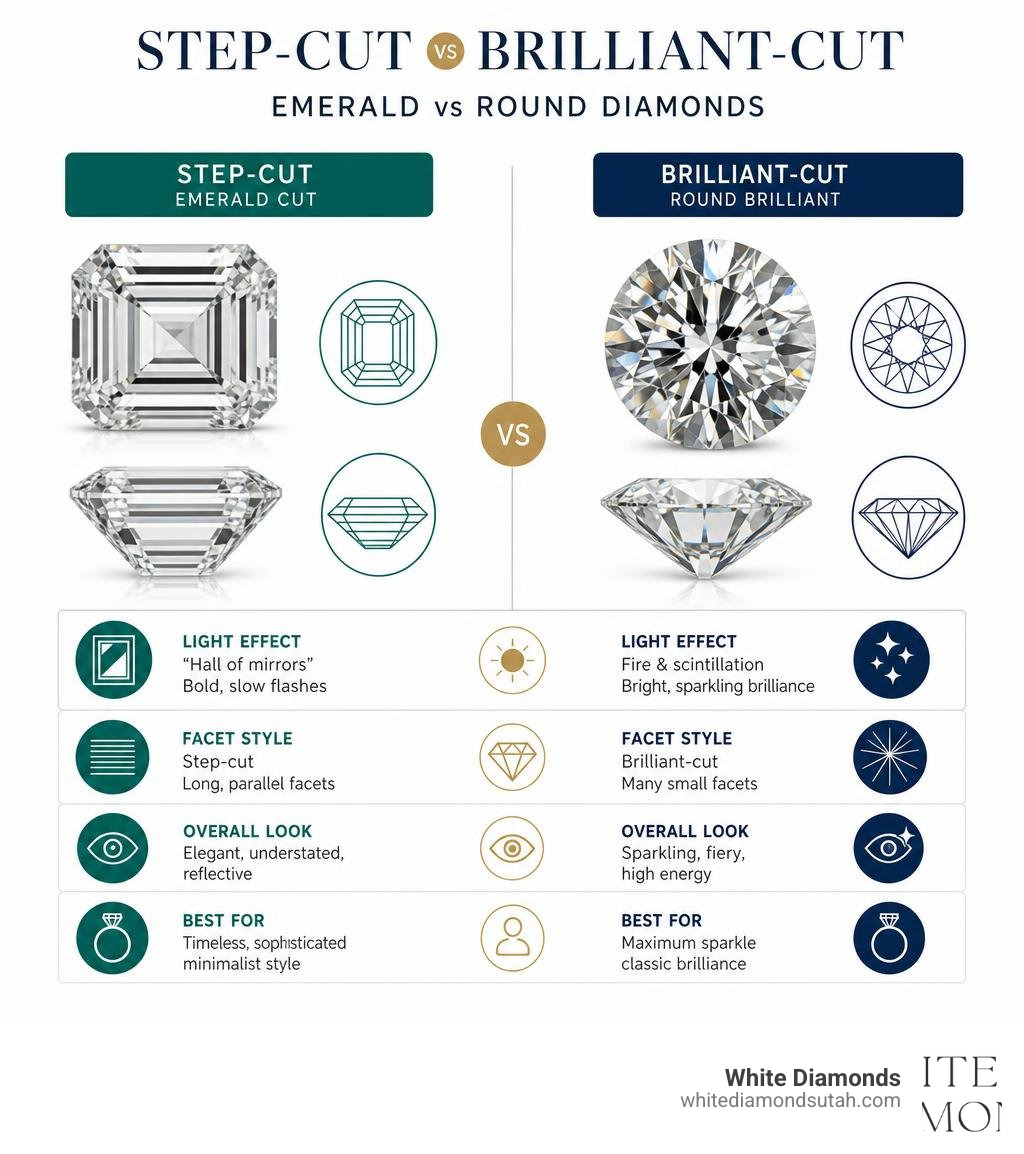
The magic of emerald cut diamonds lies in their unique geometry. Unlike round brilliant diamonds, which are cut to maximize fire and scintillation through triangular facets, the emerald cut utilizes step-cut faceting.
This cutting style features rectangular, step-like facets that run parallel to the diamond's girdle. When light enters the stone, it bounces off these long, flat surfaces to create a mesmerizing "hall of mirrors" effect. Instead of the rapid, pinpoint twinkling of a brilliant cut, you get broad, dramatic flashes of light and dark contrast.
Typically featuring 57 or 58 facets, the emerald cut is characterized by its rectangular shape, open table (the flat top surface), and beveled corners. These cropped corners are not only stylish but also functional, protecting the stone from chipping.
Historically, this cut dates back to the 16th century, when stonecutters developed it to prevent emerald gemstones from chipping during the cutting process. It rose to massive popularity during the Art Deco era of the 1920s and 1930s, where its clean, architectural lines perfectly matched the period's geometric design trends.
This clean aesthetic is why emerald cut diamonds are favored by individuals with a sophisticated, confident sense of style. Iconic wearers include:
- Grace Kelly: Wore a legendary 10.47-carat emerald cut ring.
- Elizabeth Taylor: Owned the jaw-dropping 33.19-carat Krupp diamond.
- Beyoncé: Wore a flawless 18-carat emerald cut masterpiece.
- Amal Clooney: Captivated jewelry lovers with her elegant 7-carat ring.
Beyond its pedigree, the emerald cut offers a practical advantage: visual size. Because of its elongated shape and large surface table, an emerald cut diamond will often look larger than a round brilliant or princess cut diamond of the exact same carat weight.
Comparing Emerald Cuts to Radiant and Asscher Shapes
When shopping for a rectangular or square diamond, buyers often find themselves torn between three distinct shapes: the emerald cut, the radiant cut, and the Asscher cut.
While they may look similar from a distance, their light performance and faceting patterns are completely different.
| Feature | Emerald Cut | Radiant Cut | Asscher Cut |
|---|---|---|---|
| Shape | Elongated Rectangle | Rectangle or Square | Square |
| Faceting Style | Step-cut (parallel lines) | Brilliant or Mixed cut | Step-cut (parallel lines) |
| Sparkle Type | Broad, slow flashes | Intense, crushed-ice sparkle | Concentric "windmill" flashes |
| Clarity Tolerance | Low (shows inclusions easily) | High (hides inclusions well) | Low (shows inclusions easily) |
Radiant Cuts: Brilliant Sparkle vs. Step-Cut Glow
The radiant cut is a mixed cut. It shares the cropped corners and rectangular silhouette of the emerald cut, but its underside is faceted like a brilliant cut. This creates a lively, "crushed-ice" sparkle. If you want the modern rectangular outline of an emerald cut but demand the fiery, intense sparkle of a round diamond, the radiant cut is your match. However, it lacks the clean, vintage "hall of mirrors" glow that makes the emerald cut so unique.
Asscher Cuts: The Square Alternative
The Asscher cut is essentially a square version of the emerald cut. Developed in the early 1900s, it features the same step-cut facets but pulls them into a square shape with deeply cropped corners, creating a striking "windmill" pattern when you look down through the table. It offers the same elegant step-cut aesthetic as the emerald cut, but in a symmetrical, square silhouette.
Proportions, Clarity, and Color: The Buying Blueprint
Because emerald cut diamonds have a large, open table that acts like a window directly into the stone, you cannot hide a poor cut, low clarity, or heavy body color. When buying, you need a precise strategy to balance quality and budget. For a deeper understanding of gemstone characteristics, check out our Gemstone Rings Complete Guide 2026.
Proportions of Emerald Cut Diamonds
Because the GIA does not issue an official "cut grade" for fancy shapes like they do for round diamonds, you have to look at the stone's proportions to evaluate its beauty. You can also review the Gemological Institute of America's overview of diamond quality factors for more background on how cut, color, clarity, and carat weight are assessed.
- Length-to-Width (L/W) Ratio: This determines how square or elongated the diamond appears. The traditional, most popular sweet spot is a ratio of 1.35 to 1.45. A ratio around 1.30 looks wider and more compact, while a ratio above 1.50 looks very long and slender.
- Table Percentage: Look for a table between 61% and 68% (though anything from 60% to 70% can look beautiful).
- Depth Percentage: A depth between 61% and 68% is ideal to ensure the stone is not cut too shallow (which leaks light) or too deep (which hides weight in the bottom where you can't see it).
- Symmetry & Polish: Always aim for "Excellent" or "Very Good" symmetry and polish to ensure the step facets line up perfectly.
For more details on choosing the perfect dimensions for your center stone, read our Ultimate 1 Ct Diamond Engagement Ring Guide.
Selecting Clarity and Color in Emerald Cut Diamonds
In brilliant cuts, the chaotic sparkle easily hides tiny inclusions. In an emerald cut, the open table acts like a magnifying glass.
- Clarity: We highly recommend a VS2 clarity grade or higher as the sweet spot. While you can sometimes find an "eye-clean" SI1, it is rare. For stones larger than 1.5 carats, you may even want to look at VS1 or VVS2 grades to ensure no dark spots are visible to the naked eye.
- Color: Emerald cuts also retain body color more easily because they don't reflect as much ambient light back to your eye. If you want a completely colorless look in a platinum or white gold setting, aim for G or H color.
- Setting Metals: If you are planning to set your diamond in yellow gold or rose gold, you can comfortably drop to an I or J color (or even lower), as the warm metal will naturally mask the slight warmth in the diamond.
To see how different color and clarity combinations look in hand-crafted designs, view our collection of stunning options in our guide: Put a Little Love on Her Finger with These 1 Carat Rings.
Settings, Styling, and Maximizing Value
One of the best-kept secrets in the jewelry world is that emerald cut diamonds offer incredible value. Because cutting an emerald shape results in less waste of the rough diamond crystal, they typically cost about 33% less than equivalent round brilliant diamonds.
Currently, in June 2026, a high-quality 1-carat emerald cut diamond ranges from $1,400 to $6,000 depending on its specific color and clarity. Yet despite this value, they remain highly exclusive — a historical consumer study showed that only about 8% of jewelry buyers chose an emerald cut, making it a wonderful choice if you want to stand out from the crowd.
To maximize your budget, look for a stone with a slightly shallower depth (around 60–62%) to maximize its face-up size, and prioritize clarity over color if you plan to set it in warm metal.
Best Settings for Step-Cut Stones
The clean, architectural lines of an emerald cut make it incredibly versatile. Some of our favorite ways to style them include:
- Classic Solitaire: A simple four-claw or double-prong solitaire setting lets the "hall of mirrors" effect take center stage.
- Three-Stone Setting: Pairing an emerald cut center stone with tapered baguette side stones is a classic Art Deco design that emphasizes the step-cut theme.
- Bezel Setting: Wrapping the diamond in a thin rim of metal offers a sleek, modern, and highly protective frame.
- Halo Setting: Surrounding the stone with a delicate border of brilliant-cut diamonds adds an extra layer of sparkle.
- East-West Setting: Setting the diamond horizontally across the band rather than vertically along the finger offers a bold, contemporary twist.
For a deep dive into setting options, check out our guide on Diamond Setting Style.
Natural vs. Lab-Grown Options
When shopping for emerald cut diamonds, you will find both natural (mined) and lab-grown options.
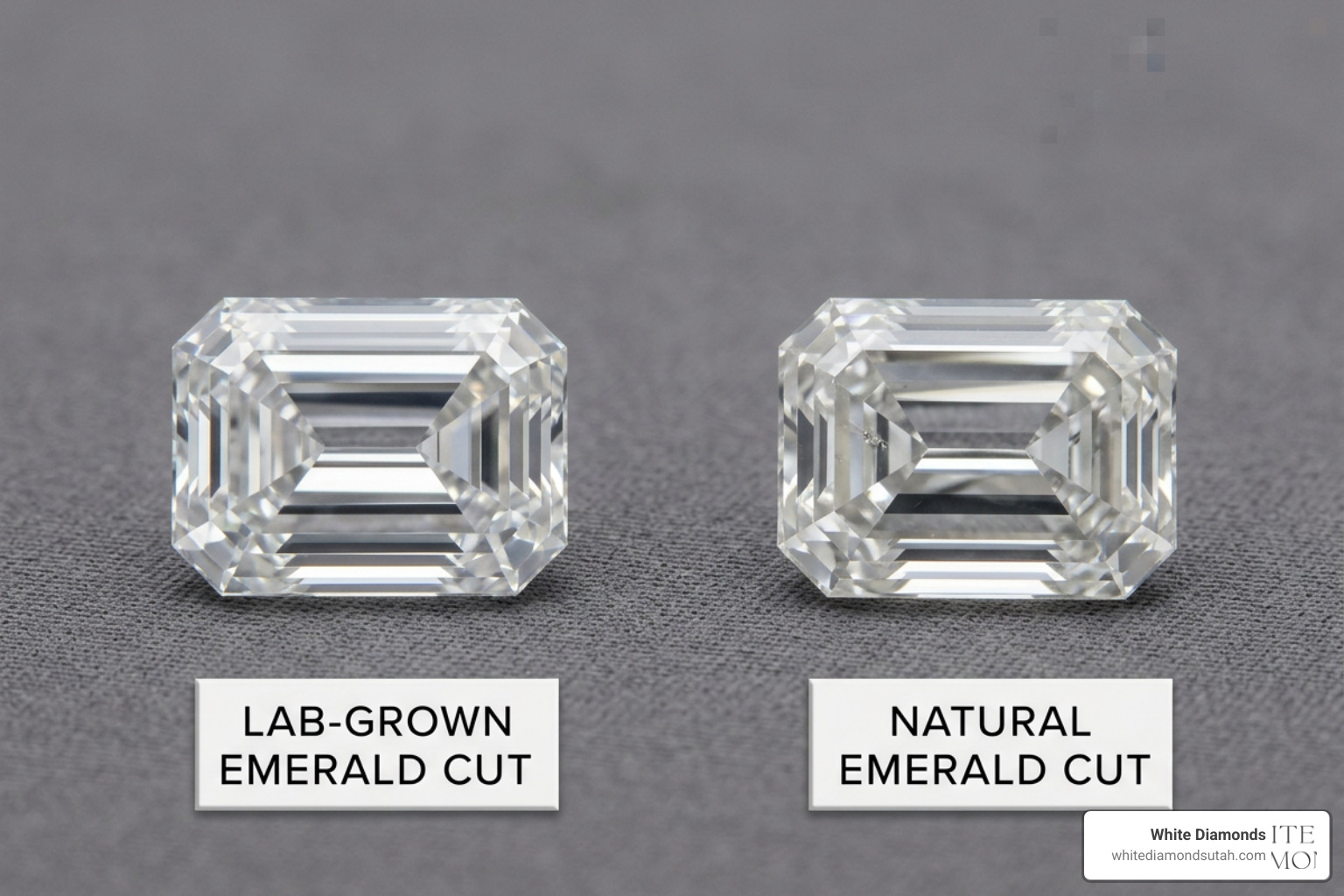
It is important to know that lab-grown diamonds are chemically, physically, and optically identical to natural diamonds. They are real diamonds; they simply grew in a highly controlled laboratory environment rather than deep within the Earth.
The primary difference is price. Lab-grown emerald cuts are significantly more affordable, allowing you to buy a much larger, higher-clarity stone for the same budget. For those who prioritize natural origin, mined diamonds offer a sense of ancient rarity and long-term value retention.
If you love the rich, deep green of traditional emeralds paired with diamonds, you might also enjoy exploring our guides on the 1 Carat Emerald Ring with Diamonds or a classic 9ct Gold Emerald Ring.
Frequently Asked Questions
Do emerald cut diamonds sparkle?
Yes, but they do not sparkle in the same way as round diamonds. Instead of a rapid, fiery twinkle, they produce large, dramatic flashes of light. This is known as the "hall of mirrors" effect, which emphasizes the diamond's clarity and luster over raw scintillation.
Do emerald cut diamonds look bigger than round diamonds?
Yes! Because of their elongated shape and the fact that more of their carat weight is distributed across the top surface (the table), emerald cuts have a larger visual footprint than round diamonds of the same weight.
Are emerald cut diamonds more expensive?
No, they are actually less expensive. Because the cutting process preserves more of the rough diamond crystal, emerald cuts typically cost about 33% less per carat than round brilliant diamonds of equivalent quality.
Conclusion
The emerald cut is a masterclass in understated elegance. It doesn’t need to shout with blinding sparkle to get noticed; its clean lines, geometric precision, and hypnotic hall-of-mirrors effect speak volumes about the wearer's confidence and taste.
At White Diamonds, we believe that finding the perfect ring should be an enjoyable, stress-free experience. Based in Ogden, Utah, we specialize in custom engagement rings and fine jewelry design. We offer personalized, pressure-free consultations with physical model rings so you can see exactly how different proportions and settings look on your hand before making a decision. Whatever your budget or timeline, we are here to help you bring your dream ring to life.
Ready to find your perfect match? Explore our Emerald Cut Diamond Engagement Rings Classic Style or contact us today to schedule your custom consultation.