Why Antique Diamond Drop Earrings Never Go Out of Style
Defining Antique Diamond Drop Earrings vs. Vintage and Modern Styles
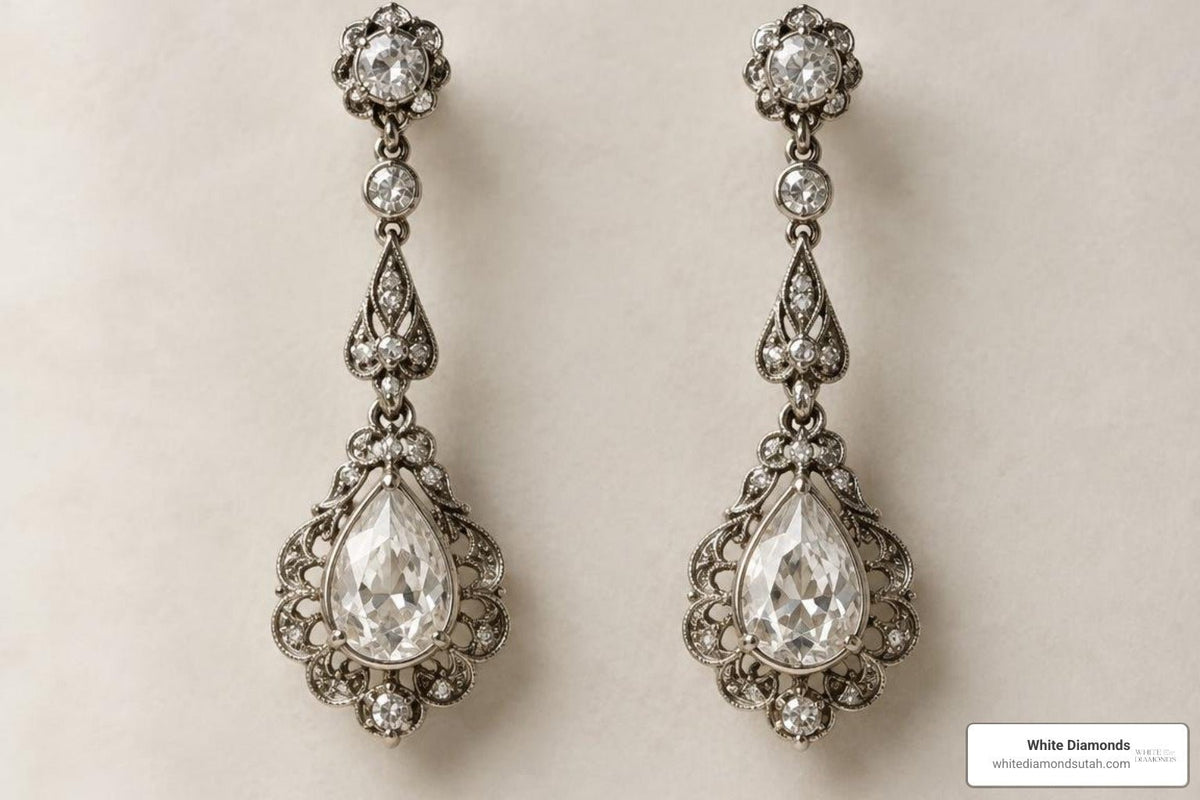
Antique diamond drop earrings are at least 100 years old, so in 2026, they date from 1926 or earlier. To explore the styles, look for Georgian rose cuts with a soft glow, Victorian designs with rich detail, and Edwardian drops with light, delicate metalwork. Each has a look that feels at home with a modern dress or formal outfit.
We are White Diamonds, a Utah-based custom jeweler. Our work designing fine jewelry and cleaning rings shapes how we think about the craftsmanship and care of antique diamond drop earrings.
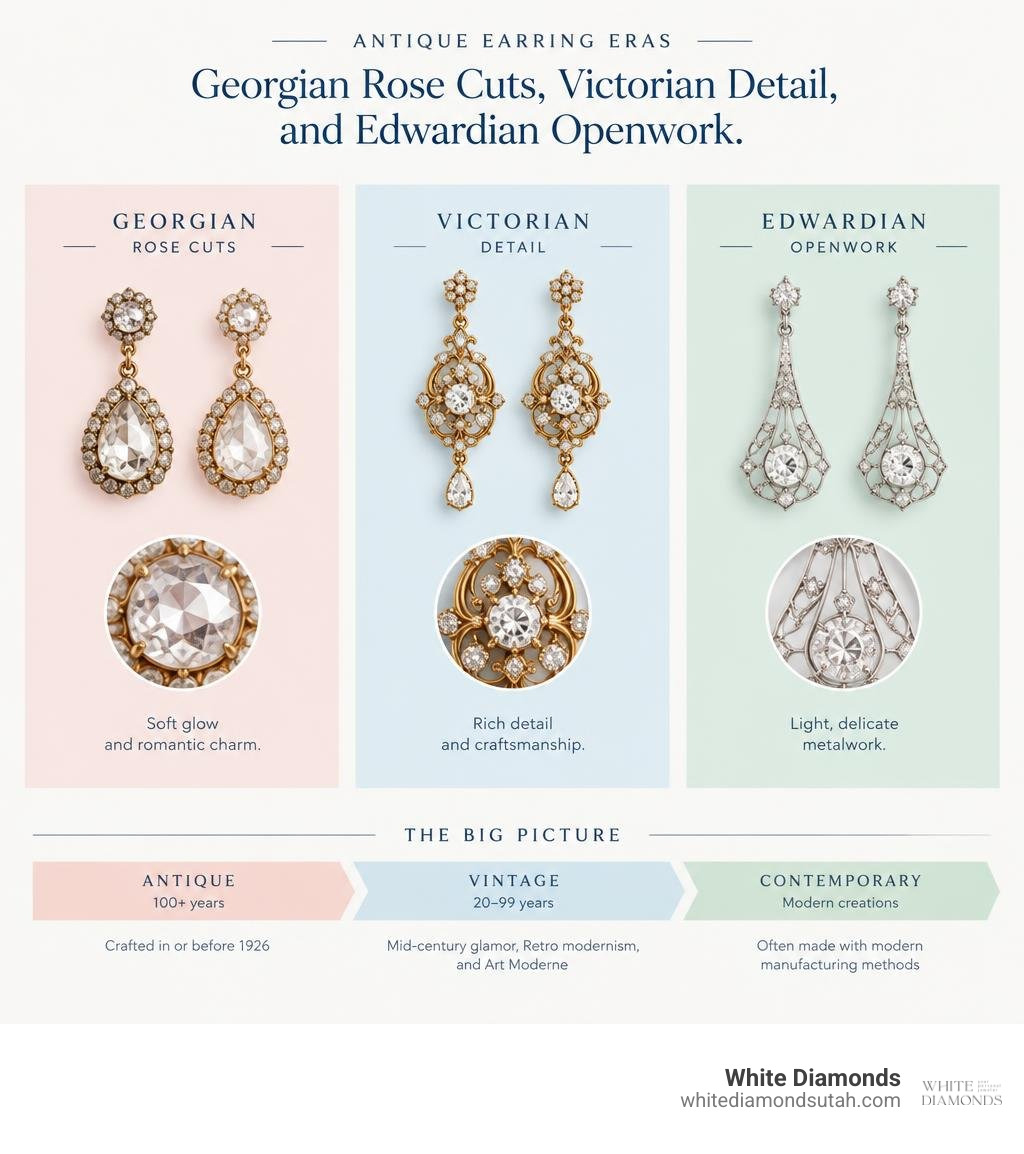
Understanding the differences between antique, vintage, and contemporary jewelry comes down to chronology, fabrication methods, and facet architecture.
In the jewelry trade, the 100-year benchmark serves as the strict threshold for antique status. As of 2026, a jewel must have been crafted in or before 1926 to be truly antique. Vintage pieces fall roughly into the 20- to 99-year-old range, spanning mid-century Hollywood glamor, Retro modernism, and Art Moderne. Contemporary and reproduction pieces, by contrast, are modern creations that might mimic historical styles using modern manufacturing methods like CAD/CAM casting, machine cutting, and laser soldering.
Authentic antique drops were shaped entirely by hand. Gem cutters did not have motorized cutting wheels or laser proportioning tools; they cleaved and shaped stones by eye, guided by daylight or candlelight. This deliberate hand-cutting gave each gem a unique geometry, asymmetry, and distinct optical personality. Modern jewelers cut diamonds using computerized algorithms that maximize light return under bright electric lighting. The charm of antique pieces lies in their organic soul, deep culets, small tables, and charming irregularities.
When exploring classic diamond earrings, collectors quickly notice how the visual weight, patina, and movement of historical drops differ from modern counterparts:
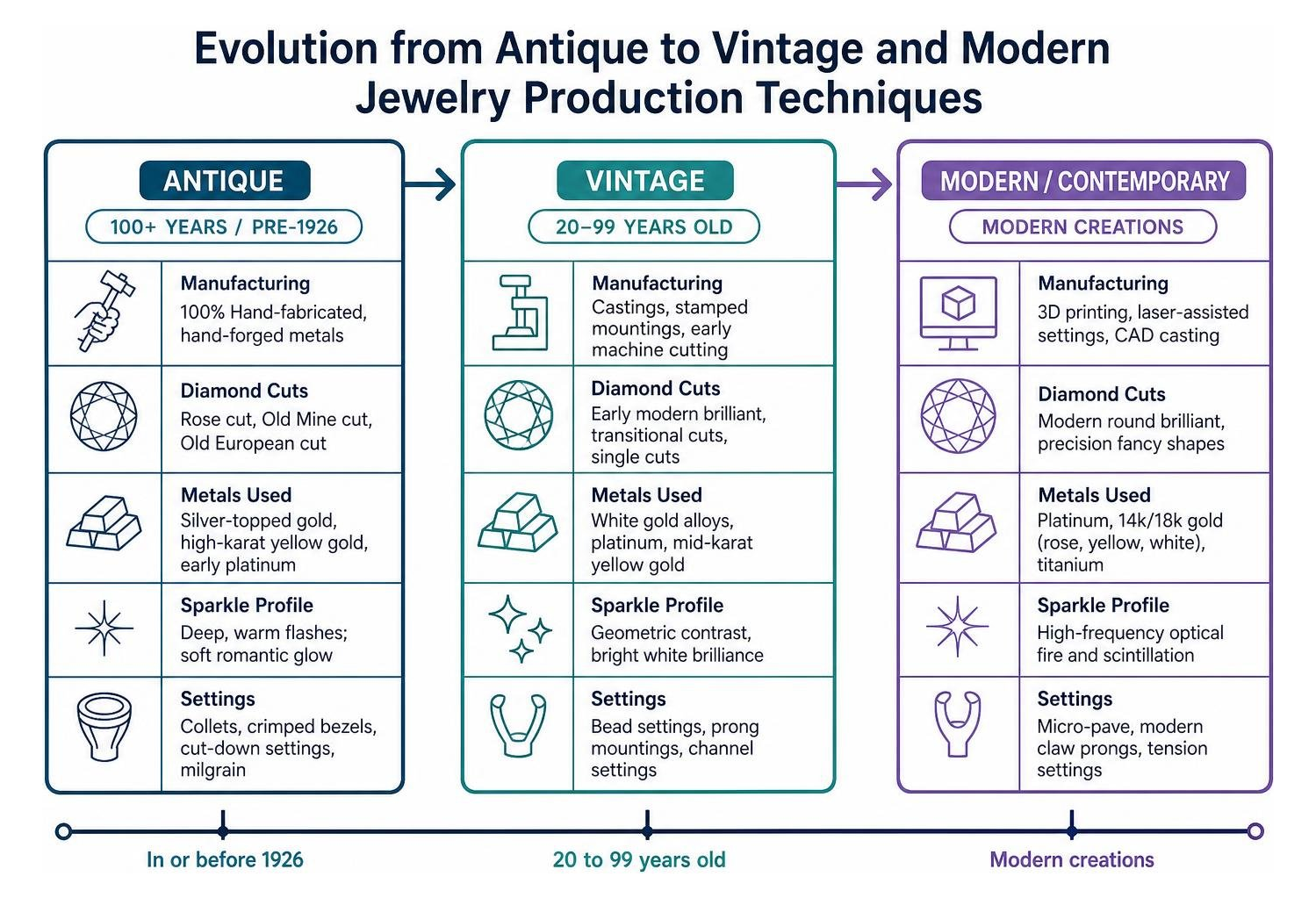
| Attribute | Antique (100+ Years / Pre-1926) | Vintage (20–99 Years Old) | Modern / Contemporary |
|---|---|---|---|
| Manufacturing | 100% Hand-fabricated, hand-forged metals | Castings, stamped mountings, early machine cutting | 3D printing, laser-assisted settings, CAD casting |
| Diamond Cuts | Rose cut, Old Mine cut, Old European cut | Early modern brilliant, transitional cuts, single cuts | Modern round brilliant, precision fancy shapes |
| Metals Used | Silver-topped gold, high-karat yellow gold, early platinum | White gold alloys, platinum, mid-karat yellow gold | Platinum, 14k/18k gold (rose, yellow, white), titanium |
| Sparkle Profile | Deep, warm flashes; soft romantic glow | Geometric contrast, bright white brilliance | High-frequency optical fire and scintillation |
| Settings | Collets, crimped bezels, cut-down settings, milgrain | Bead settings, prong mountings, channel settings | Micro-pave, modern claw prongs, tension settings |
Major Historical Eras and Craftsmanship
Antique diamond drop earrings span distinct aesthetic design movements, each reflecting the politics, trade, and metalworking technologies of its era.
- The Georgian Era (1714–1836): Georgian jewelers embraced nature motifs, cascading garland clusters, and dramatic girandole or pendeloque silhouettes. Because platinum working was not yet developed and jewelers believed yellow gold cast an unflattering yellow tint into colorless stones, they set diamonds into silver mounts backed with yellow gold to prevent tarnish from touching skin or clothing.
- The Victorian Era (1837–1901): Queen Victoria’s long reign is divided into the Romantic, Grand, and Aesthetic periods. Early Romantic Victorian drops featured serpentine motifs, floral bouquets, and sentimentality. Mid-Victorian pieces turned bolder and more somber, utilizing deep yellow gold and starburst settings. By the late Victorian era, the South African diamond rush flooded the market with gems, leading to larger diamond clusters and articulated drops.
- The Edwardian Era (1901–1915): Known for its featherlight, lace-like aesthetic, Edwardian jewelry introduced platinum fabrication techniques. Jewelers could now create strong, gossamer-thin lattice frameworks with milgrain borders. Drops from this period often feature bow motifs, delicate garlands, and combinations of diamonds alongside luminous pearl drop earrings for a regal, ethereal drape.
- Early Art Deco (1915–1926): Transitioning toward modern geometry, the early Art Deco period favored sharp linear forms, symmetry, and architectural drops. Calibre-cut accent stones, step-cut geometric bezels, and bold contrasts defined these transitional years.
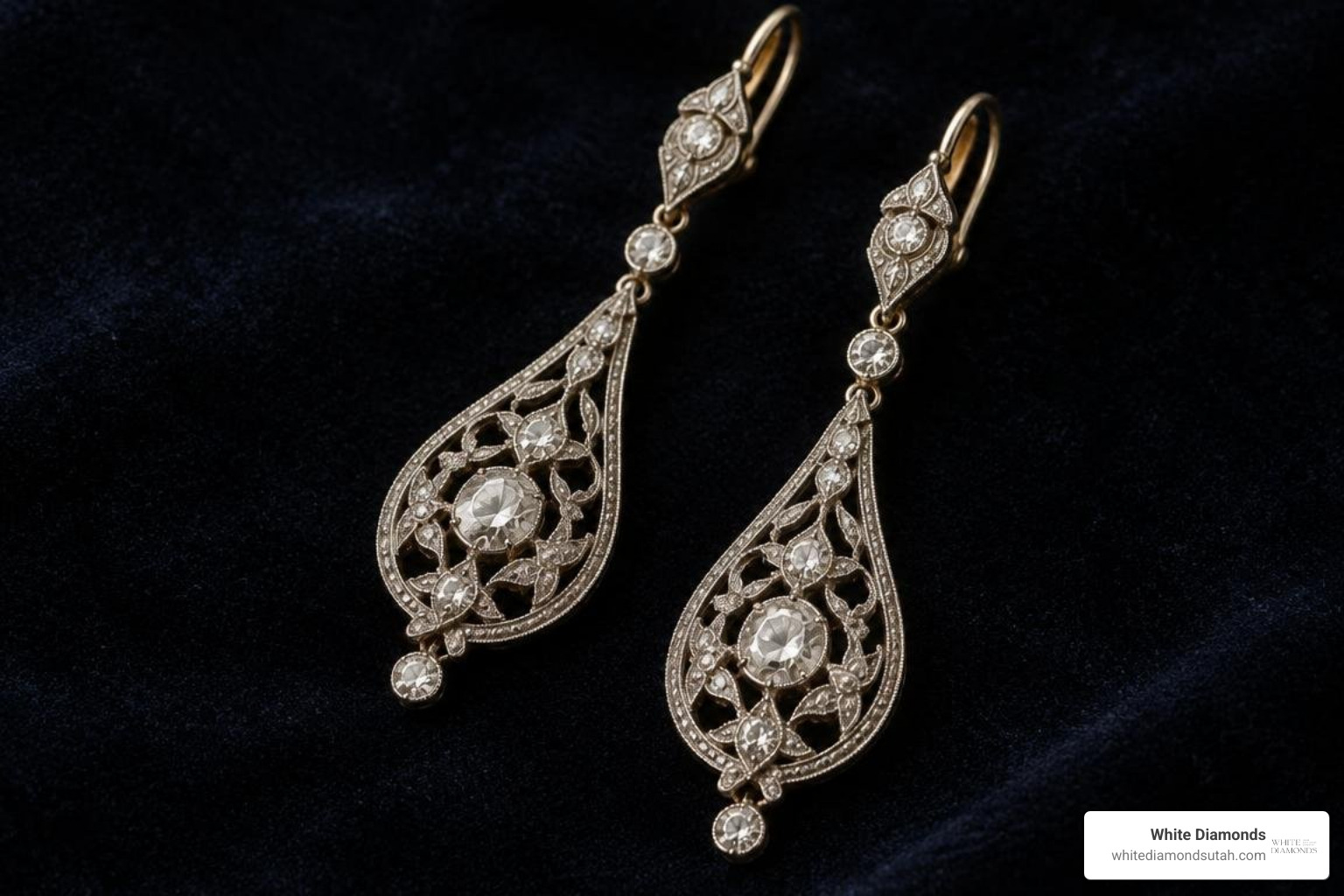
Many museum collections, including the historic Jewellery designs · V&A, illustrate how royal commissions established these timeless silhouette styles across Europe and the Americas.
Historic Diamond Cuts in Antique Diamond Drop Earrings
The cut of an antique diamond completely alters its light performance. While modern stones sparkle with intense disco-ball scintillation, historic cuts were optimized for gentle, ambient candlelight:
- Rose Cut (1500s–1800s): Resembling the spiral petals of a rosebud, this cut has a flat base and a domed, faceted top featuring anywhere from 3 to 24 triangular facets. Because they lack a pavilion (the bottom half of a modern diamond), rose cuts emit a soft, pool-of-water shimmer. Rose cuts make up roughly 5% of historic diamond cuts found on the collector market today. An authentic pair of Georgian rose cut diamond drop earrings in silver and gold often features gems around 5mm with a drop length of 18mm, weighing approximately 2.8 grams—displaying a subtle, understated glow.
- Old Mine Cut (1700s–Late 1800s): The predecessor to the round brilliant, Old Mine cuts have a squarish or cushion-shaped outline, a high crown, a deep pavilion, a tiny table, and a large, visible open culet at the base. They catch light in broad, chunky flashes of rainbow fire.
- Old European Cut (Late 1800s–1930s): As mechanical diamond-cutting lathes emerged in the late 19th century, cutters developed circular outlines. Old European cuts retain the high crown, small table, and open culet of the Old Mine cut, but feature a symmetrical round circumference.
- Single Cut: Featuring just 17 or 18 facets (an eight-fold symmetry around the crown and pavilion), single cuts were commonly used for small pavé and halo accents on larger drop pendeloques.
When comparing these classic gems to today's handcrafted 18k diamond earrings, one can see how antique cuts prioritized weight retention and fire over sheer brilliance.
Characteristic Settings and Metalwork Techniques
The settings of antique earrings are miniature works of architectural art, incorporating techniques largely replaced by modern mass-production casting:
- Foil Backing: In Georgian and early Victorian jewelry, stones were set into closed-back settings lined with tinted or mirrored silver foil. This illuminated the diamond from behind, compensating for asymmetrical cuts. (A pair of Russian royal drop earrings from the late 1800s weighing 3 carats in gold illustrates how royal workshops perfected these enclosed, reflective metal housings.)
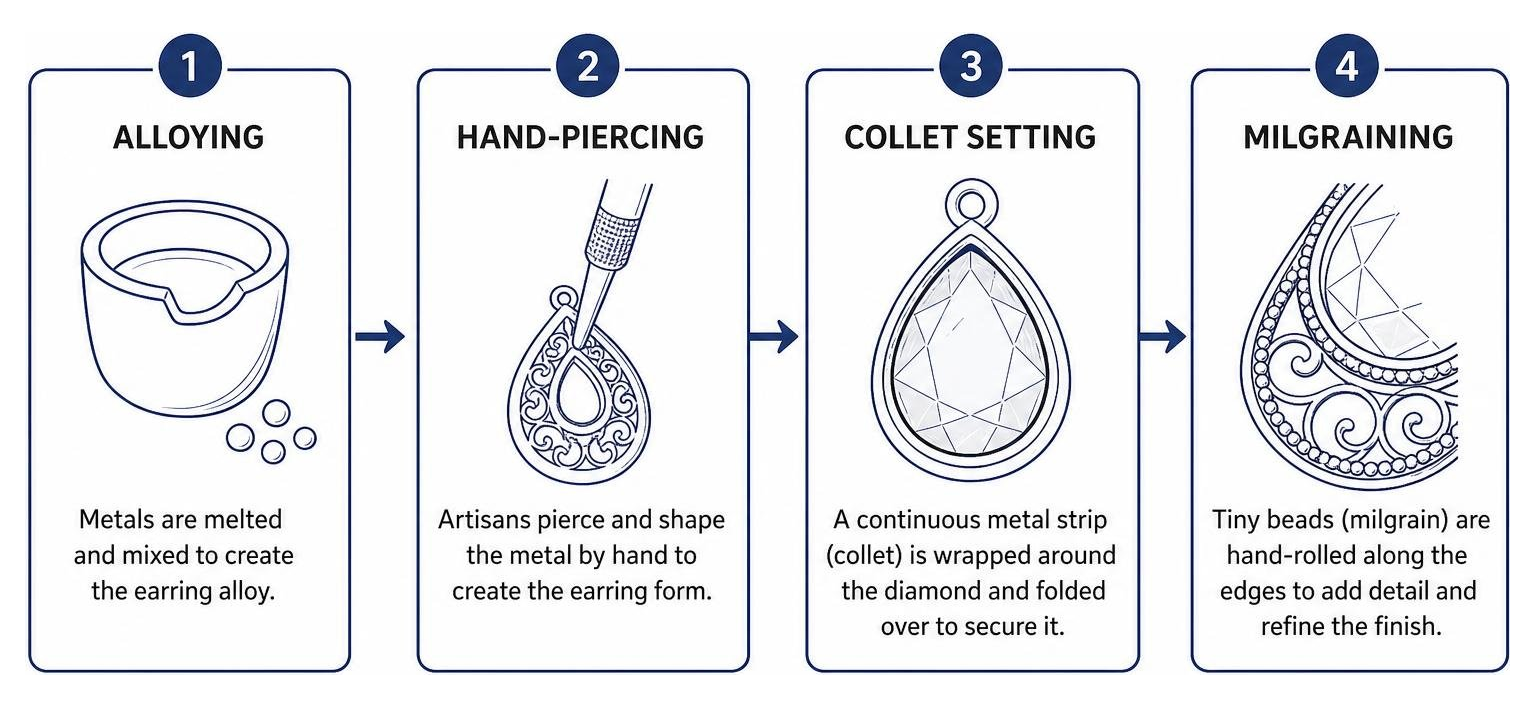
- Collet and Cut-Down Settings: Rather than using individual wire prongs, artisans wrapped a continuous strip of metal (a collet) around the diamond's girdle, folding the top rim over the stone to hold it securely.
- Milgrain and Openwork Filigree: Edwardian jewelers hand-rolled tiny beads along metal edges (milgrain) and sawed out paper-thin gold and platinum ribbons (filigree) to yield airy designs similar to three-stone drop styles.
- Shepherd’s Crook & Back-to-Front Hooks: Antique ear wires often feature extended shepherd's crook hooks or hinged lever-backs that inserted through the back of the earlobe and latched into a loop at the front.
Assessing Value, Pricing, and Provenance
Determining the value of antique diamond drop earrings involves assessing both raw material worth and historical significance. A tiny 1/20-carat vintage accent earring might retail around $220 USD, while an entry-level pair of 0.5-carat antique diamond drops typically ranges from $800 to $1,200. Significant museum-grade or royal-provenance pairs easily command tens of thousands of dollars at major auction houses like Christie's.
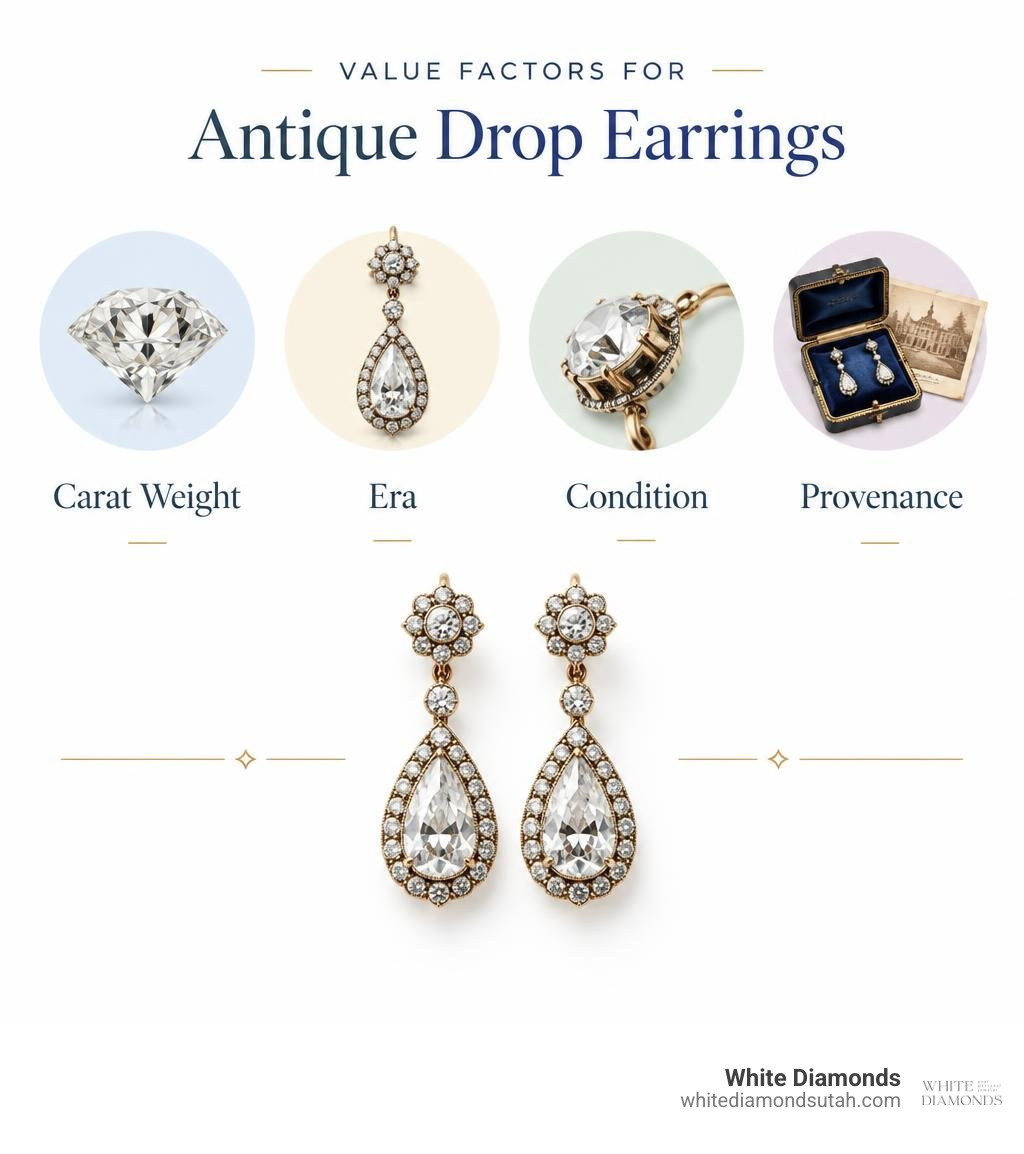
When valuing an antique jewel, appraisers examine several core factors:
- Rarity of Era and Style: Authentic Georgian drops are much scarcer than late Victorian drops, as many were dismantled over the centuries to reset stones into newer fashions.
- Total Diamond Weight & Quality: While antique diamonds are not graded by modern diamond cut standards, clarity, natural body color, and substantial carat weight still drive valuations.
- Preservation of Original Findings: Original ear wires, uninterrupted collet walls, and untouched settings carry higher premiums than converted pieces (such as antique brooch components converted into earrings).
- Documented Provenance: A verified bill of sale, archival box, or recorded history linked to a notable estate adds market value.
How to Authenticate Antique Diamond Drop Earrings
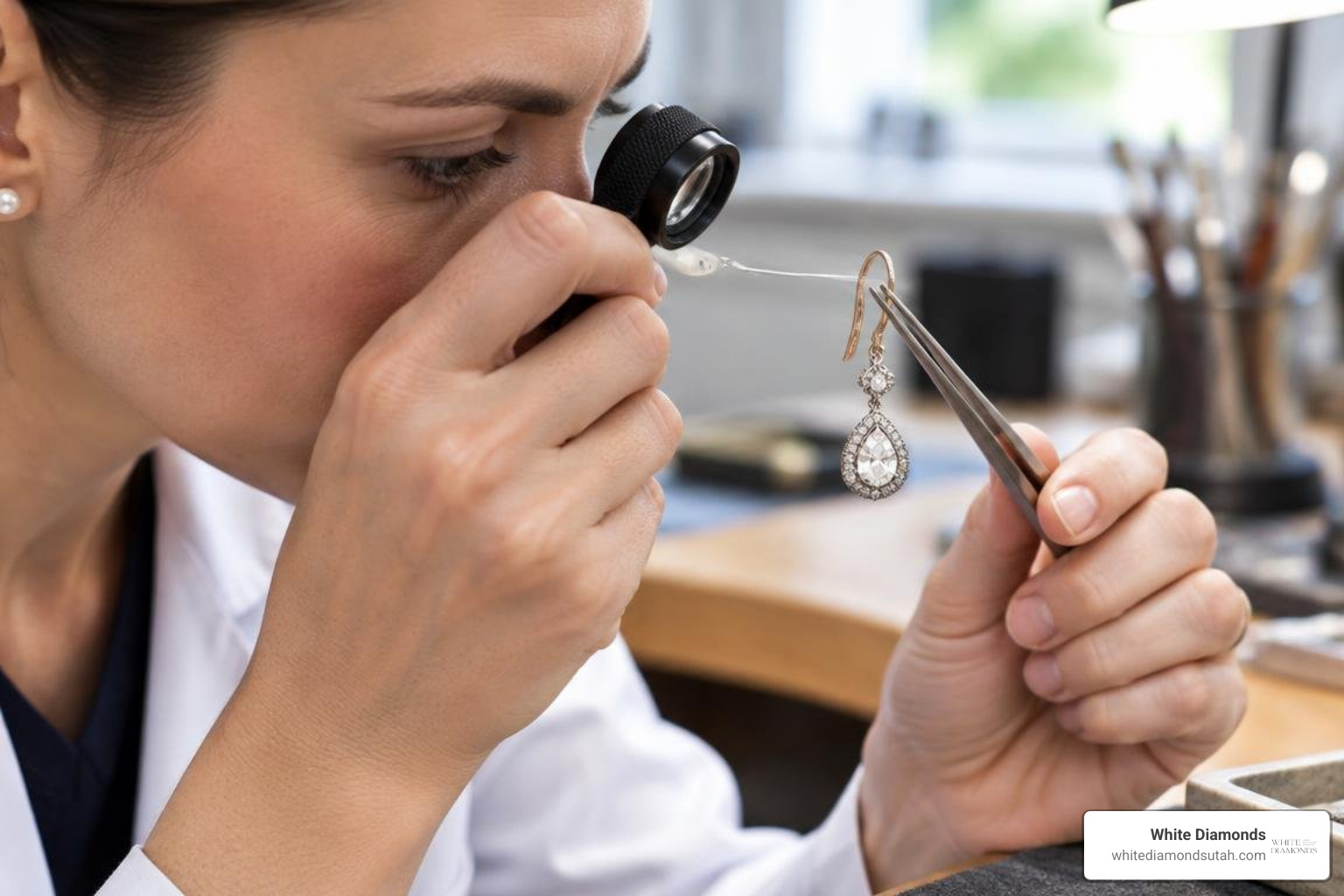
Before investing in antique jewelry, evaluate the piece using systematic physical inspection steps:
- Examine Hallmarks and Maker's Marks: Use a 10x jeweler’s loupe to inspect the ear wires, settings, and drop joins. European pieces often bear assay stamps denoting city, metal purity, and date letters. However, worn or illegible marks are normal on authentic century-old pieces.
- Inspect Wear Patterns: True antiques show soft, uneven wear on high-contact zones, such as the hinges and loops of a drop mechanism. If an earring looks completely pristine, sharp, and cast without seam lines, it may be a modern reproduction.
- Analyze the Diamond Cuts Under Magnification: Look for the characteristic hand-cut asymmetry, wide facet junctions, small tables, and open culets of genuine Old European or Old Mine cuts. Modern laser-cut stones are too geometrically uniform.
- Check for Foil Backing Integrity: If the earrings have closed backs, examine the reverse side. The metal should be intact and free from water discoloration or dark brown spotting.
- Request an Independent Appraisal: Always obtain a certification or independent appraisal from an experienced gemologist specializing in historical estates.
Styling Antique Drops for Modern Wardrobes
The dynamic, articulated drop of an antique earring brings romance and soft movement to contemporary silhouettes. Because historic diamonds glow warmly, they integrate seamlessly into both daily and formal wardrobes.
- Modern Bridal Glamour: For brides wearing clean-lined crepe, silk, or lace gowns, antique drops serve as a focal point. Their gentle candlelight scintillation creates a romantic bridal aesthetic that avoids the harsh glare of modern light reflection.
- Tailored Minimalism: Contrast the ornate filigree of Edwardian drops with a sharp black blazer, crisp white button-down, or structured jumpsuit. The juxtaposition of historical detail against clean modern tailoring makes a refined statement.
- Layered Ear Curations: If you have multiple ear piercings, pair an antique diamond drop in the primary lobe with sleek, modern 14k gold hoops or minimalist studs in the upper cartilage for a curated, multi-era stack.
- Evening Galas & Black-Tie: Lengthier girandole and multi-stone drops catch every flicker of ambient room lighting, framing the jawline and neck without overwhelming your overall ensemble.
Frequently Asked Questions About Antique Diamond Drop Earrings
What is the difference between antique and vintage diamond drop earrings?
The difference lies in chronological age. To be classified as antique, a piece of jewelry must be at least 100 years old (crafted in 1926 or earlier, based on the current year 2026). Vintage jewelry encompasses pieces made between 20 and 99 years ago (1927–2006). Vintage pieces typically exhibit mid-century, Retro, or Art Deco production techniques, including white gold alloys and transitional brilliant diamond cuts.
How should you clean and preserve antique drop earrings with foil backing?
Closed-back, foil-backed antique earrings must never be submerged in water or placed in an ultrasonic cleaner. Moisture entering the closed setting oxidizes the silver or metallic foil behind the diamond, turning it dark grey or black—damage that cannot be reversed without taking the entire piece apart. Instead:
- Wipe the diamonds and front metals gently with a soft, dry micro-fiber jewelry cloth.
- Use a dry, soft-bristle natural brush to dust crevices and milgrain borders.
- Store antique earrings in a low-humidity, temperature-controlled jewelry box away from bathrooms and direct heat sources.
Are antique diamond earrings considered a strong investment in 2026?
Yes. Antique diamond drop earrings hold their value well because the supply of authentic 100-plus-year-old pieces is finite and continues to dwindle. As surviving pieces are bought by private collectors or museums, market demand for authentic historical cuts—especially undamaged rose cuts and Old European cuts—remains strong. When accompanied by documented provenance or intact original metalwork, antique jewels provide tangible historical value.
Conclusion
Antique diamond drop earrings carry stories, artistry, and romantic fire that modern mass manufacturing cannot duplicate. From the soft shimmer of Georgian rose cuts to the openwork platinum lace of the Edwardian era, these heirloom treasures bridge past and present with unmatched grace.
Whether you are seeking an original century-old pair, looking to care for an inherited family treasure, or designing a bespoke heirloom-inspired piece, our team at White Diamonds is here to help. We provide personalized, pressure-free consultations from our Utah workshop, helping you navigate fine jewelry choices within your budget and timeline.
Explore our comprehensive diamond earrings buying guide to learn more about diamond settings, metal types, and how to find an enduring design that reflects your personal style.