
The Ultimate Guide to Diamond Earrings
Why Diamond Earrings Belong in Every Jewelry Collection
Diamond earrings are one of the most versatile and beloved pieces of jewelry you can own or give. Whether you're looking for everyday wear, a special occasion, or a meaningful gift, there's a style and price point for almost every budget.
Quick answer — the most popular types of diamond earrings:
| Style | Best For | Typical Price Range |
|---|---|---|
| Stud earrings | Everyday wear, beginners | $200 – $5,000 |
| Hoop earrings | Casual and dressy looks | $300 – $4,000 |
| Drop / dangle | Special occasions | $500 – $10,000+ |
| Huggie earrings | Comfort, daily wear | $250 – $3,000 |
| Climber earrings | Fashion-forward styling | $400 – $5,000 |
A few things to know upfront:
- Studs are the most popular style — they make up over 60% of diamond earring purchases
- Lab-grown diamonds look identical to natural diamonds and cost significantly less
- Metal type matters — platinum and 14k gold are the best choices for sensitive ears
- The 4Cs (cut, color, clarity, carat) affect both beauty and price
The global diamond jewelry market is worth over $80 billion, and earrings alone account for roughly 15–20% of all diamond jewelry sold. That's not just a trend — it's a reflection of how deeply people connect with these pieces.
At White Diamonds, we specialize in custom jewelry design and personalized consultations, giving you the expertise to find or create the perfect diamond earrings without pressure or overwhelm. This guide covers everything you need to make a confident decision.
Popular Styles and Settings

When you begin looking for the perfect pair of diamond earrings, the sheer variety of designs can feel both exciting and a little overwhelming. The right style does not just complement an outfit; it works in harmony with your other jewelry, your lifestyle, and your personal aesthetic.
Whether you are matching a new pair of earrings with your favorite fashion rings or finding a standalone statement piece, understanding the core earring silhouettes is the best place to start.
Popular Styles of Diamond Earrings
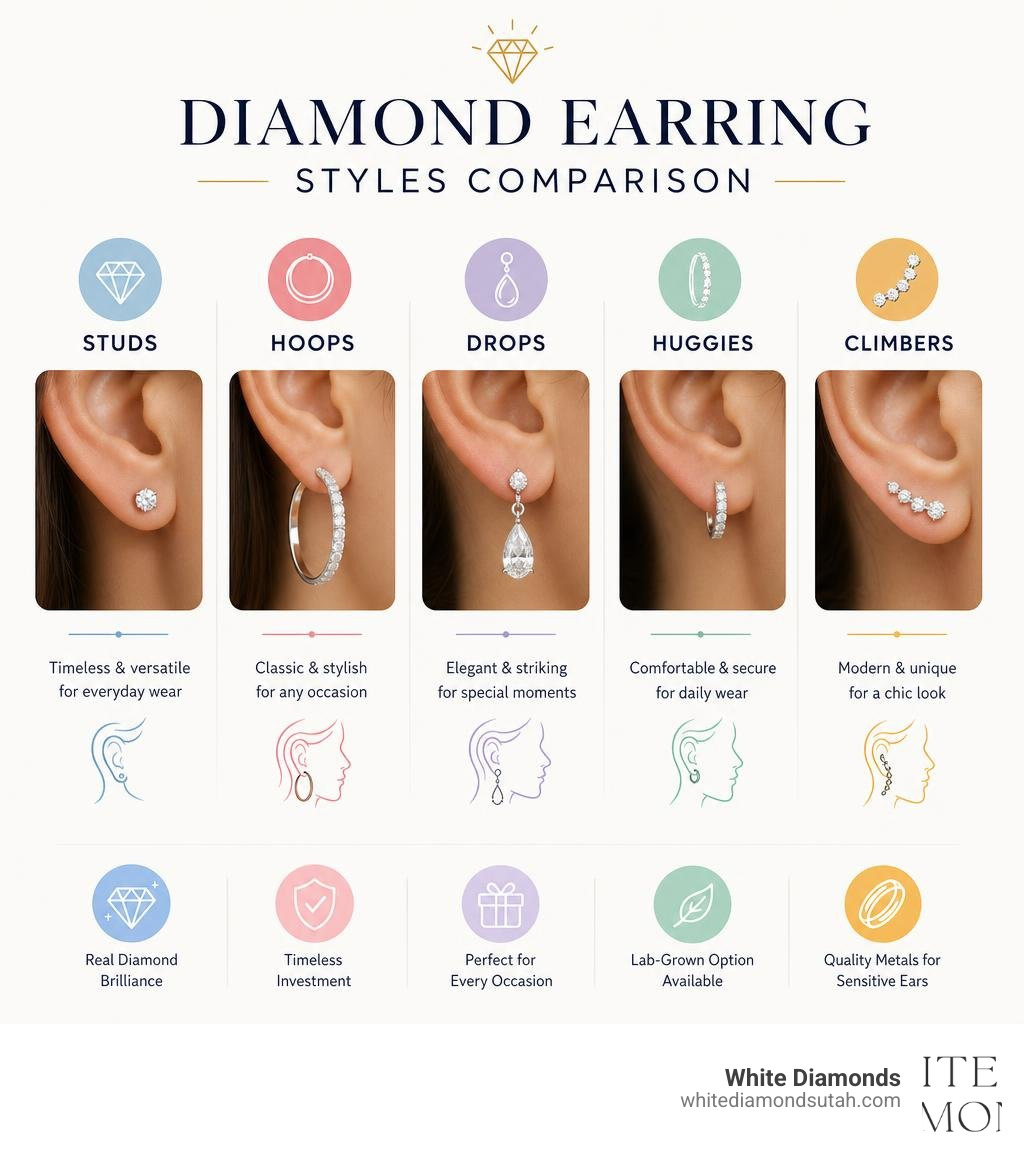
Let's break down the most popular styles of diamond earrings that we design and showcase:
- Stud Earrings: The undisputed king of versatility. Accounting for over 60% of all diamond earring purchases globally, studs feature a single diamond mounted directly on a post. They sit snugly against the earlobe and transition seamlessly from a morning gym session to a black-tie gala. They are the ultimate classic option for any jewelry collection.
- Hoop Earrings: A timeless classic that circles the lobe. Hoops can be delicate and minimalist with pavé-set diamonds along the front, or bold and geometric for a modern look. They offer a beautiful frame for the face and catch the light from every angle.
- Drop and Dangle Earrings: Designed to hang below the earlobe, drop earrings move gracefully with your every turn. They can feature simple single-stone drops or elaborate, multi-tiered chandelier arrangements perfect for milestone celebrations.
- Climber Earrings: A modern, fashion-forward choice. Climbers start at the lobe and "climb" up the curve of the ear cartilage, giving the illusion of multiple piercings with just a single post.
- Huggie Earrings: A petite cousin of the hoop. Huggies literally "hug" the earlobe, offering a secure, low-profile fit that is incredibly comfortable for daily wear and sleeping. They are perfect for layering in second or third lobe piercings.
How Settings Affect Security and Comfort
The setting of your diamond earrings does more than just hold the stone; it defines the piece's style, protects the diamond from damage, and dictates how comfortable the earrings are to wear all day.
- Prong Setting: The most common setting, usually featuring three, four, or six metal claws that hold the diamond. Prongs allow the maximum amount of light to enter and exit the diamond, highlighting its brilliance. However, they can occasionally snag on loose-knit sweaters or hair.
- Bezel Setting: A modern classic. In a bezel setting, a smooth metal collar completely surrounds the perimeter of the diamond. This offers the ultimate protection against chips and snags, making it perfect for active lifestyles. It also makes the diamond appear slightly larger and gives a clean, contemporary edge.
- Halo Setting: A central diamond encircled by a "halo" of smaller accent diamonds. This setting is fantastic for maximizing sparkle and making a smaller center stone look significantly larger and more luxurious without a massive jump in price.
When it comes to keeping your investment safe, the backing mechanism is just as crucial as the setting:
- Push-Backs (Friction Backs): The most common backing. A metal slide slips onto a grooved post. It is quick and convenient but can loosen over years of daily wear.
- Screw-Backs: The post is threaded like a screw, requiring you to spin the backing until it is tight. This is highly secure and a popular choice for larger, high-value studs, though it takes a little longer to put on.
Key Factors to Consider When Buying Diamond Earrings
Buying diamond earrings requires a slightly different approach than buying an engagement ring. Since earrings are viewed from a distance and in motion, you can often make smart compromises on certain quality factors to get a larger look for your budget.
| Diamond Shape | Best Setting Style | Security Level | Visual Impact |
|---|---|---|---|
| Round Brilliant | 4-Prong or Bezel | High | Maximum Sparkle |
| Princess Cut | V-Prong or Bezel | High | Modern & Geometric |
| Emerald Cut | 4-Prong | Medium | Elegant & Vintage |
| Pear Shape | 3-Prong (with V-tip) | Medium-High | Elongating & Unique |
| Oval Cut | 4-Prong | Medium-High | Soft & Brilliant |
Understanding the 4Cs and Metal Types
To get the best value, you need to understand how the 4Cs apply specifically to earrings:
- Cut: This is the most important "C" for any diamond, especially earrings. A diamond with an Excellent or Ideal cut will bounce light beautifully, masking slight imperfections in color or clarity. Always prioritize cut quality over carat weight.
- Color: Because earrings are not viewed side-by-side under magnification like engagement rings, you can comfortably drop down the color scale. While D-F (Colorless) is pristine, G-J (Near Colorless) diamonds look beautifully white in the ear and offer incredible value, especially when set in yellow or rose gold.
- Clarity: Look for "eye-clean" diamonds. You do not need flawless clarity for earrings. Grades like SI1 or SI2 (Slightly Included) are virtually indistinguishable from VS grades to the naked eye when worn, allowing you to save money or redirect your budget toward a larger carat weight.
- Carat Weight: Earring carat weights are usually listed as Total Carat Weight (TCW). This means a 1.00 TCW pair of studs features two 0.50-carat diamonds, not two 1.00-carat diamonds.
For the metal, your choice will influence both the look and hypoallergenic properties of your earrings:
- Platinum: Extremely durable, naturally white, and completely hypoallergenic. It is the gold standard for sensitive ears but is heavier and more expensive.
- 18k and 14k Gold: Available in classic yellow, cool white, and romantic rose. 14k gold is highly durable and excellent for daily wear, while 18k gold offers a richer color but is slightly softer. White gold is typically plated with rhodium to give it a bright white shine, which may need replating every few years.
If you are looking to explore these options in person, visiting a trusted local jeweler is the best way to see how different shapes and settings catch the light and complement your style.
How to Clean and Care for Diamond Earrings
Diamonds are natural grease magnets. Hair products, makeup, sunscreen, and skin oils quickly build up on the stones, blocking light and making your sparkling earrings look dull. Fortunately, keeping them clean at home is incredibly easy.
- The Gentle Soak: Mix a few drops of mild dish soap (like Dawn) with warm water in a small bowl. Let your earrings soak for 20 to 30 minutes.
- The Soft Brush: Use a brand-new, baby-soft toothbrush to gently scrub the diamonds, paying close attention to the back of the setting where dirt accumulates.
- The Rinse and Dry: Rinse thoroughly in warm running water (make sure the sink drain is closed!). Pat dry with a lint-free microfiber cloth.
- Professional Checkups: We recommend bringing your fine jewelry into our Utah showroom once a year. We can professionally steam-clean your earrings and inspect the prongs under a microscope to ensure your diamonds remain safe and secure.
Natural vs. Lab-Grown Diamonds
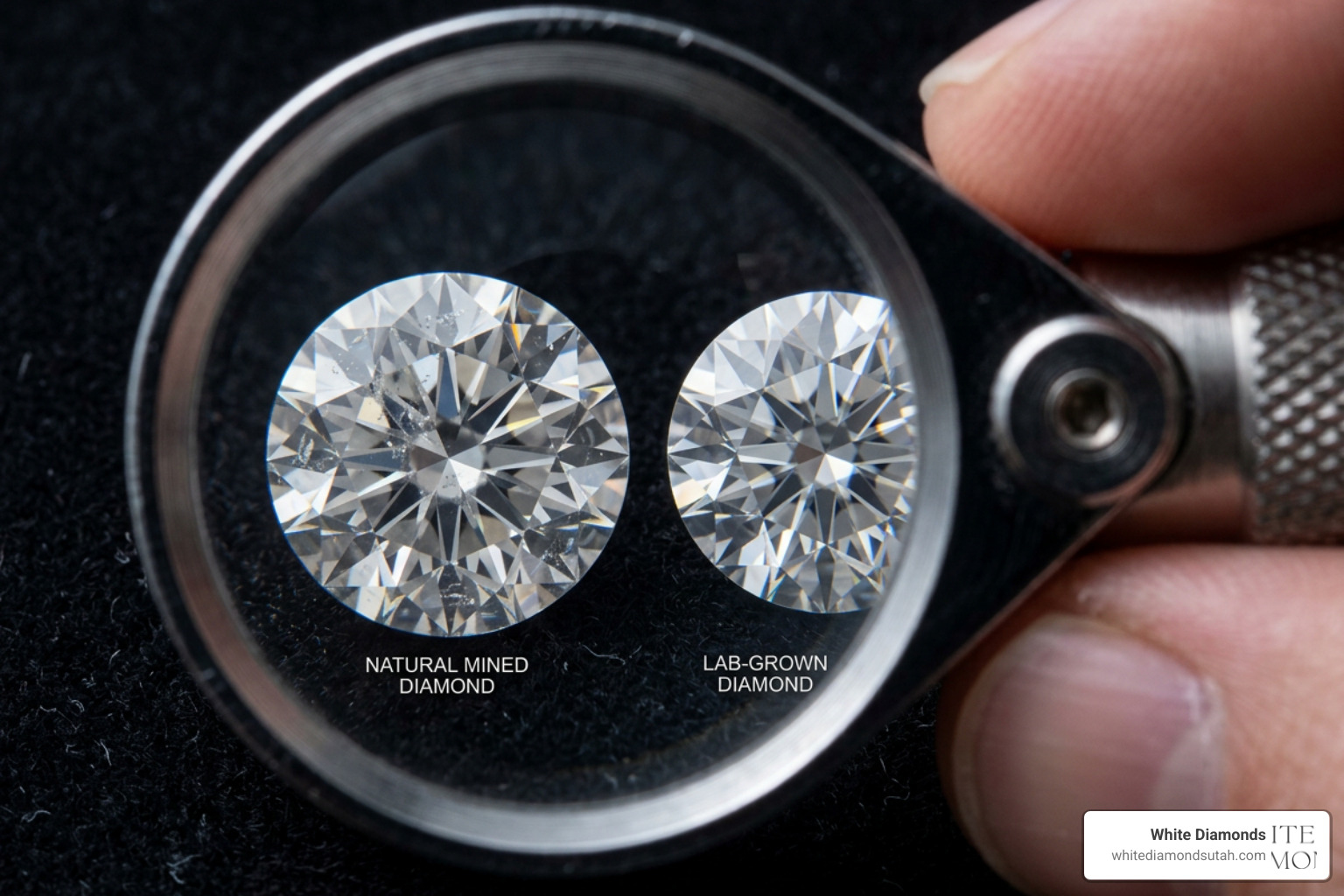
One of the most important decisions you will make when shopping for diamond earrings in 2026 is choosing between natural (mined) diamonds and lab-grown diamonds.
The Modern Choice
First, let's clear up a common misconception: lab-grown diamonds are real diamonds. They are optically, chemically, and physically identical to natural diamonds. They are made of pure carbon and are graded on the exact same 4Cs scale by independent gemological laboratories like the GIA and IGI.
To dive deeper into this topic, you can read our comprehensive guide on lab vs mined diamonds.
- The Price Difference: This is the primary driver of the massive 40% year-over-year increase in lab-grown diamond demand. Because the supply chain is shorter and more efficient, lab-grown diamonds typically cost 70% to 80% less than natural diamonds of the same size and quality. This means you can buy a significantly larger, more brilliant pair of earrings for your budget.
- Ethical Sourcing: Lab-grown diamonds offer a transparent, conflict-free history, making them a popular choice for eco-conscious shoppers.
- Value Retention: Natural diamonds are rare and carry a higher resale and heirloom value over time. If you view your jewelry purchase as a long-term financial store of value, natural diamonds remain the traditional choice. However, if your goal is maximum sparkle and visual impact for your budget, lab-grown diamonds are hard to beat.
Styling, Gifting, and 2026 Trends
Your earrings should feel like an extension of your personality. Whether you are dressing up a casual white tee and jeans or accessorizing for a major career milestone, the right pair of diamond earrings ties your entire look together.
Matching Earrings to Lifestyle and Face Shape
When choosing a style, consider your daily routine and face shape:
- Active Lifestyles: If you love hiking in the beautiful Utah mountains, chasing kids, or hitting the gym, opt for bezel-set studs or low-profile huggies. They won't snag or get caught.
- Round Faces: Elongate your features with drop or dangle earrings. Linear designs draw the eye downward, creating a balanced, elegant look.
- Oval Faces: You can wear almost any style! Studs, hoops, and triangular drops look particularly striking on oval face shapes.
- Square/Heart Faces: Soften strong jawlines or wider foreheads with circular hoops, huggies, or curved climber designs.
If you are looking to coordinate your earrings with other jewelry, check out our gemstone rings complete guide 2026 for expert pairing tips.
Current Trends and Gifting for 2026
As we move through 2026, we are seeing several exciting shifts in earring fashion:
- Geometric Motifs: Hexagons, kites, and sharp-angle princess cuts are taking center stage, offering a sleek, architectural alternative to traditional round brilliant cuts.
- Mixed Metals: Don't be afraid to mix yellow gold huggies with white gold studs. Asymmetrical styling and curated ear stacks are highly popular.
- The Power of Customization: More than ever, clients want jewelry that tells a personal story. Whether it's replicating a vintage family heirloom or designing a completely unique shape, custom jewelry is the ultimate luxury. If you are in the Ogden area, you can easily design your ring ogden or design a custom pair of earrings to match your signature style.
Frequently Asked Questions
How do I choose diamond earrings for sensitive ears?
To avoid painful irritation or allergic reactions, stick to highly pure, hypoallergenic metals. Look for platinum or 14k/18k solid gold (especially yellow gold, which contains fewer nickel alloys than some white golds). Avoid cheap plated metals or mystery alloys that contain nickel, which is the leading cause of metal allergies.
Are diamond earrings a good investment?
Yes, but primarily as an emotional and stylistic investment. While natural diamonds hold value over generations and make incredible family heirlooms, jewelry should be bought first and foremost to be worn and loved. Classic styles like diamond studs or simple hoops never go out of fashion, making them incredibly safe and timeless gifts.
What is the most secure backing for diamond earrings?
For maximum peace of mind, screw-backs or patented locking mechanisms (like La Pousette backs) are the most secure. They require intentional pressure or unscrewing to remove, making it highly unlikely that your earrings will accidentally slip off during a busy day.
Conclusion
Finding the perfect pair of diamond earrings is a journey of celebrating your personal style, marking special milestones, and investing in pieces that will shine for generations.
At White Diamonds, we believe that shopping for jewelry should be an enjoyable, educational, and completely stress-free experience. As a premier customize jewelry store in Utah, we specialize in bringing your unique visions to life. From choosing the perfect lab-grown or natural diamonds to crafting custom-tailored settings in our Ogden showroom, we work within your budget and timeline to create pieces you will cherish forever.
Ready to find or design your dream pair of earrings? Book an Appointment with our expert team today, or visit White Diamonds to explore our collections.