From Quarter to Five Carats What You Should Actually Pay for Diamond Earrings
What You Should Actually Pay for 1 Carat Solitaire Earrings
The 1 carat solitaire earrings price can catch a lot of shoppers off guard — the range is much wider than most people expect.
Here's a quick snapshot so you can orient yourself before diving deeper:
| Diamond Type | Metal | Typical Price Range (1 ct total weight) |
|---|---|---|
| Lab-grown | 14K white gold | $139 – $600 |
| Lab-grown | 14K/18K gold or platinum | $500 – $1,500 |
| Natural | 14K white gold | $1,000 – $3,000 |
| Natural | 18K gold or platinum | $2,500 – $7,000+ |
| Luxury brand | Platinum | $1,450+ (low carat weight) |
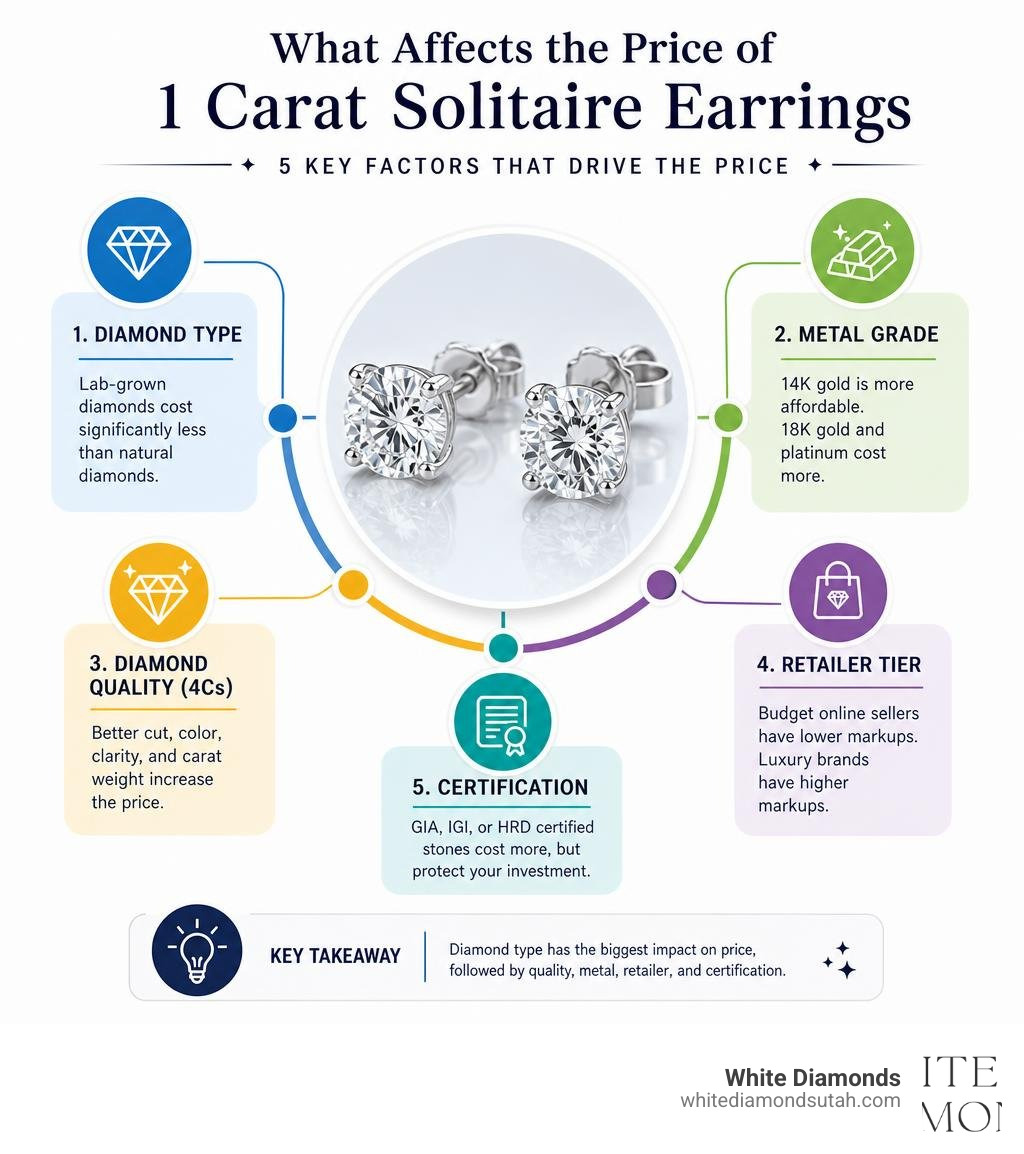
A few things drive that spread:
- Diamond type — lab-grown vs. natural is the single biggest price factor
- The 4Cs — cut, color, clarity, and carat weight
- Metal choice — 14K gold vs. platinum can add hundreds of dollars
- Retailer tier — budget online sellers vs. luxury brands carry very different markups
- Certification — GIA, IGI, or HRD certified stones cost more, but protect your investment
This guide walks through every one of those factors so you know exactly what you're paying for — and what you're not.
At White Diamonds, we specialize in custom jewelry and have helped countless clients navigate the often confusing world of 1 carat solitaire earrings prices without the pressure or guesswork. Whether you're shopping for yourself or someone you love, we're here to make the process simple and personal.
Decoding the 1 Carat Solitaire Earrings Price
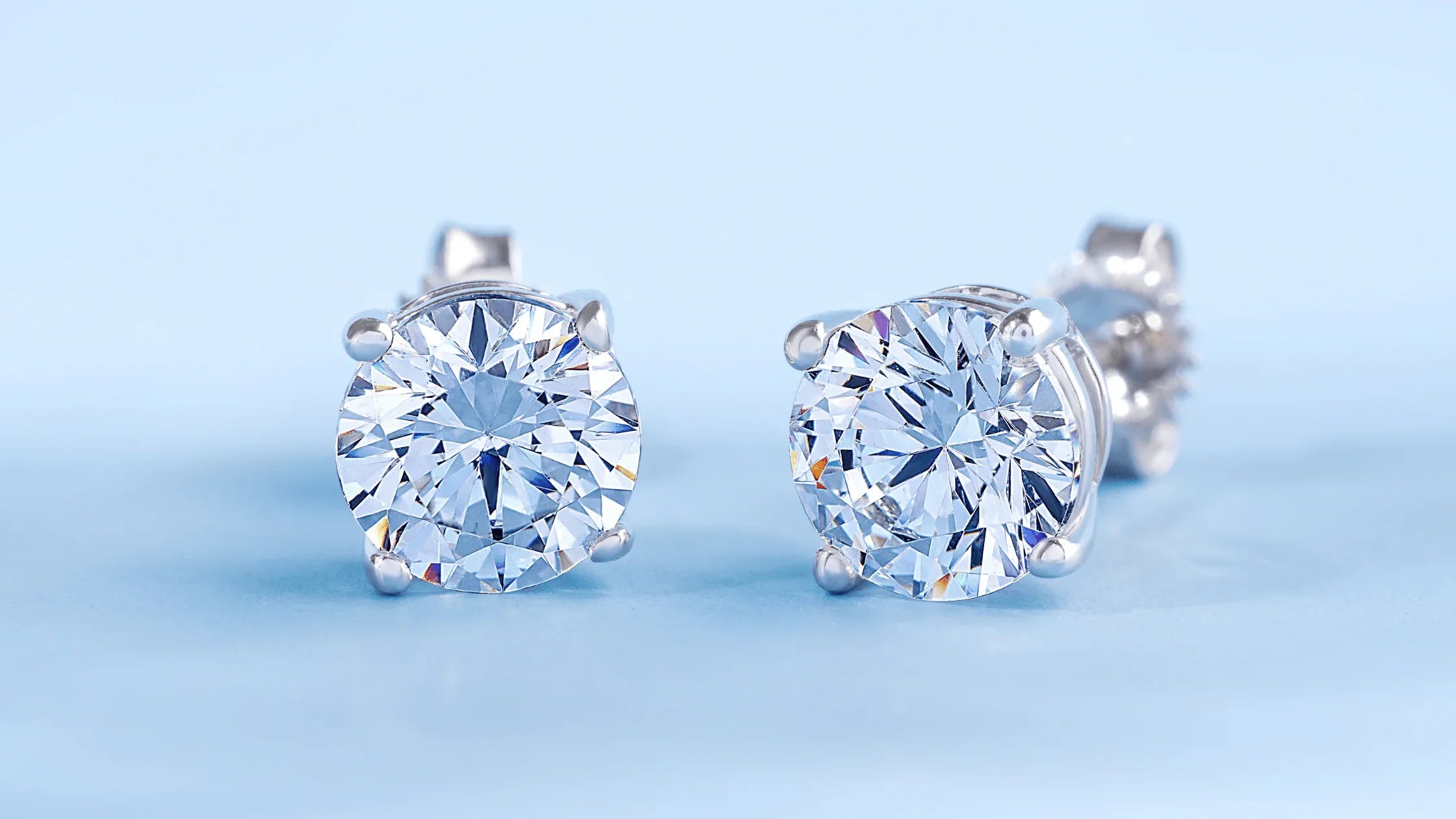
When you start searching for the perfect pair of 1-carat diamond solitaire earrings, you will quickly notice that prices are all over the map. You might see one online listing for $250 and another for $3,500, even though both claim to be "1 carat."
So, what gives? Are the cheaper ones a scam, or are the expensive ones just a massive rip-off?
The truth lies in the details. A "1 carat" label usually refers to the total carat weight (tcw) of the pair, meaning each individual earring features a 0.50-carat stone. The actual cost of these stones varies wildly based on whether they were grown in a lab or mined from the earth, their gemological quality, and the metal holding them in place.
According to industry pricing guides, a pair of natural 1-carat diamond studs can start around $1,000 for lower-grade cuts and colors, but easily scale up to $4,000 or more for premium, near-flawless stones. On the other hand, lab-grown alternatives have made gorgeous, high-quality sparkle incredibly accessible, with entry-level prices starting as low as $139 for budget-friendly configurations and topping out around $2,500 for top-tier designs in premium metals.
For example, popular online catalogs list solitaire stud earrings starting around $678 for smaller, entry-level designs, reaching up to $2,507 for premium 1-carat natural diamond options. This demonstrates how much flexibility you have when balancing your budget against your desired diamond quality.
Natural vs. Lab-Grown: The Ultimate Cost Comparison
If you want to get the most sparkle for your dollar, understanding the difference between natural and lab-grown diamonds is your golden ticket.

Let’s clear up the biggest misconception first: lab-grown diamonds are real diamonds. They aren't fake, they aren't cubic zirconia, and they aren't moissanite. Chemically, physically, and optically, they are identical to earth-mined diamonds.
To understand how they are made, think of a home ice maker versus a natural glacier. Both produce real ice, but one uses modern technology to speed up the process in a controlled environment, while the other takes time and natural elements. Because growing a diamond in a laboratory takes weeks rather than billions of years under the earth's crust, the supply chain is much more efficient. This efficiency translates directly into massive savings for you.
When comparing How lab diamond stud earrings compare to natural diamonds, the price difference is staggering. A high-quality, 1-carat total weight natural diamond stud pair will easily run you $2,000 to $3,500. For that exact same budget, you could buy a massive, ultra-premium 2-carat or even 3-carat pair of lab-grown studs with flawless cut and color. If you stick to a 1-carat total weight in lab-grown, you can expect to pay anywhere from $250 to $800, depending on the metal and setting.
To help you weigh your options, check out this breakdown of the pros and cons:
Natural Diamonds
- Pros: Hold some historical resale value; carry a sense of traditional prestige and rarity.
- Cons: Significantly more expensive (often 3 to 4 times the price of lab-grown); smaller stone size for the same budget.
- Price Range (1 tcw): $1,000 – $4,000+
Lab-Grown Diamonds
- Pros: Incredible value; allows you to buy larger, higher-quality stones; conflict-free and highly sustainable; identical sparkle.
- Cons: Very little long-term resale value as manufacturing technology continues to improve.
- Price Range (1 tcw): $139 – $1,500
The choice comes down to what you value most. If you view your jewelry as a traditional heirloom that must be earth-mined, natural is the way to go. But if your goal is maximum visual beauty, brilliance, and value for your hard-earned money, lab-grown diamonds are an unbeatable option. You can read more about this in our deep-dive on Lab vs mined diamonds to find the perfect fit for your lifestyle.
Key Factors That Influence Diamond Stud Pricing
When evaluating the 1 carat solitaire earrings price, it helps to look at the purchase as an equation. The final number on the price tag is the sum of several distinct parts: the 4Cs of the diamonds, the metal used for the settings, and the markup of the seller.
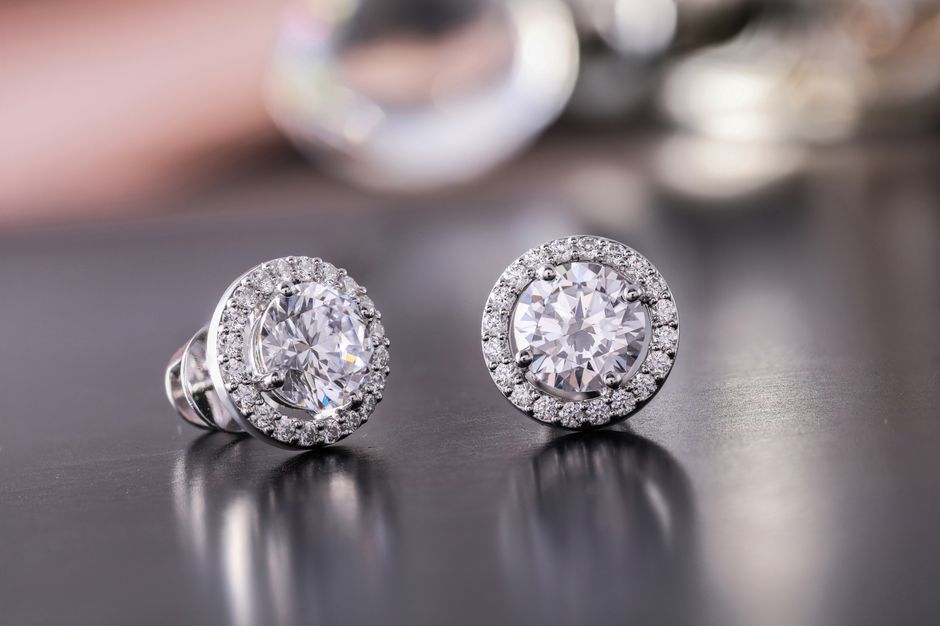
Before you buy, make sure you understand how the classic 4Cs impact your bottom line:
- Cut: This is the most important "C" because it directly determines how much the diamond sparkles. A poorly cut diamond will look dull and lifeless, no matter how big or clean it is. Always prioritize an "Excellent" or "Very Good" cut grade.
- Color: Diamond color is graded from D (completely colorless) to Z (noticeably yellow). For solitaire earrings, you don’t need to pay a premium for a D-grade stone. Because earrings are viewed from a distance and catch the light constantly, stones in the G-H-I range will look bright white to the naked eye while saving you hundreds of dollars.
- Clarity: This measures the internal imperfections (inclusions) of the stone. While a flawless diamond is incredibly rare and expensive, "eye-clean" diamonds (usually graded VS2 or SI1) have tiny inclusions that are completely invisible without a jeweler's loupe. Since no one will be looking at your earlobes with a magnifying glass, choosing a VS2 or SI1 stone is a brilliant way to cut costs without sacrificing beauty.
- Carat Weight: Carat is a measure of weight, not physical size. Two diamonds with the exact same carat weight can look slightly different in size depending on how they are cut.
For a complete breakdown of how to balance these factors to get the absolute best deal, check out our comprehensive Diamond earrings buying guide 2026.
How Metal Choice and Settings Impact the 1 Carat Solitaire Earrings Price
The metal holding your diamonds does more than just keep them secure — it also plays a major role in the overall cost and style of your earrings.
The most common metal options include:
- 14K Gold (White, Yellow, or Rose): The industry standard for fine jewelry. It is highly durable, beautiful, and budget-friendly. White gold is particularly popular for diamonds because it complements their colorless sparkle.
- 18K Gold: Contains a higher percentage of pure gold, making it richer in color and heavier on the ear. However, it is softer than 14K gold and costs more.
- Platinum: The most luxurious option. Platinum is naturally hypoallergenic, incredibly durable, and has a heavy, premium feel. Because it is denser and more difficult to work with, platinum settings will easily add $300 to $600 to the price of your earrings.
- Palladium-Alloy White Gold: Some premium jewelers use palladium instead of nickel to alloy white gold. This eliminates the risk of allergic reactions (perfect for sensitive ears) and keeps its bright white color longer without needing frequent rhodium replating.
The setting style also influences the price and look. A classic four-prong setting allows maximum light to enter the diamond, maximizing its fire and brilliance. A six-prong setting offers extra security and can make round diamonds look even rounder and larger. If you prefer a modern, sleek look, a bezel setting wraps the diamond in a thin collar of metal, protecting the edges of the stone and making it appear slightly larger, though it may slightly reduce light entry.
How Retailer Tiers Affect the 1 Carat Solitaire Earrings Price
Where you buy your earrings is just as important as what you buy. Retailers generally fall into three tiers, each with its own pricing structure:
- Mass-Market & Big-Box Retailers: Large national chains offer convenient shopping and frequent sales. For example, mass-market lab-grown 1-carat total weight solitaire studs typically range from $239.99 to $2,499, depending on the quality and metal. While accessible, these retailers often sell pre-packaged jewelry with middle-of-the-road cut grades.
- High-End Luxury Brands: If you walk into a luxury designer boutique, you are paying for the famous box and the heritage brand name. A pair of platinum solitaire studs with a very small carat weight (such as 0.22 tcw) can cost $1,450, while a full 1-carat pair can climb well past $5,000.
- Online-Only Diamond Warehouses: Large online-only platforms offer massive inventories and low markups. While you can find great deals here, buying a diamond sight-unseen online can be risky, as grading reports don't always capture how a stone actually behaves in the light.
This is why working with a trusted local jeweler is often the best path. At White Diamonds in Ogden, UT, we bridge the gap. We provide the competitive, transparent pricing of online warehouses, but combine it with a personalized, pressure-free consultation. We use model rings and physical stones you can see and feel, ensuring you get the exact quality you want within your real-world budget.
Price Breakdown by Carat Weight: From Quarter to Five Carats
If you are trying to decide if 1 carat is the right size for you, it helps to see how prices scale as you move up and down the carat ladder.
Diamond pricing is not linear; it is exponential. A 2-carat diamond does not cost twice as much as a 1-carat diamond — it can cost three to four times as much. This is because larger raw diamond crystals are much rarer in nature, making their price skyrocket as they grow.
To help you visualize the pricing landscape for natural diamond studs, here is what you can typically expect to pay across different sizes:
- 0.25 Carat Total Weight (0.12 ct each): $200 – $500. Perfect for second ear piercings, children, or ultra-minimalist daily wear.
- 0.50 Carat Total Weight (0.25 ct each): $500 – $1,200. A beautiful, subtle sparkle that is comfortable for everyday wear without drawing too much attention.
- 1.00 Carat Total Weight (0.50 ct each): $1,000 – $3,000. The absolute "sweet spot" for diamond studs. They are large enough to be noticed from across a room but lightweight enough for daily wear.
- 2.00 Carat Total Weight (1.00 ct each): $4,000 – $10,000+. A serious statement piece. These have incredible presence and catch the light beautifully.
- 5.00 Carat Total Weight (2.50 ct each): $30,000 – $80,000+. Ultra-luxury territory. These are red-carpet-worthy showstoppers that require incredibly strong, secure platinum settings.
If you are still unsure which size will look best on your earlobe, take a look at our guide on What diamond carat size is right for you for visual comparisons and styling tips.
Frequently Asked Questions About Diamond Studs
What is the difference between total carat weight (tcw) and single-stone carat weight?
This is the most common point of confusion for jewelry shoppers. Total Carat Weight (tcw) represents the combined weight of all the diamonds in the piece of jewelry.
When you buy a pair of "1 carat diamond solitaire earrings," you are almost always buying a pair with a 1.00 tcw, meaning each individual earring contains a 0.50-carat diamond. If you want each ear to have a full 1-carat diamond, you need to search for "2.00 carat total weight" earrings.
Because two 0.50-carat diamonds are much easier to find than a single 1.00-carat diamond, a 1.00 tcw pair of earrings is significantly less expensive than a single 1-carat diamond ring. To browse different weight options and see how they look in classic settings, it is best to consult with a custom jeweler who can show you various carat weights side-by-side.
Are there hidden costs when buying diamond solitaire earrings?
The price on the tag isn't always the final price you will pay. When budgeting for your diamond studs, make sure to account for these additional factors:
- Sales Tax: Depending on where you live, sales tax can add a decent chunk to a multi-thousand-dollar purchase.
- Shipping & Insurance: If you are buying online, ensure the package is shipped via fully insured, signature-required delivery.
- Appraisal Fees: If you buy natural diamonds, you will want to get them appraised by an independent gemologist so you can add them to your homeowners or renters insurance policy.
- Maintenance Costs: To keep your diamonds sparkling, they should be professionally cleaned and have their prongs checked at least once a year. Fortunately, at White Diamonds, we offer complimentary cleaning and inspection services to keep your jewelry in pristine condition.
Which diamond shape offers the best value for solitaire studs?
While the classic round brilliant is the most popular diamond cut, it is also the most expensive. This is because cutting a round diamond wastes a significant portion of the rough stone during the manufacturing process.
If you want to stretch your budget, consider "fancy shapes" like the princess cut (square), oval, or emerald cut. These shapes preserve more of the original rough diamond, making them roughly 10% to 30% cheaper than round diamonds of the exact same carat weight and quality. Additionally, elongated shapes like ovals can make the diamond appear larger on the earlobe than a round diamond of the same weight. You can learn more about how these cuts differ in GIA's guide on fancy shape diamonds.
Conclusion
Finding the perfect pair of diamond earrings doesn't have to be an overwhelming or stressful experience. Whether you choose the incredible value of lab-grown diamonds or the traditional heritage of natural stones, the key is knowing which factors to prioritize so you get the most beauty for your budget.
At White Diamonds in Ogden, Utah, we believe in a different kind of jewelry shopping. We offer personalized, pressure-free consultations where you can sit down with us, explore model rings and loose stones, and design a custom pair of earrings that fits your style, timeline, and budget perfectly.
Ready to find your perfect pair of studs? Check out our Diamond earrings buying guide 2026 to learn more, or schedule a visit to our Ogden showroom today. Let's create something beautiful together!