Old-School Romance: How to Choose Antique Victorian Vintage Engagement Rings
What Makes Antique Victorian Vintage Engagement Rings So Special
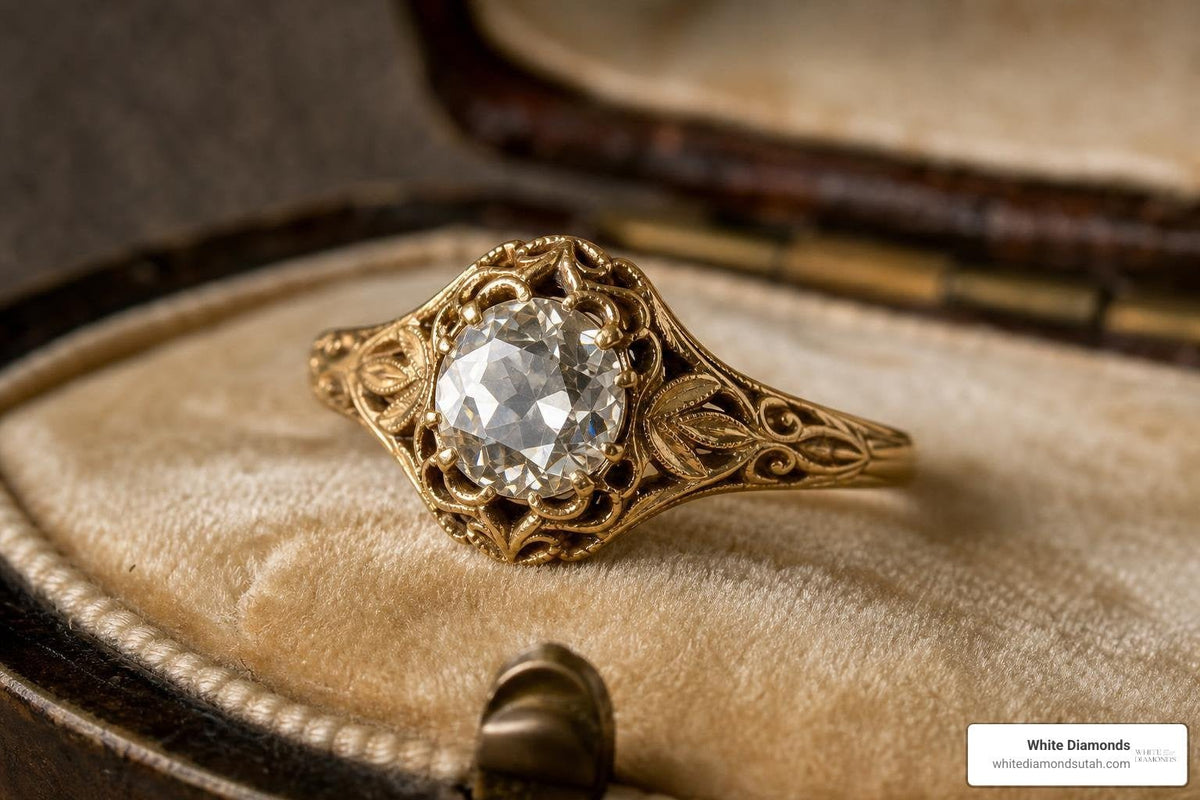
Antique Victorian vintage engagement rings are one-of-a-kind pieces crafted between 1837 and 1901, known for their romantic designs, warm gold tones, and hand-cut diamonds. Here is a quick look at what sets them apart:
- Era: Victorian period, 1837-1901
- Signature diamond cut: Old European cut — round shape, high crown, small table, flat culet
- Common metals: Yellow gold and rosy yellow gold (10k, 14k)
- Typical accent stones: Seed pearls, colored gemstones
- Design themes: Flowers, nature, organic motifs
- Key buying tip: Always look for independent lab certification (such as GIA) to confirm the diamond's authenticity and quality
These rings carry more than just history — they carry meaning. Each detail, from the warm glow of rosy gold to the soft shimmer of seed pearls, was chosen with intention.
Today, many couples are drawn to antique rings because they feel personal and timeless in a way that modern mass-produced rings often don't. But shopping for one can feel overwhelming, especially when evaluating condition, authenticity, and true value.
At White Diamonds, we are personal jewelers with hands-on experience crafting custom rings and wedding bands, and we work closely with clients who love the character of antique Victorian vintage engagement rings. Whether you are considering buying one or want a custom ring inspired by Victorian style, we are here to help you make a confident, informed choice.
The History and Anatomy of Antique Victorian Vintage Engagement Rings
To truly appreciate antique Victorian vintage engagement rings, we have to take a quick trip back to the 19th century. The Victorian era, which spanned Queen Victoria’s reign from 1837 to 1901, was a time of deep sentimentality. Jewelry wasn't just a status symbol; it was a love letter written in metal and stone.
Because Queen Victoria was deeply in love with her husband, Prince Albert, her personal tastes dictated the fashion of the entire Western world. When Albert proposed with a serpent ring featuring an emerald-set head (representing eternal love), it sparked a massive jewelry revolution.
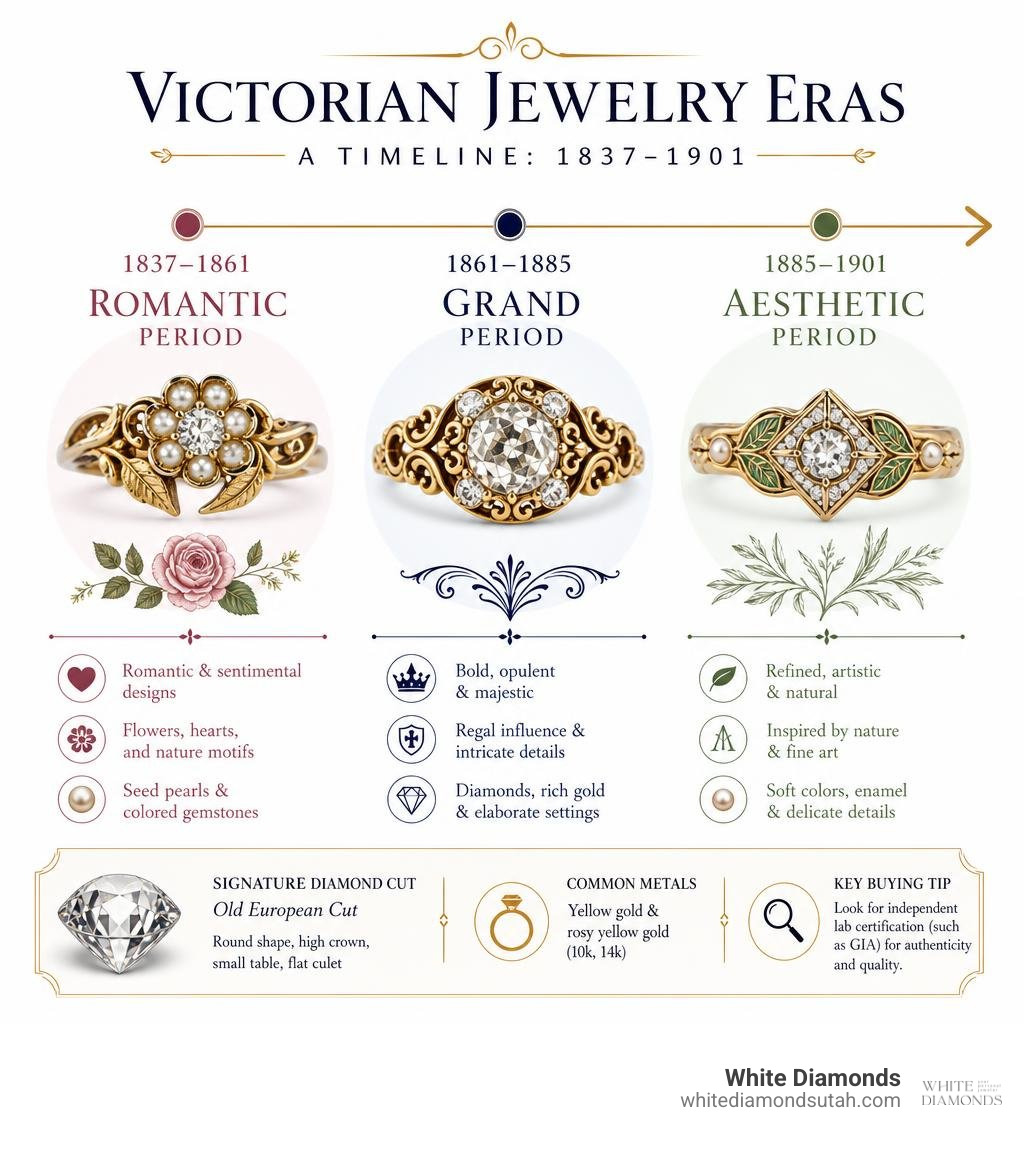
Throughout this sixty-four-year period, design characteristics shifted dramatically across three distinct sub-eras:
- The Romantic Period (1837–1860): Marked by a love for nature, floral motifs, snakes, hands, and highly intricate gold work.
- The Grand Period (1861–1885): Following Prince Albert’s death, jewelry took a somber, bolder turn, featuring dark stones, heavy yellow gold, and majestic, structural designs.
- The Aesthetic Period (1885–1901): A return to lighter, more delicate styles. As women entered the workforce and took up outdoor activities, jewelry became smaller, more practical, and highly feminine.
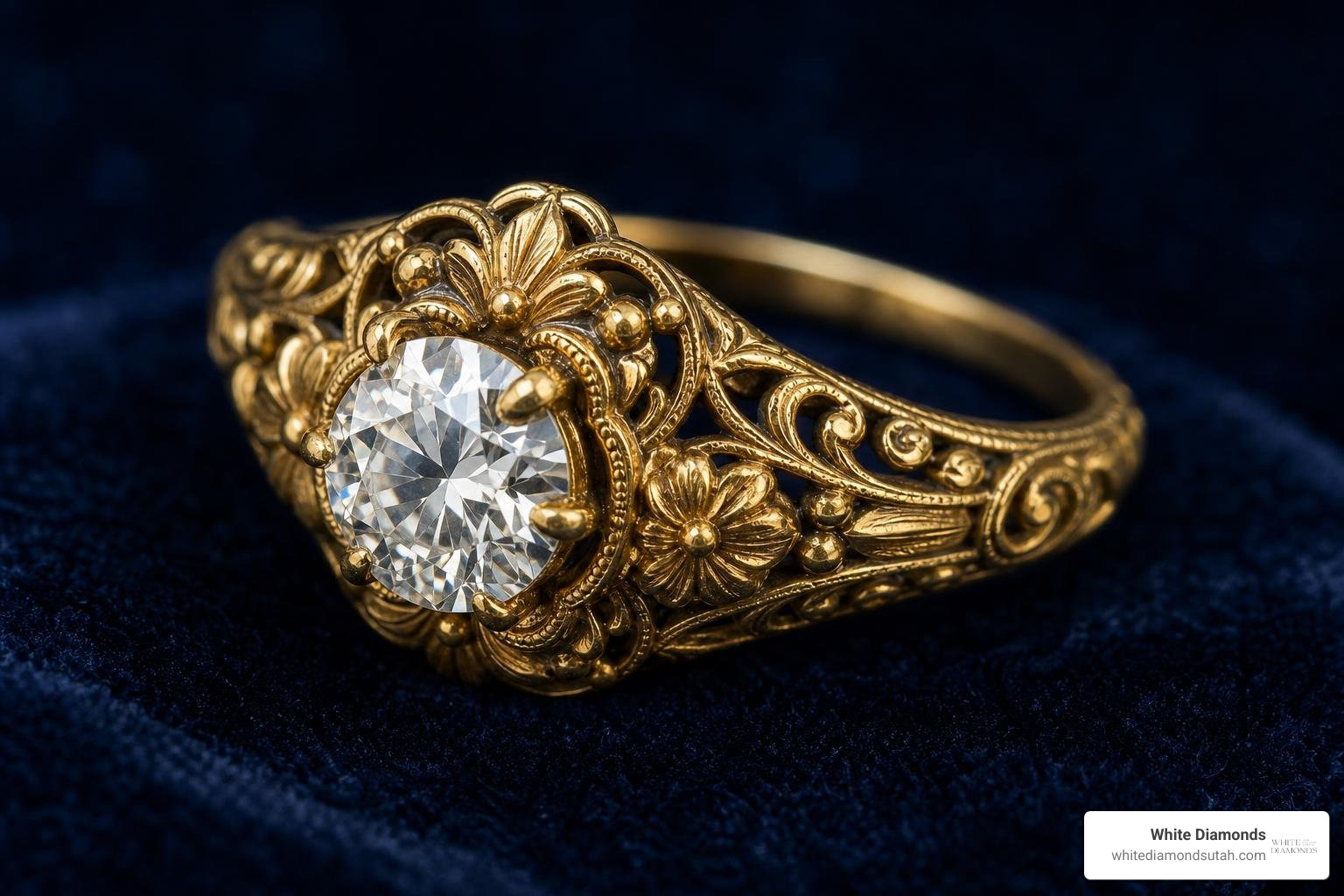
When we look at the anatomy of a Victorian ring, the craftsmanship is immediately obvious. Jewelers of this era didn't have the high-powered lasers or computer-aided design (CAD) software that we use today in our Custom Ring Design Process. Instead, they relied on hand-carving, hand-alloying metals, and setting stones by candlelight.
This hand-made nature means that no two Victorian rings are identical. If you are trying to figure out How to Choose a Diamond Ring Setting, understanding the history of these settings is a great place to start. Victorian settings often featured buttercup prongs, belcher settings, or detailed gallery scrollwork that elevated the diamond, allowing light to enter from different angles. You can learn more about how these historical styles compare to modern options in our guide on Diamond Setting Style.
Why the Old European Cut Defines Antique Victorian Vintage Engagement Rings
If you have ever looked at a modern diamond and felt it was almost too bright or sterile, the Old European cut might be exactly what your soul is craving.
Before the advent of modern diamond-cutting machinery in the early 20th century, diamonds were cut entirely by eye. The Old European cut (often abbreviated as OEC) was the reigning champion of the Victorian era. It is the direct ancestor of the modern round brilliant cut, but it behaves very differently under light.
An Old European cut diamond is characterized by:
- A high crown: The top portion of the diamond sits taller than modern cuts.
- A small table: The flat facet at the very top of the stone is noticeably smaller.
- A flat, polished culet: The bottom point of the diamond is cut flat, which looks like a tiny, charming circle when viewed straight down through the table.
- Thicker facets: These hand-carved facets produce broad flashes of light—often called a "checkerboard" or "inner fire" pattern—rather than the tight, splintery sparkle of a modern round brilliant.
To help you visualize the difference, let’s compare the Old European cut to its modern successor:
| Feature | Old European Cut (OEC) | Modern Round Brilliant |
|---|---|---|
| Creation Era | 1800s to early 1900s | mid-1900s to Present |
| Cutting Method | Hand-cut by master artisans | Laser-cut with computer precision |
| Crown Height | Very high | Medium to low |
| Table Size | Small (usually under 53%) | Large (usually 54% to 60%) |
| Culet | Flat, open, and visible | Pointed (none or very small) |
| Light Play | Warm, broad, romantic flashes | Intense, white-hot sparkle |
While modern round brilliants are engineered to maximize white light return, Old European cuts were designed to glow beautifully under candlelight. This gives them an incredibly romantic, soft personality.
If you love the soft shape of the OEC but want to explore other historical cuts, you might also enjoy reading about What is a Cushion Cut Diamond or comparing it to geometric options like What is a Radiant Cut Diamond.
Materials and Gemstones in Antique Victorian Vintage Engagement Rings
Victorian jewelers worked with a unique palette of materials that set their work apart from any other era.
First, let's talk about the gold. In Victorian jewelry, you will frequently find 10k rosy yellow gold. Why 10k? Because 10k gold contains 41.7% pure gold mixed with copper and silver, making it incredibly durable and resistant to scratching. The higher copper content gives the gold a beautiful, warm, rosy-yellow hue that modern yellow gold simply cannot replicate. It sits in that perfect sweet spot between classic yellow gold and modern pink rose gold.
Second, Victorian design loved to incorporate organic elements. Natural cultured seed pearls were incredibly popular, often paired directly alongside diamonds.
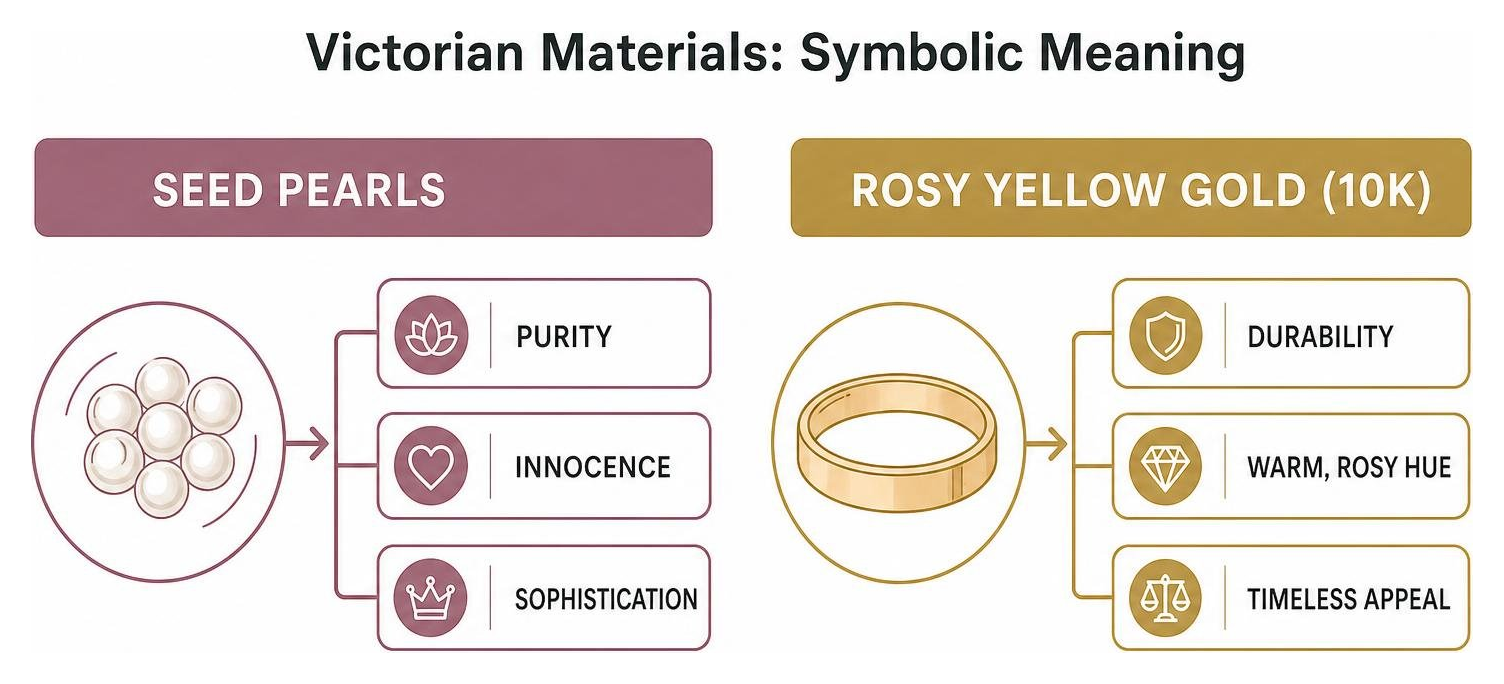
In Victorian times, seed pearls weren't just decorative; they symbolized purity, innocence, and sophistication. Combining the soft, iridescent luster of seed pearls with the deep, fiery flash of an Old European cut diamond created a striking contrast that remains breathtaking today.
If you are looking for something that breaks the mold of traditional modern jewelry, exploring these antique combinations is highly rewarding. For those who want a truly unique look, you might also want to look into What is a Salt and Pepper Diamond or read about The Rise of Salt and Pepper Diamonds a Unique Engagement Trend to see how alternative stones are trending in 2026.
Case Study: Evaluating a GIA-Certified 0.47ct Victorian Ring
To understand how to evaluate these rings in the real world, let's analyze an actual historical piece: an Antique Victorian 10k Gold Gia 0.47ct Old European Diamond Engagement Ring Auction specimen.
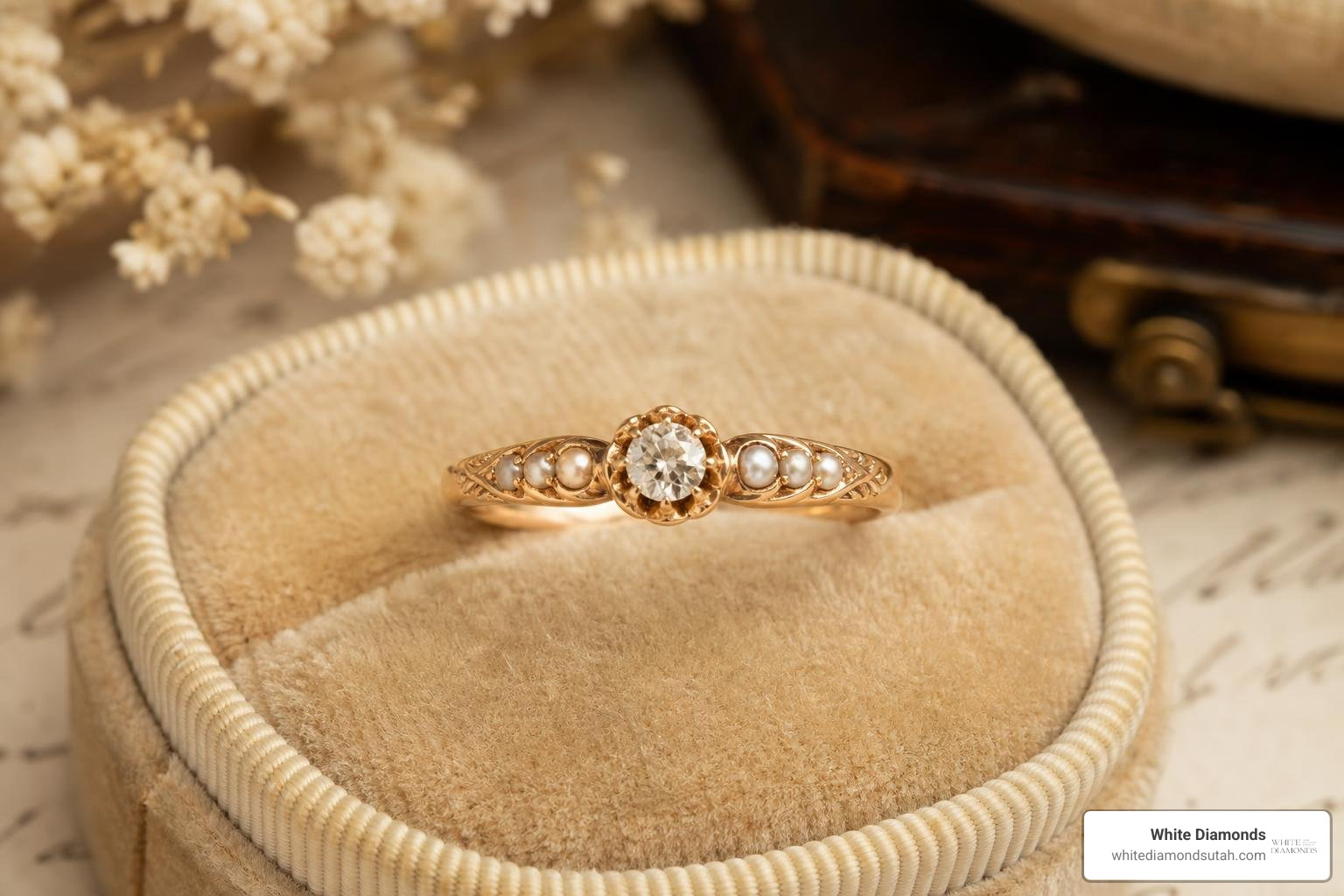
This specific ring serves as a textbook example of late-Victorian design. Weighing in at a delicate 1.51 grams, it is crafted from 10k rosy yellow gold and centers around a GIA-certified 0.47-carat Old European cut diamond, flanked by two natural cultured seed pearls.
By analyzing this ring's specifications, we can learn how to assess the value, quality, and wearability of any antique ring you might encounter.
Diamond Quality, Color, and Clarity Analysis
When evaluating an antique diamond, you must throw out the modern rulebook. Today, many buyers chase "colorless" grades (D-F) and expect flawless clarity. However, antique diamonds tell a different story.
In our case study ring, the center diamond has the following GIA specifications:
- Carat Weight: 0.47 carat
- Color Grade: K (Faint Warmth)
- Clarity Grade: VS1 (Very Slightly Included)
In a modern round brilliant cut, a "K" color grade might sometimes show a slightly yellow tint that buyers try to avoid. However, in an Old European cut diamond, a warmer color grade like K, L, or M is actually highly desirable!
Because these stones were cut to showcase warmth and character, the faint yellow-champagne undertone of a K-color diamond beautifully complements the warm tones of 10k rosy yellow gold.
Furthermore, the VS1 clarity is exceptionally high for an antique stone. Because Victorian diamonds were mined and cut before modern sorting technologies, finding a stone with very few microscopic inclusions (VS1) is a rare treat. It ensures that the diamond is completely eye-clean and retains its maximum brilliance.
For a deeper dive into how diamond carat weight and grading affect pricing, check out our Ultimate 1 Ct Diamond Engagement Ring Guide.
Understanding Band Dimensions and Wearability
Before falling head over heels for an antique ring, you must look at its physical dimensions. Our case study ring has the following measurements:
- Ring Size: 5
- Band Width: 1.9 mm
- Ring Height (Rise): 4.3 mm
A 1.9mm band width is beautifully delicate, which is very typical of the Aesthetic Period of the late Victorian era. A ring height of 4.3mm means the diamond sits relatively low to the finger, making it highly practical for daily wear without snagging on sweaters or pockets.
However, a ring size of 5 is quite small. This brings us to a crucial point: resizing risks.
Resizing an antique ring is not always a straightforward task. Because 10k rosy yellow gold has a specific copper-to-gold ratio, a modern jeweler must match the alloy perfectly, or you will see a visible "solder seam" where the ring was resized. Furthermore, if the ring features delicate accent stones like seed pearls, the heat from a jeweler's torch can easily damage them.
When you purchase an antique ring, we always recommend consulting with an experienced bench jeweler first to ensure it can safely be sized to fit your hand.
Navigating Auctions and Verifying Authenticity Online
Purchasing antique Victorian vintage engagement rings online can feel a bit like the Wild West. With so many reproductions floating around, how do you make sure you are getting the real deal?
The absolute gold standard of verification is an independent laboratory report, specifically from the Gemological Institute of America (GIA).
In our case study ring, the diamond is accompanied by GIA certification number 6227722791. A GIA report doesn't just verify the carat weight, color, and clarity; it officially identifies the cut style as an "Old European." This is your ultimate insurance policy. It proves that the diamond is a genuine antique cut and not a modern imitation.
If you are just starting your search, we highly recommend reading our Engagement Ring Shopping Guide 2026 to familiarize yourself with the process of verifying fine jewelry.
Best Practices for Bidding on LiveAuctioneers
Online auction platforms like LiveAuctioneers are treasure troves for finding authentic antique jewelry, including pieces like our featured Antique Victorian 10k Gold Gia 0.47ct Old European Diamond Engagement Ring Auction. However, bidding at auction requires a disciplined strategy.
Here is a simple framework to keep you safe and successful when bidding on antique jewelry online:
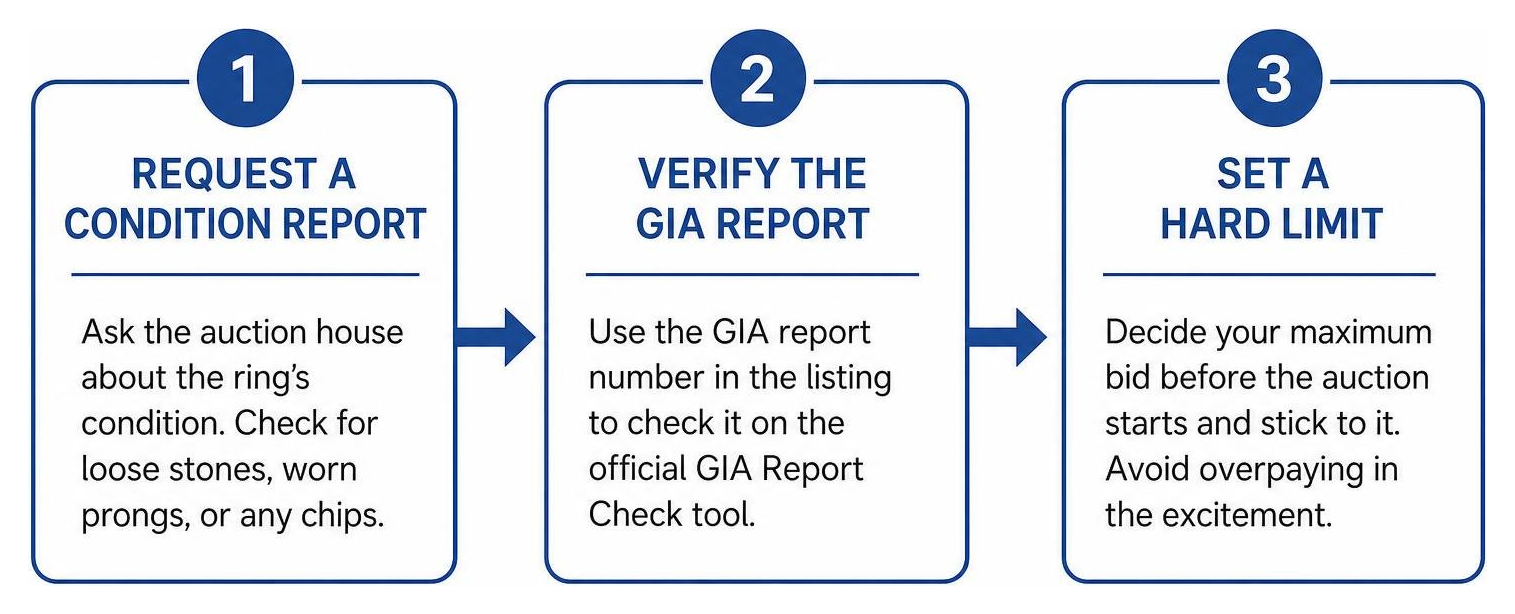
- Request a Condition Report: Never rely solely on the auction photos. Email the auction house and ask: Are any of the seed pearls loose? Is there any wear to the gold prongs? Has the diamond been chipped?
- Verify the GIA Report: Take the GIA number provided in the listing and run it through the official GIA Report Check tool online to ensure the paperwork matches the stone.
- Set a Hard Limit: Decide on your maximum bid before the auction starts. It is incredibly easy to get swept up in the excitement of live bidding and overpay.
Calculating the True Cost of Auction Purchases
When you bid on an auction item, the hammer price is not the final price you will pay. You must account for additional fees that can quickly add up.
Let's look at the math for our case study ring, which has an estimated value range of $1,872 to $2,433 and a starting bid of $1,425:
- Hammer Price: Let’s assume you win the ring at the starting bid of $1,425.
- Buyer’s Premium: Auction houses charge a fee for processing the sale, typically ranging from 20% to 25%. At 25%, this adds $356.25.
- Shipping & Insurance: High-value jewelry requires secure, insured shipping. This usually costs between $50 and $100.
- Taxes: Local state taxes will be applied based on your delivery address.
In this scenario, a winning bid of $1,425 actually translates to a total out-of-pocket cost of around $1,850 to $1,900. Fortunately, this still falls beautifully within the estimated market value of $1,872 to $2,433, making it a very fair deal—but you must always calculate these extra costs beforehand so you aren't surprised by the final invoice!
Frequently Asked Questions about Victorian Rings
What are the characteristics of a Victorian-era engagement ring?
Victorian-era rings (1837-1901) are characterized by nature-inspired designs, including floral, leaf, and snake motifs. They frequently feature warm metal purities like 10k or 14k rosy yellow gold, hand-cut diamonds (such as Old European or cushion cuts), and delicate organic accent stones like natural seed pearls or colorful gemstones.
What is an Old European cut diamond?
An Old European cut diamond is a historical hand-cut diamond style popular from the 1800s through the early 1900s. It features a round shape, a high crown, a small table, and a flat, polished culet. Unlike modern diamonds, which have sharp, splintered sparkle, the Old European cut is known for its warm, broad flashes of light.
Are seed pearls durable enough for an engagement ring?
Seed pearls are organic gemstones, meaning they are much softer than diamonds. They are sensitive to water, acids, perfumes, and household chemicals. While they add incredible antique charm, a ring with seed pearls requires extra care and should not be worn while washing dishes, swimming, or doing heavy hands-on work.
Conclusion
There is an undeniable magic to antique Victorian vintage engagement rings. They are romantic, rich in history, and completely unique. However, buying an antique ring online requires careful research, GIA verification, and a clear understanding of restoration and resizing risks.
If you love the Victorian aesthetic but are worried about the fragility of a 130-year-old ring, there is another wonderful path: custom design.
At White Diamonds, we can help you design a brand-new, highly durable ring that captures the exact soul, warmth, and romantic detailing of the Victorian era. Whether you want to source a genuine antique Old European cut diamond and set it into a modern, secure mounting, or design a vintage-style ring from scratch, we offer personalized, pressure-free consultations at our Ogden, UT jewelry store.
To explore what style fits your love story best, take a look at the Top 5 Engagement Ring Styles Trending in Utah This Year, or learn more about our Bespoke Jewellery Design services.
Ready to start your journey? Book a Custom Ring Consultation Free with us today, and let's bring your dream ring to life!