How to Choose the Perfect 1 Carat Princess Cut Earrings Without Losing Your Crown
Why 1 Carat Princess Cut Earrings Make a Brilliant Statement
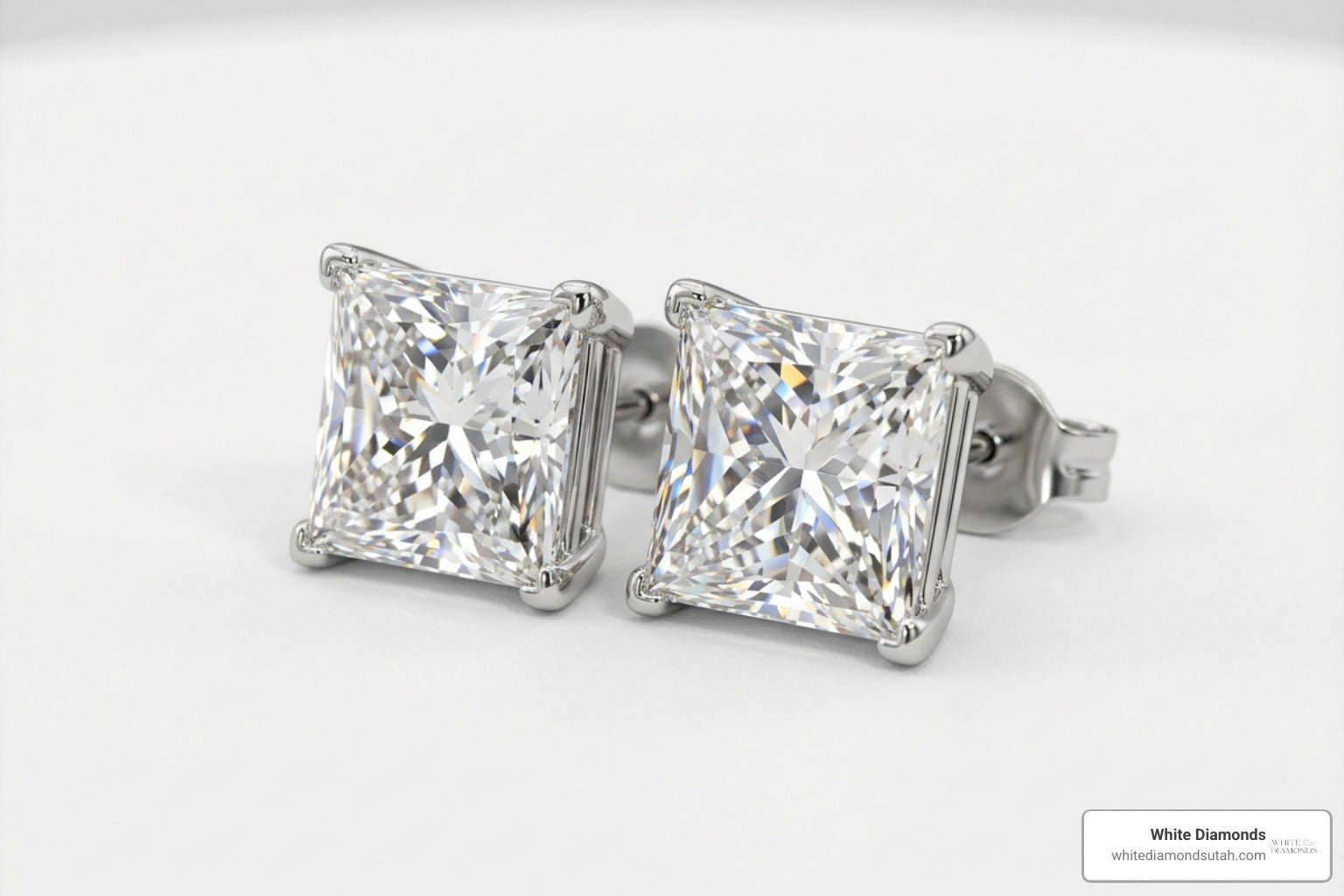
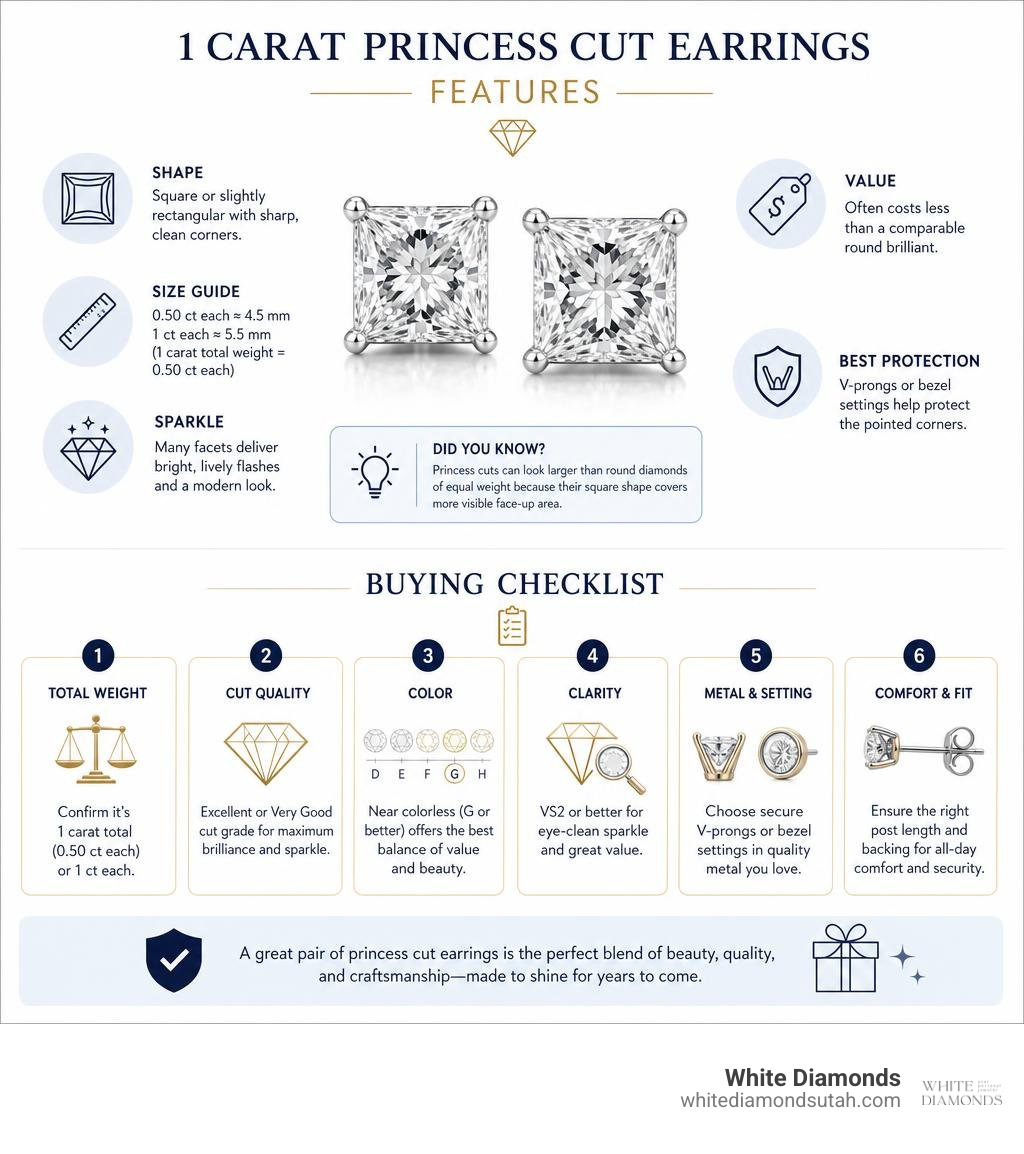
1 carat princess cut earrings are square diamond studs known for crisp lines, bright sparkle, and a modern look that works for both daily wear and special events. In most listings, "1 carat" means 1 carat total weight - two diamonds of about 0.50 carats each - although some pairs contain 1 carat in each ear, so always check the details.
| Quick fact | What it means |
|---|---|
| Shape | Square or slightly rectangular with sharp geometric corners |
| Typical size | A 0.50-carat princess diamond is often about 4.5 mm square; a 1-carat single stone is roughly 5.5 mm |
| Sparkle | Bright, lively flashes created by the cut's many facets |
| Value | Often costs less than a comparable round brilliant diamond |
| Best protection | V-prongs or a bezel help shield the pointed corners |
Princess cuts are among the most popular fancy diamond shapes. They can also look larger than round diamonds of equal weight because their square outline covers more visible space. The tradeoff is simple: those sharp corners need a secure setting, and quality matters greatly because cut, color, clarity, metal, and diamond origin all affect the final price and appearance.
At White Diamonds, we create custom rings and wedding bands and provide professional jewelry cleaning, bringing that same detail-focused care to helping clients understand 1 carat princess cut earrings. Next, we will break down what makes these studs distinctive and how to choose a pair that fits your style, comfort, and budget.
Key Characteristics of 1 Carat Princess Cut Earrings
The princess cut is the second most popular diamond shape in the world, trailing only the traditional round brilliant. Accounting for approximately 25% to 30% of all fancy-shaped diamond sales worldwide, this square geometry has earned its spot as a staple in fine jewelry collections.
When you look closely at 1 carat princess cut earrings, you will immediately notice their clean lines and inverted pyramid profile. Unlike soft, rounded shapes, the princess cut boasts crisp 90-degree corners and intricate cross-pattern faceting across its crown and pavilion. This precise faceting allows for incredible light dispersion, scattering light into geometric flashes rather than soft concentric circles.
Because of their square visual surface, princess cuts make a striking architectural statement against the earlobe. They offer a refined balance between classic diamond fire and sharp, contemporary style.
Dimensions and Visual Appeal of 1 Carat Princess Cut Earrings
One of the greatest advantages of selecting a princess cut is visual surface area. A single 1 carat princess cut diamond typically measures approximately 5.5 mm square. When built into a pair of 1 carat total weight (tw) earrings—where each stud features a 0.50-carat diamond—each stone measures roughly 4.5 mm to 4.7 mm across.
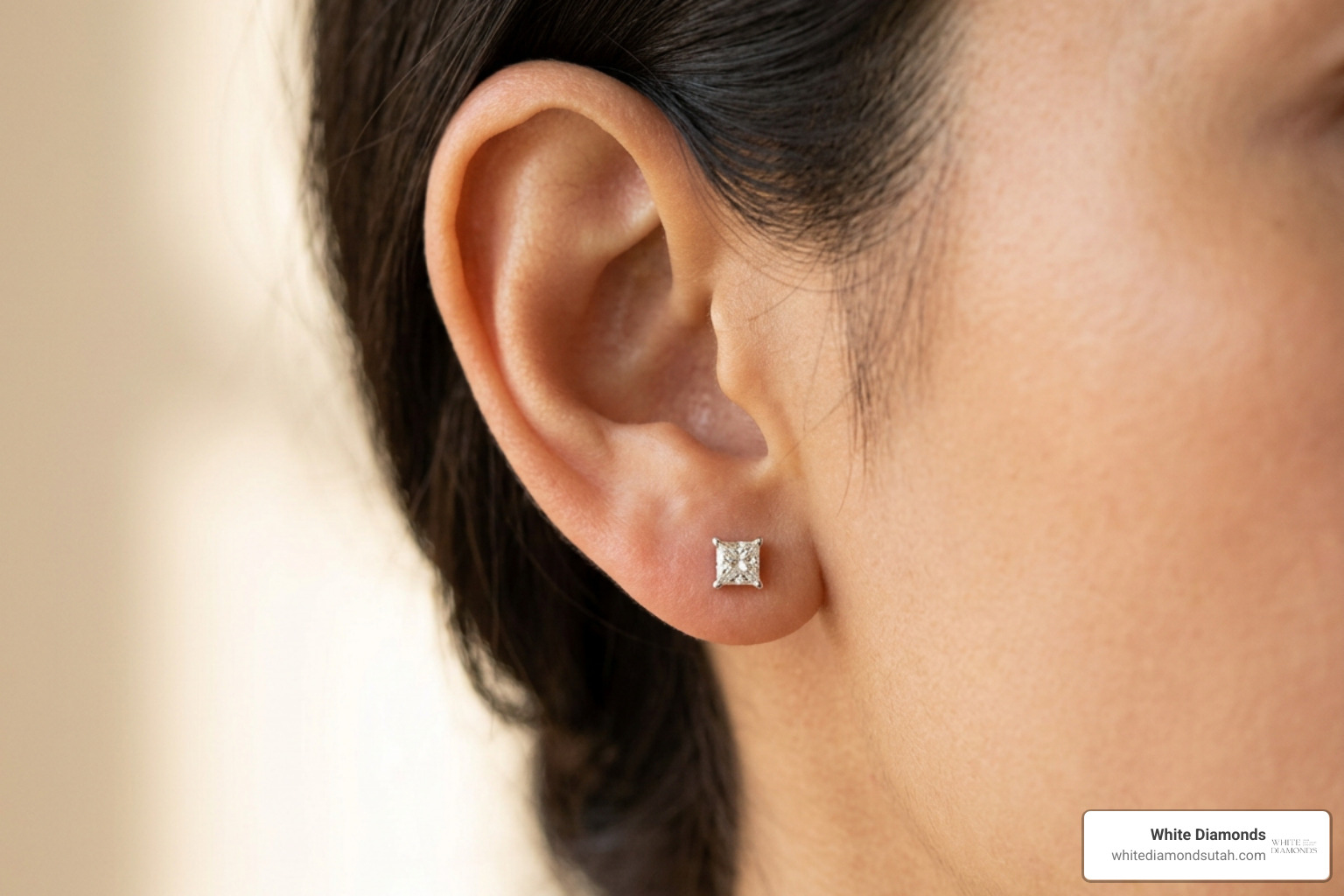
Thanks to their square footprint and open culet, princess cut diamonds can appear up to 10% to 15% larger than round brilliant diamonds of identical carat weight. A round diamond buries a significant amount of its carat weight deep in its rounded belly and base. In contrast, the square face of a princess cut spans diagonally across the lobe, giving the illusion of a bigger stone without paying for extra carat weight.
Princess Cut vs. Round Brilliant Cut Diamonds
While both shapes offer spectacular sparkle, they differ greatly in manufacturing efficiency, brilliance pattern, and pricing.

When diamond cutters shape a rough octahedral diamond crystal into a round brilliant cut, they retain only about 40% to 50% of the original stone. The rest is lost as diamond dust. When shaping a princess cut, however, the rough crystal naturally aligns with the cut's square pyramid shape. Cutters retain up to 80% or 85% of the rough stone!
Because less diamond material is wasted during cutting, princess cut diamonds cost significantly less per carat than round cut diamonds of identical weight and quality grade.
| Attribute | Princess Cut Studs | Round Brilliant Cut Studs |
|---|---|---|
| Visual Shape | Sharp 90-degree square | Soft, circular outline |
| Rough Diamond Yield | 80% - 85% retained | 40% - 50% retained |
| Relative Price Per Carat | 15% - 30% lower cost | Premium cost due to high yield loss |
| Perceived Size | Appears 10-15% larger | True-to-weight appearance |
| Corner Vulnerability | Requires corner protection (V-prongs/bezel) | No sharp corners; low snag risk |
| Sparkle Pattern | Chevron geometric flashes | Concentric ring dispersion |
The 4 Cs of Quality for Princess Cut Earring Diamonds
Understanding diamond grading is crucial when investing in high-end stud earrings. However, selecting diamonds for your ears is slightly different from choosing an engagement ring center stone. Earrings are viewed from a conversation distance rather than under a magnifying glass, giving you smart opportunities to optimize your budget without compromising visual elegance.
Color and Clarity Recommendations for 1 Carat Princess Cut Earrings
Because princess cuts have multiple tiny facets that create a "crushed ice" scintillation effect, they hide minor natural characteristics exceptionally well.
- Clarity: For stud earrings, an SI1 or SI2 clarity grade provides incredible value. As long as the inclusions are "eye-clean" (meaning they cannot be seen with the naked eye from 6 to 12 inches away), paying extra for VVS or IF clarity grades is unnecessary. However, ensure that no large feathers or inclusions sit directly in the vulnerable 90-degree corners, as these can weaken the crystal structure.
- Color: Princess cuts hold slightly more body color in their corners than round diamonds do. If you plan to set your studs in white gold or platinum, we recommend selecting G or H color to maintain a icy white look. If you prefer yellow gold or rose gold settings, you can comfortably drop to an I or J color grade. The warm tone of the metal naturally masks subtle yellow hues in the stone.
For a deeper look into pricing nuances across various carat weight configurations, explore our Complete Guide to 1 Carat Solitaire Earrings Price.
Evaluating Cut Quality and Table Dimensions
While major grading laboratories (such as GIA) traditionally issue official cut grades for round brilliants, evaluating fancy shapes like the princess cut requires paying close attention to specific geometric proportions:
- Length-to-Width Ratio: A perfect square princess cut has a ratio of 1.00 to 1.05. If the ratio exceeds 1.10, the diamond will look noticeably rectangular.
- Table Percentage: Look for a table width between 65% and 75%. A table that is too large reduces crown height and dulls fire.
- Total Depth Percentage: Aim for a depth between 65% and 75%. Too shallow, and light leaks straight out the bottom; too deep, and the diamond carries hidden weight without adding visual surface area.
- Polish and Symmetry: Always look for Excellent or Very Good ratings in polish and symmetry to guarantee maximum symmetry across the four quadrants.
Best Settings and Styles for Security and Daily Wear
Because princess cut diamonds feature four delicate point corners, choosing the proper earring setting is critical to protect your investment from accidental chipping.
Prong vs. Bezel Settings for Corner Protection
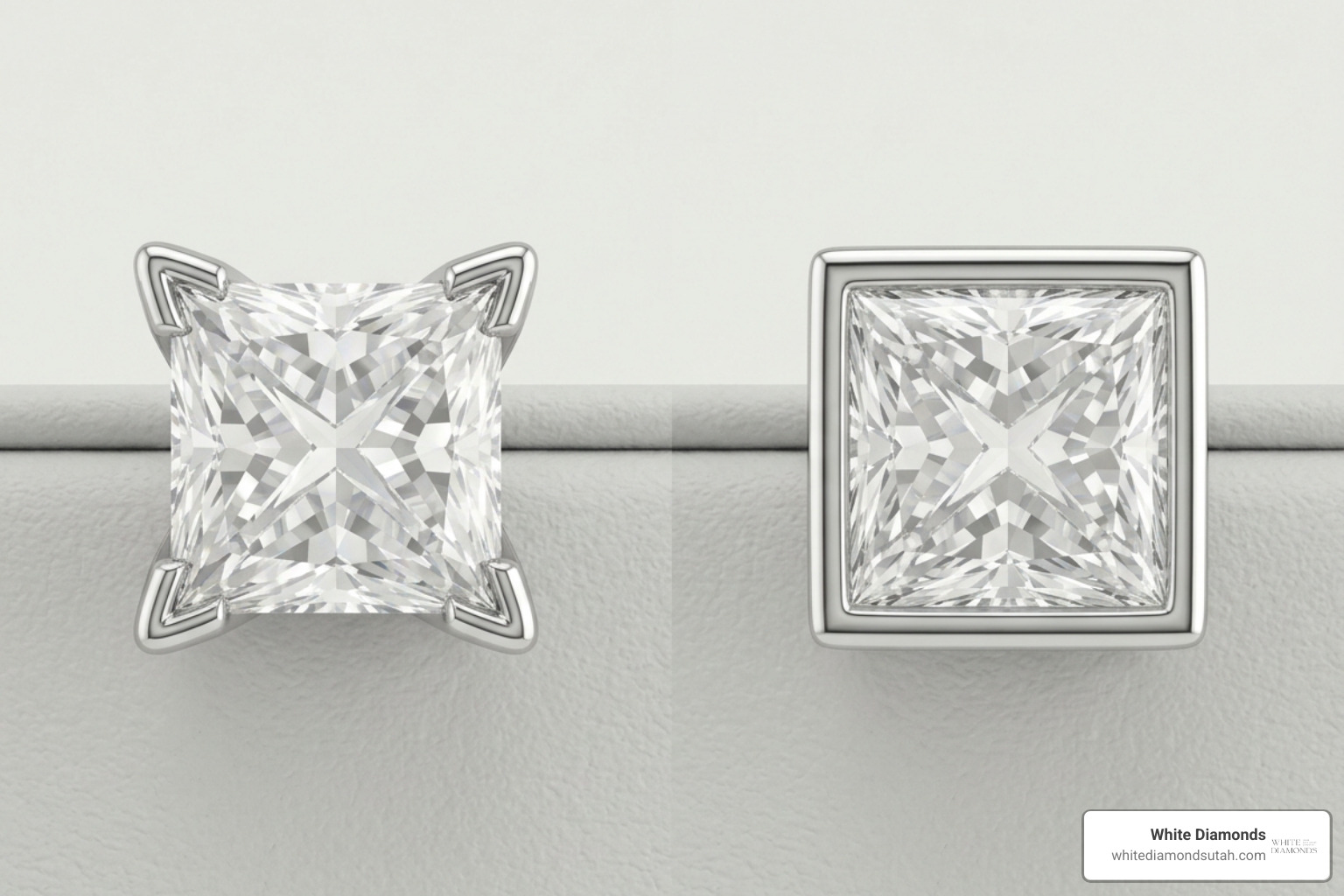
When custom-designing or selecting 1 carat princess cut earrings, you will generally choose between three primary mounting styles:
- V-Prong Basket Settings: Standard round prongs leave corner points exposed to accidental bumps. V-prongs (also known as chevron prongs) wrap around each 90-degree corner with a protective metal shield, protecting the edges while keeping the sides open to sunlight.
- 4-Prong Standard Baskets: These offer a classic silhouette, though you must verify that the jeweler has fitted specialized notched prongs over the extreme tips.
- Bezel Settings: A full metal rim completely wraps around the outer edge of the square diamond. Bezel settings offer maximum protection and zero snagging on hair or clothing, while creating a modern, sleek frame that makes the stones look even bigger.
Versatility: Everyday Wear vs. Special Occasions
Stud earrings are prized for their versatility. You can wear them to a casual morning workout, in professional office environments, or to formal black-tie dinners in the evening.
For supreme daily confidence, choose the right backing mechanism:
- Friction Backs (Push Backs): Fast and convenient for daily removal, ideal for lighter total carat weights.
- Screw Backs: Threaded posts that require turning the backing until locked. Highly recommended for 1 carat total weight studs to eliminate loss risks during active days.
- LaPousette Backs (Locking Backs): Squeeze-release security backings that combine convenience with maximum lock security.
To browse classic stud options, check out our selection of 1 Carat Diamond Solitaire Earrings.
Face Shapes and Styling Trends for 2026
As we navigate through 2026, personal styling in fine jewelry focuses on geometric harmony and mixed metal layering. Selecting stud shapes that complement your unique facial structure enhances your natural features effortlessly.
Matching Princess Cuts with Your Face Shape
The architectural lines of a square princess cut contrast beautifully with softer facial contours:
- Round Face Shapes: The bold, linear angles of square studs add subtle definition, visually elongating softer jawlines and cheeks.
- Oval Face Shapes: Highly versatile; oval shapes naturally balance square shapes without visually widening the face.
- Heart-Shaped Faces: Square cut bases help balance a narrower chin, drawing harmonious attention to eye level.
- Square Face Shapes: If you possess a strong, angular jawline, consider setting your princess cuts on a diagonal orientation (often called a "kite setting") to soften harsh parallel lines.
Modern Setting Trends in 2026
In 2026, diamond stud design leans heavily toward personal self-expression and architectural minimalism:
- Warm Yellow Gold Framings: Rich 18k and 14k yellow gold settings continue to dominate fashion trends, offering high contrast against icy white diamonds.
- Kite-Set Orientations: Turning a square princess diamond 45 degrees so it sits like a diamond-card shape brings an edgy, modern twist to classic studs.
- Minimalist Bezel Frames: Low-profile bezel mountings stripped of intricate filligree highlight clean, industrial aesthetic lines.
You can also check out trendy alternative options through curated platforms like 1 Carat Princess Cut Earrings - Etsy to explore artisan setting ideas.
Pricing, Lab Diamonds, and Authenticity Verification
Understanding diamond pricing helps you purchase with total peace of mind. Let us take a clear look at pricing metrics, lab-grown alternatives, and proper diamond certification.
Understanding the Price Range and Cost Factors
The market price for natural 1 carat princess cut earrings (1.00 carat total weight, or 0.50 carat per ear) generally ranges between $2,000 and $6,000.
If you are looking at a full 1.00 carat per ear (2.00 carats total weight), prices jump exponentially to $7,000 to $18,000+, as larger single diamonds are significantly rarer in nature.
Key factors that move price points include:
- Carat Weight Thresholds: Diamonds priced per carat leap upward at full half-carat and full-carat markers (e.g., 0.49 ct vs 0.50 ct).
- Color & Clarity: Moving from an H/SI1 stone to a D/VVS1 stone nearly doubles the cost without adding visible size.
- Metal Choice: 14k gold provides durable affordability, while 18k gold and solid platinum command higher material premiums.
Lab-Grown vs. Natural Options and Certification
For buyers looking to maximize optical brilliance within budget, lab-grown diamonds present an incredible modern solution.
- Chemical & Physical Identity: Lab-created diamonds share identical atomic structures, hardness (10 on Mohs scale), optical sparkle, and physical properties as natural mined diamonds.
- Cost Savings: Lab-grown princess cut studs typically cost 70% to 80% less than natural diamonds of identical size and clarity grade, allowing buyers to easily upgrade to 2.00 carat total weight studs within modest budgets.
Regardless of whether you choose lab or natural diamonds, insist on independent grading reports from recognized laboratories such as the GIA (Gemological Institute of America) or IGI (International Gemological Institute). Official certificates verify diamond authenticity, precise dimensions, and quality characteristics.
For an in-depth breakdown of laboratory alternatives, read our guide on How Lab Diamond Stud Earrings Compare to Natural Diamonds.
Cleaning and Care Maintenance
To maintain that brilliant visual fire day after day, proper home care and routine maintenance are essential. Oils from skin, hairspray, and lotions quickly build up behind the diamond's open culet and table.
Follow these step-by-step cleaning steps every few weeks:
- Prepare a Gentle Soaking Solution: Fill a small bowl with warm water and add a few drops of mild dish soap (avoid harsh detergents or bleach).
- Soak the Earrings: Let your stud earrings soak for 15 to 20 minutes to loosen trapped oils and hair products.
- Gently Brush: Use a soft-bristled baby toothbrush to gently brush around the bottom basket, V-prongs, and underside facets. Pay extra attention to the four corner tips where debris collects.
- Rinse Thoroughly: Rinse the earrings under lukewarm running water. Safety Tip: Always plug your sink drain first!
- Pat Dry: Dry gently with a lint-free microfiber cloth or air dry on a soft towel.
Every six months, visually inspect your prongs. If a prong catches on sweaters or if you hear a clicking sound when tapping the earring near your ear, bring them to our custom shop for professional prong tightening and ultrasonic safety checks.
Frequently Asked Questions About Princess Cut Earrings
What is the average price range for 1 carat total weight princess cut earrings?
The average price for a natural pair of 1 carat total weight (0.50 ct per stone) princess cut diamond studs ranges between $2,000 and $6,000. If you choose lab-grown diamonds, high-quality pairs typically range from $600 to $1,500.
Are princess cut diamonds prone to chipping in stud earring settings?
Yes, the 90-degree corners of a princess cut are naturally vulnerable to sharp impacts. However, when mounted in protective V-prong baskets or full bezel settings, the vulnerable points are fully sheltered, making them completely safe for everyday wear.
Should I buy 1 carat total weight or 1 carat per ear?
It comes down to personal taste and budget. A 1 carat total weight pair (0.50 ct per ear, ~4.5 mm size) offers balanced, elegant everyday sparkle suitable for work or leisure. A 1 carat per ear pair (2.00 tw total, ~5.5 mm size) delivers a striking, high-impact look that commands attention.
Conclusion
Choosing the perfect 1 carat princess cut earrings comes down to balancing brilliant geometric cut proportions, secure setting choices, and trusted diamond certification. Whether you prefer the classic brilliance of natural diamonds or the accessible scale of lab-grown options, princess cut studs remain a timeless jewel in any fine collection.
At White Diamonds, located in Ogden, Utah, we specialize in personalized, pressure-free consultations. We sit down with you to explore custom settings, work directly with model rings, and build fine custom jewelry that aligns perfectly with your timeline and budget.
Ready to find or design your dream pair of diamond studs? Visit us in Utah or consult our comprehensive Diamond Earrings Buying Guide 2026 to get started today!