Choosing the Perfect Carat Weight in a Loose Emerald Cut Diamond
Is a 3 Carat Emerald Cut Diamond the Right Size for You?
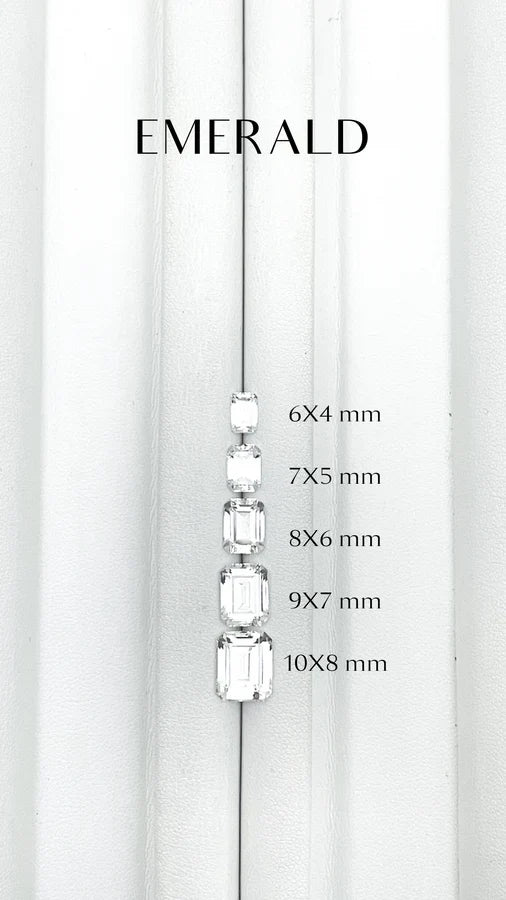
A 3 carat emerald cut loose diamond is a bold choice that typically measures about 9.5 by 7.5 mm, though dimensions vary by stone. To decide if it is right for you, compare actual measurements rather than carat weight alone. Then check its proportions, look for marks visible through its broad facets, and review an independent grading report before choosing a setting.
An emerald cut gives you long, clean lines and broad flashes of light rather than the dense sparkle of a round cut. That makes the stone's appearance worth judging in person or through clear video, especially if you are balancing size against your budget.
We are White Diamonds, a personal jeweler that creates custom rings and wedding bands and offers ring cleaning. We help you consider how a 3 carat emerald cut loose diamond will look and fit in a ring before you commit to a design.
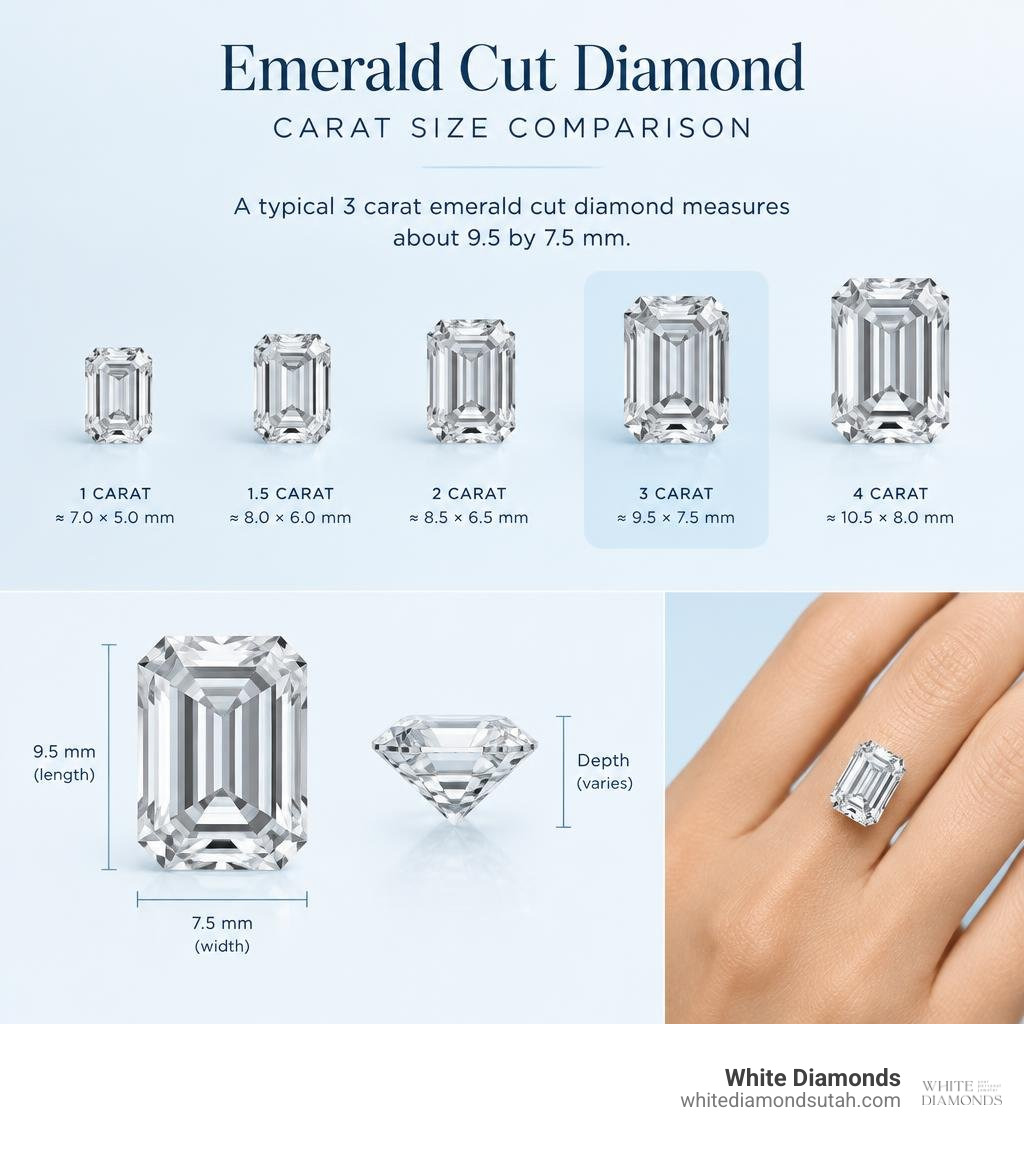
Evaluating a 3 Carat Emerald Cut Loose Diamond: Dimensions and Proportions
When you start browsing for a 3 carat stone, you quickly realize that carat is a measure of weight, not physical size. Two gems with identical weights can present entirely different surface areas depending on how the rough crystal was fashioned. A beautifully proportioned 3 carat emerald cut diamond generally spans roughly 9.5 mm in length by 7.5 mm in width. These dimensions provide exceptional surface area, commanding attention without overwhelming the finger.
To evaluate loose gems accurately, you need to understand the relationship between length, width, and depth.
The length-to-width (L/W) ratio determines the diamond's overall silhouette:
- 1.30 to 1.35: Produces a broader, squarer rectangular look.
- 1.40 to 1.45: Represents the quintessential classic rectangular emerald cut.
- 1.50+: Delivers a distinctly elongated, slender profile that flatters and lengthens the hand.
The table percentage (the large flat facet on top) and depth percentage (the stone's overall height from table to culet) dictate how light bounces within the gem. If the depth is too shallow, light leaks through the bottom, sapping the stone's life. If it is cut too deep, significant carat weight hides beneath the setting, making your 3 carat stone look like a 2.5 carat gem from the top down.
For industry-standard reference, consult the GIA diamond size chart to understand how millimeters correlate to carat weight across fancy shapes. When you are ready to evaluate individual gems, exploring our curated selection of loose diamonds will help you pinpoint the precise proportions that match your taste.
Hall-of-Mirrors Effect and Optical Performance
Unlike round brilliant cuts that use triangular and kite-shaped facets to scatter light into tiny pinpricks of sparkle, an emerald cut relies on parallel, rectilinear facets. This architectural style creates the celebrated "hall-of-mirrors" effect.
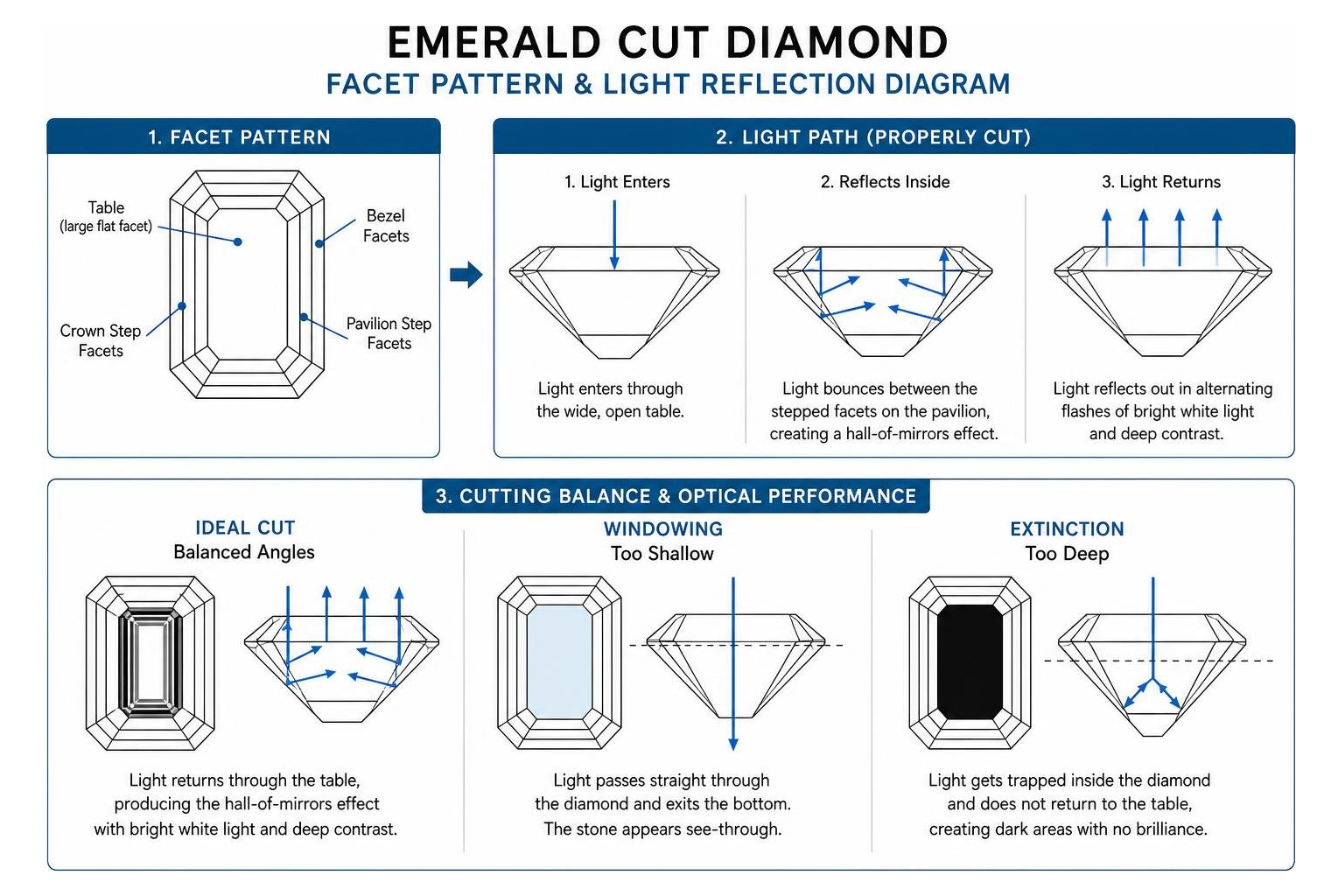
Light enters the wide, open table, bouncing between the stepped facets on the pavilion and reflecting out in alternating flashes of bright white light and deep contrast. When properly balanced, this dynamic creates mesmerizing optical depth.
However, poor cutting can ruin this visual performance:
- Windowing: If the pavilion angles are cut too flat, light passes straight through the diamond rather than reflecting back up. Looking down through the table, you will see right through the stone like a clear glass window.
- Extinction: If facets are cut too steep, light gets trapped and creates large, permanent black dead zones where no light reflects.
For an exhaustive breakdown of facet geometry, see our emerald cut diamond guide before finalizing your choice.
Comparing 3 Carat Emerald Cuts to Other Diamond Shapes
How does a 3 carat emerald cut compare to other shapes when placed side by side? Step cuts produce a very different aesthetic and price dynamic compared to brilliant cuts.
| Diamond Shape | Typical 3 Carat Surface Dimensions | Visual Spread Perception | Price Per Carat (Relative to Round) | Primary Optical Feature |
|---|---|---|---|---|
| Emerald Cut | ~9.5 × 7.5 mm | High (elongated coverage) | 20% to 30% lower | Hall-of-mirrors flash pattern |
| Round Brilliant | ~9.3 × 9.3 mm | Moderate (symmetrical) | Baseline (highest) | Maximum scintillation & fire |
| Oval Cut | ~11.5 × 7.5 mm | Very High (slender spread) | 10% to 15% lower | Crushed-ice brilliance |
| Radiant Cut | ~9.0 × 7.0 mm | Moderate to High | 15% to 25% lower | Brilliant sparkle in step silhouette |
| Cushion Cut | ~8.5 × 8.5 mm | Moderate (deeper carry) | 15% to 25% lower | Soft pillow-like glow |
Emerald cuts offer tremendous value. Because emerald cuts follow the natural octahedral shape of rough diamond crystals, cutters retain a higher yield during manufacturing. In contrast, crafting a round brilliant diamond can waste over 50% of the original rough crystal. This efficiency translates directly into consumer savings: a high-quality emerald cut diamond frequently costs 20% to 30% less than a round cut of identical weight, color, and clarity.
The 4Cs: Quality Factors for Emerald Cut Diamonds
Navigating the 4Cs (Cut, Carat, Color, and Clarity) requires a specialized strategy when evaluating a step cut. With brilliant cuts, intense sparkle helps mask minor natural blemishes and subtle body color. With an emerald cut, the open geometry provides an unobstructed view straight into the heart of the stone.
When verifying loose stones, always insist on a grading certificate from an internationally recognized independent gemological laboratory such as the Gemological Institute of America (GIA) or the International Gemological Institute (IGI). These reports verify the carat weight, millimeter dimensions, polish, symmetry, color, and clarity, ensuring the authenticity and value of your investment.
Color and Clarity Priorities for a 3 Carat Emerald Cut Loose Diamond
Because a 3 carat stone has an expansive table, clarity and color must be evaluated with great care.

Clarity: Finding the Eye-Clean Sweet Spot
Inclusions that would remain completely hidden in a round or cushion cut can stand out immediately in an emerald cut.
- VVS1 to VVS2: Pristine clarity. Inclusions are invisible to the naked eye and difficult to spot even under 10x magnification. Ideal if you demand total peace of mind.
- VS1 to VS2 (The Sweet Spot): The best balance of beauty and budget. Most VS1 and VS2 emerald cuts are completely eye-clean, meaning no imperfections are visible without magnification.
- SI1 and SI2: Exercise caution. An SI1 emerald cut can be eye-clean, but only if the inclusions are faint, located near the outer stepped edges, or hidden under the corners. A dark carbon spot directly under the center table will be visible.
To dive deeper into navigating inclusions, review our article on emerald cut diamond clarity standards.
Color: Choosing the Right Hue for Your Metal
Because emerald cuts feature broad step facets, they hold and concentrate body color more noticeably than round brilliant diamonds.
- D to F (Colorless): Crisp, icy-white appearance. Essential if you are mounting the diamond in platinum or white gold.
- G to H (Near Colorless): Excellent visual value. Viewed face-up, G and H diamonds appear pure white to all but the most trained gemological eyes.
- I to J (Slight Warmth): Shows a delicate golden or champagne hue. These pair gorgeously with yellow gold or rose gold vintage-style settings, which naturally complement the stone's warm undertone.
Natural vs. Lab-Grown Options at the 3-Carat Mark
One of the most consequential decisions when buying a 3 carat stone in 2026 is choosing between an earth-mined diamond and a lab-created diamond.
- Earth-Mined Diamonds: A natural 3 carat diamond represents an extraordinary geological marvel. Because diamonds larger than 1 carat exist in the top 1% of all mined diamonds, a natural 3 carat stone is exceptionally rare, commanding a substantial investment.
- Lab-Grown Diamonds: Created using advanced Chemical Vapor Deposition (CVD) or High Pressure High Temperature (HPHT) processes, lab-grown diamonds share identical physical, chemical, and optical characteristics with natural stones. They are real diamonds, graded under the exact same 4C criteria by the GIA and IGI.
Opting for lab-grown allows you to maximize size, clarity, and color while maintaining a modest budget. You can learn more about these stones in our lab-grown diamonds overview.
Best Settings and Ring Styles for Large Emerald Cut Diamonds
A 3 carat loose emerald cut diamond requires a setting that highlights its clean lines while providing robust protection. Step-cut diamonds feature beveled corners, which are inherently more durable than the sharp points of a princess or marquise cut. However, corners remain vulnerable to everyday impacts and require deliberate support.
When crafting a ring for a stone of this scale, collaborating on a custom engagement ring design ensures the gallery, prongs, and band balance structural durability with your aesthetic preferences.
Setting Ideas for Your 3 Carat Emerald Cut Loose Diamond
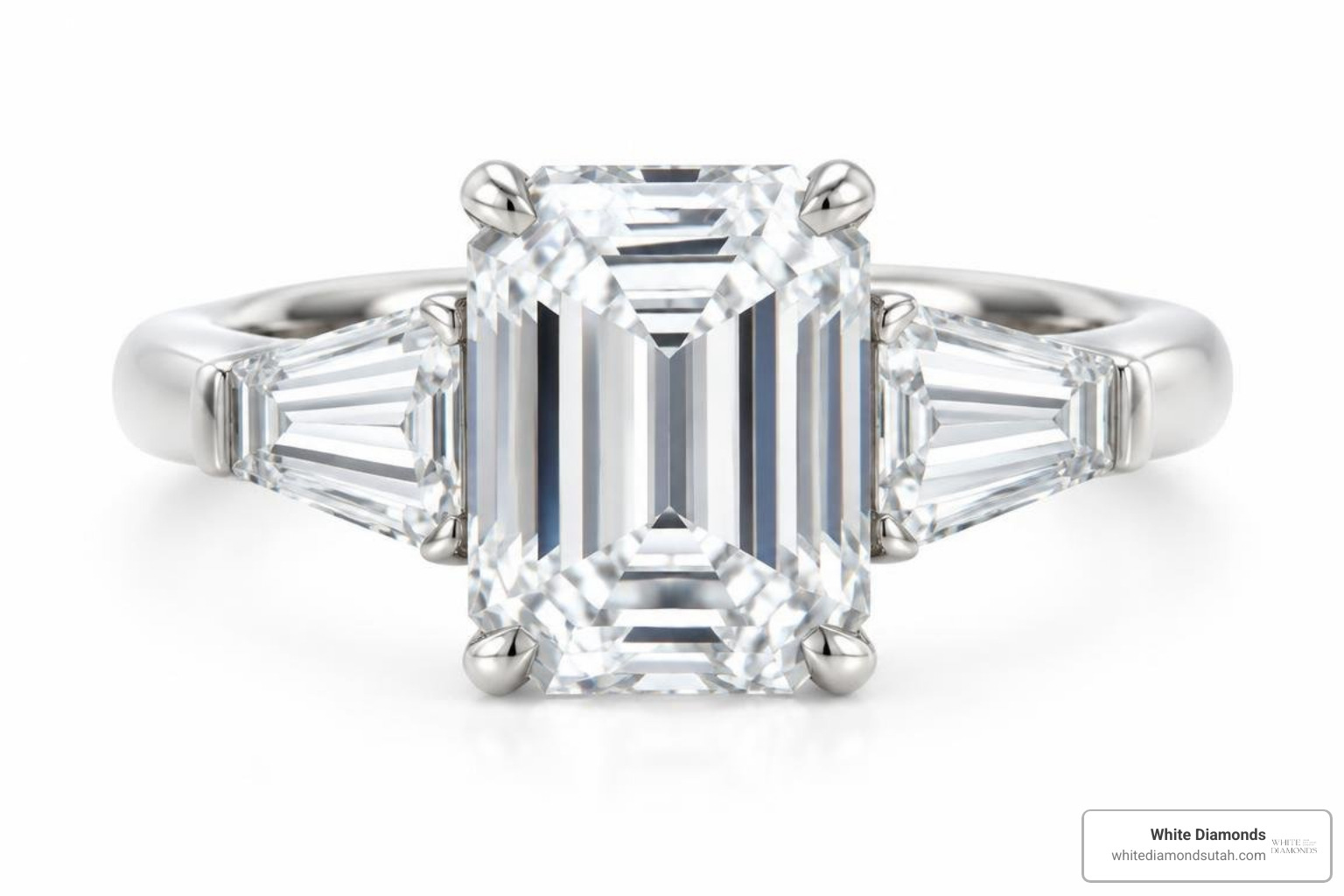
- Classic Solitaire: A minimalist four-prong or double-claw prong mount lets the center stone take center stage. Choosing delicate claw prongs accentuates the cropped corners.
- Three-Stone with Tapered Baguettes: The ultimate Art Deco statement. Stepped baguette side stones create a harmonious geometric transition from the large center diamond down to the metal band.
- Trapezoid or Cadillac Side Stones: For a bolder architectural spread across the finger, pairing your center stone with trapezoid side diamonds creates an unbroken wall of brilliance.
- Modern Full Bezel: Encircling the diamond in a slim rim of platinum or gold delivers a sleek, snag-free design that emphasizes the rectangular silhouette.
- East-West Orientation: Turning the diamond 90 degrees horizontally across the finger creates an eye-catching, contemporary profile.
Explore our curated gallery of emerald cut engagement ring settings to see how various metal profiles and side stones complement large step cuts.
Frequently Asked Questions About 3 Carat Emerald Cuts
Does a 3 carat emerald cut look bigger than a round brilliant?
Yes, in most cases, an emerald cut diamond creates the visual impression of a larger stone. Because of its elongated rectangular shape and broad surface spread, a 3 carat emerald cut (roughly 9.5 × 7.5 mm) occupies more length along the finger than a 3 carat round brilliant (approx. 9.3 × 9.3 mm). This elongation creates an optical lengthening effect on the hand.
What is the minimum recommended clarity grade for a 3 carat emerald cut?
We recommend aiming for a VS2 clarity grade as your starting baseline. Because a 3 carat emerald cut has an expansive, crystal-clear top table facet, any internal inclusions in the SI1 or SI2 range can be visible to the naked eye. A carefully vetted VS2 diamond will almost always be completely eye-clean while saving you thousands compared to VVS or Flawless grades.
How much should I expect to pay for a 3 carat emerald cut diamond?
Pricing varies significantly depending on whether you choose an earth-mined or lab-grown stone, as well as the diamond's color, clarity, and cut quality:
- Earth-Mined 3 Carat: A high-quality (G-H color, VS1-VS2 clarity) natural 3 carat stone typically ranges from $25,000 to $55,000+. Top-tier (D-F color, VVS clarity) specimens can exceed $75,000.
- Lab-Grown 3 Carat: A premium lab-grown stone with exceptional color (E-F) and clarity (VVS2-VS1) generally ranges from $1,800 to $4,500.
Because emerald cuts yield more finished weight from rough crystal, you can expect to pay roughly 20% to 30% less than you would for a round brilliant diamond of equivalent grade.
Conclusion
A 3 carat emerald cut loose diamond is a refined balance of timeless sophistication, bold scale, and architectural beauty. Choosing the right stone requires careful attention to length-to-width proportions, facet alignment, and eye-clean clarity.
At White Diamonds in Ogden, Utah, we believe finding your perfect diamond should be an enjoyable, relaxed experience. We offer personalized, pressure-free consultations where you can examine loose diamonds side-by-side, try on physical model rings, and build a one-of-a-kind ring tailored precisely to your budget and timeline.
To explore more inspiration, check out our favorite classic emerald cut engagement ring styles, or visit us to begin creating your custom piece today.