10x7 Oval Gemstones Compared for Everyday Wear
How Big Is a 10x7 Oval Diamond?
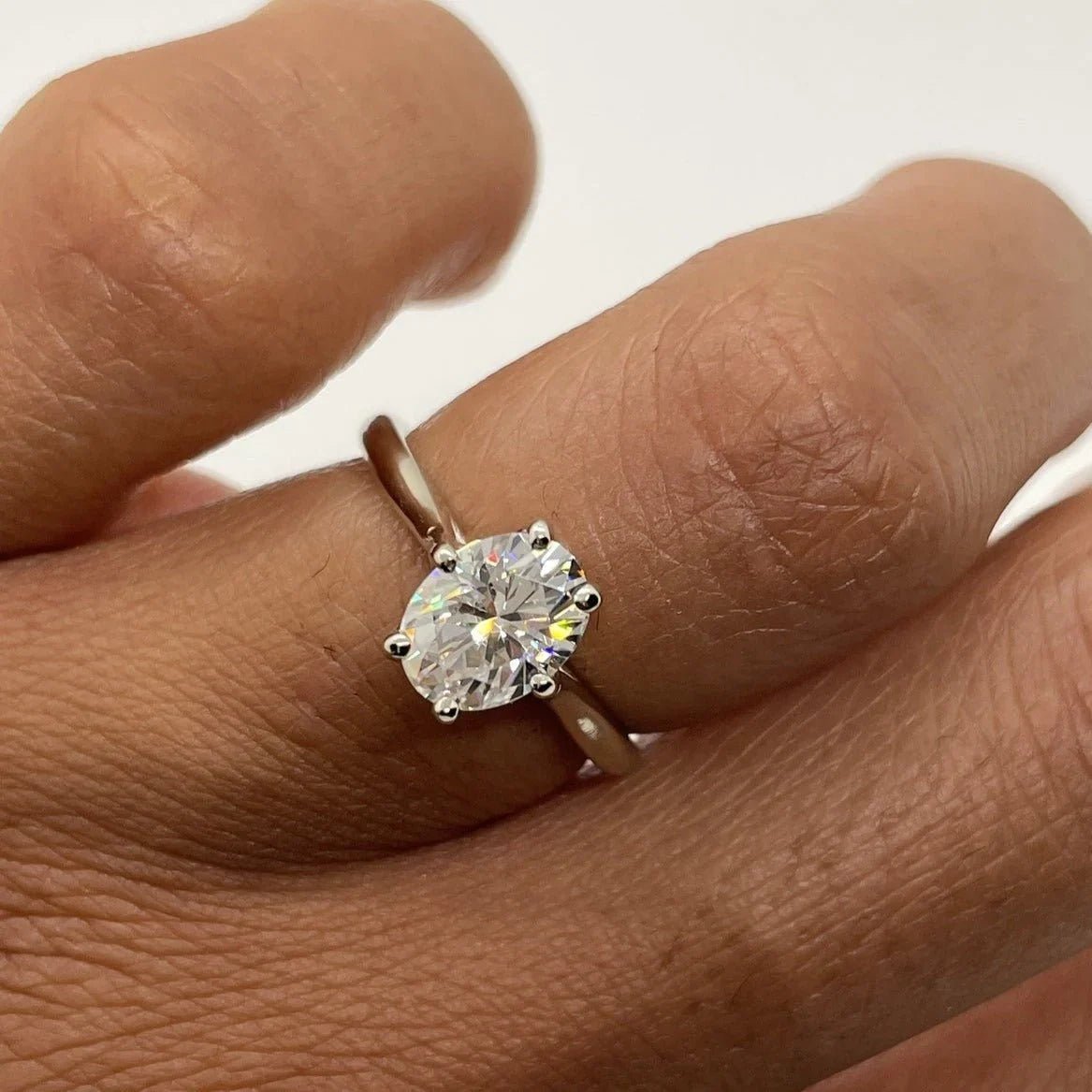
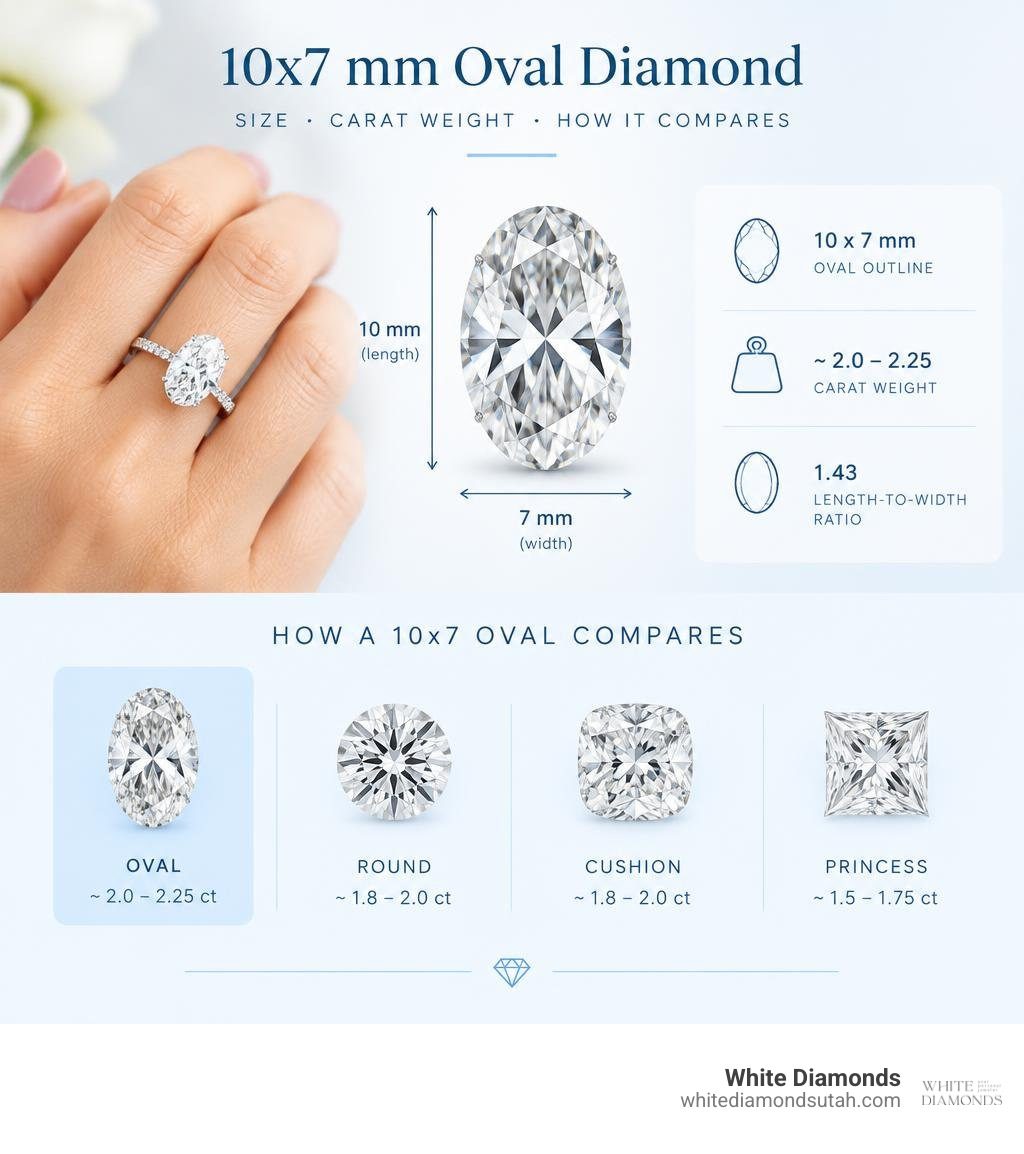
A 10x7 oval diamond measures 10 mm long and 7 mm wide. It often weighs about 2.0 to 2.25 carats, though cut and depth can change the weight. Its long shape tends to look larger on the finger than a round, cushion, or princess-cut diamond of similar weight. A 10x7 oval gemstone has the same outline, but diamond is a strong choice for a ring worn every day.
At White Diamonds, we craft custom rings and wedding bands and offer ring cleaning. We can help you compare a 10x7 oval diamond with other stones and choose a setting that fits your daily life.
Understanding Proportions and Carat Weight of a 10x7 Oval Diamond
When shopping for an engagement ring, many people start with carat weight. However, carat measures physical weight, not visual size. Two stones sharing the exact same carat weight can look noticeably different on your hand depending on how their weight is distributed. To find the right balance between millimeter dimensions and overall budget, it helps to first determine what diamond carat size is right for you.
Millimeter measurements give you the real-world footprint of a diamond. A 10x7mm shape features an elongated elliptical outline with a length-to-width ratio of approximately 1.43 (10 divided by 7). This proportion provides an elegant silhouette that is neither too round nor too narrow. When comparing fancy shapes to a standard reference diamond, the 10x7mm footprint stands out for delivering generous visual presence without unnecessary bulk.
Millimeter Dimensions and Carat Weight Expectations
For a classic 10x7mm oval cut, the expected weight typically falls between 2.00 and 2.25 carats. Variations occur based on how deep or shallow the stone is cut:
- Shallow Cuts (under 59% depth): May weigh slightly under 2.00 carats while retaining the 10x7mm outline, though light performance can suffer.
- Standard Proportions (59% to 65% depth): Typically weigh between 2.00 and 2.25 carats with balanced brilliance and fire.
- Deep Cuts (over 65% depth): Can hide excess weight in the pavilion (the bottom half), tipping the scale above 2.30 carats without adding any visible width or length.
For comparison, a 2.5ct Oval Cut Diamond (10×7.5×4.58mm) - Actual Size has a face-up area of approximately 61.5 mm², which is slightly compact for a full 2.50-carat stone and looks closer in spread to a well-cut 2.17-carat oval. This demonstrates why millimeter dimensions matter just as much as the number on the scale.
Face-Up Surface Area and Finger Elongation
The primary advantage of an elongated oval is its face-up surface area. Face-up size refers to the visible surface of the diamond when viewed directly from above inside a setting. Because an oval distributes its surface area along an extended vertical axis, it creates a slimming optical illusion on the wearer's hand.
There are distinct reasons oval diamond rings are flattering on every hand. A 10x7mm stone spans a significant portion of the finger's width on most ring sizes (sizes 5 to 7), providing ample finger coverage while maintaining smooth, rounded lines that complement both slender and wider fingers.
Comparing 10x7 Ovals to Other Popular Gemstone and Diamond Shapes
Choosing a diamond shape involves weighing visual spread against everyday durability. While round brilliant diamonds set the standard for maximum light return, fancy shapes offer unique design advantages and surface coverage.
Face-Up Size Comparison: Oval vs. Round, Cushion, and Princess
An oval diamond typically presents a larger face-up area than most other shapes of equal carat weight. Compared to a standard round brilliant cut, an oval cut features roughly 9% more visible surface area.
Cushion and princess cuts carry more of their total carat weight in their corners and deeper pavilions. As a result, a 2.0-carat princess or cushion cut generally appears smaller from the top view than a 2.0-carat 10x7 oval.
| Shape | Typical Dimensions (2.0 ct) | Relative Face-Up Area | Edge Durability | Primary Advantage |
|---|---|---|---|---|
| Oval (10x7mm) | 10.0 × 7.0 mm | Largest (~55–58 mm²) | High (no sharp corners) | Maximum finger coverage and elongation |
| Round Brilliant | 8.1 × 8.1 mm | Baseline (~51–52 mm²) | High (continuous curve) | Maximum fire and light scintillation |
| Princess Cut | 7.0 × 7.0 mm | Compact (~49 mm²) | Moderate (pointed corners need prongs) | Sharp, modern geometric lines |
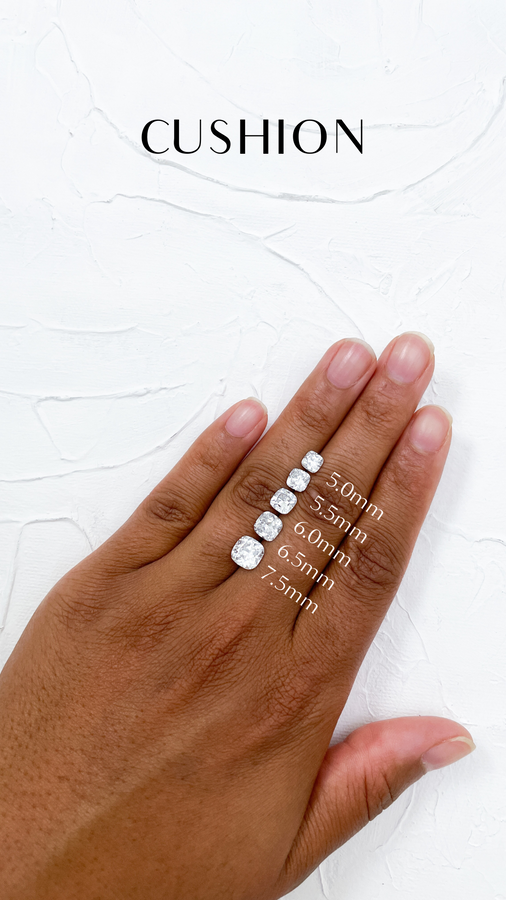
| Cushion Cut | 7.5 × 7.0 mm | Compact (~48–51 mm²) | High (curved corners) | Vintage pillow aesthetic with soft glow |
Wearability and Practicality for Daily Lifestyles
For everyday wear, the structural contours of your center stone play a major role in preventing accidental damage:
- Snag Prevention: Unlike princess, marquise, or pear cuts with sharp, pointed tips, the gentle curves of an oval glide easily against knit sweaters, gloves, and pockets.
- Chipping Resistance: Pointed corners are natural weak points prone to chipping if struck against hard surfaces. An oval's smooth perimeter eliminates these vulnerable angles.
- Setting Security: Setting a classic oval diamond ring with 4 or 6 prongs, or even a protective bezel, keeps the stone secure during daily activities such as typing, exercising, or running errands.
Cut Specifications and Best-Value Grading Parameters
Cut quality directly determines how well a diamond handles light. While round diamonds receive standardized cut grades from labs like the Gemological Institute of America (GIA), fancy shapes like ovals do not receive an overall cut grade on grading reports. Buyers must evaluate individual proportion metrics such as depth, table, and symmetry.
Even in much larger sizes, such as a 10ct Oval Cut Diamond (18.71×13.11×8.2mm) - Actual Size, keeping these geometric ratios in harmony is necessary to preserve brightness across the stone.
Recommended Cut Parameters for a 10x7 Oval Diamond
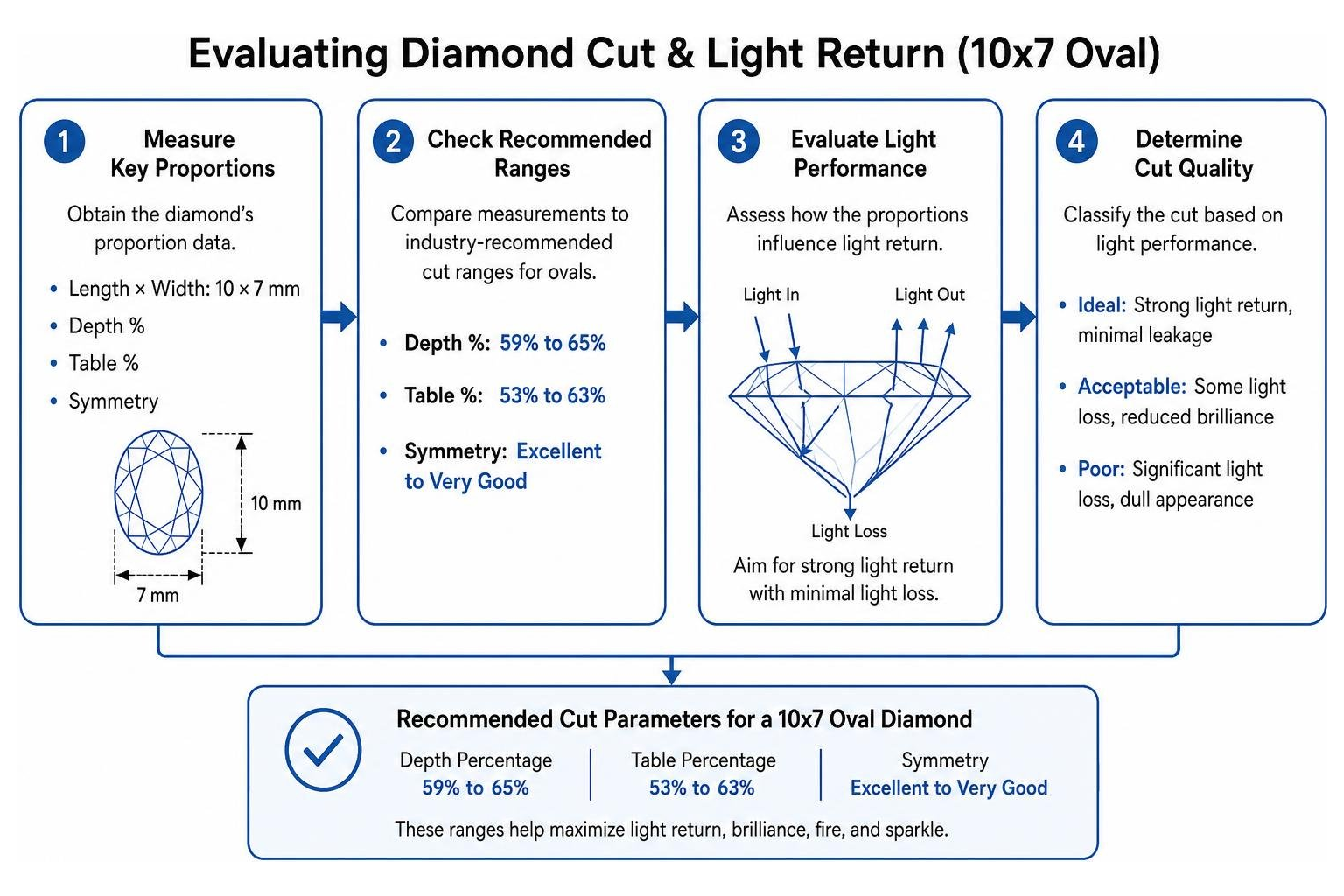
To ensure strong brilliance, fire, and sparkle across a 10x7mm stone, aim for these industry-recommended ranges:
- Depth Percentage: 59% to 65%. A depth within this range ensures light enters and bounces back out through the top table facet rather than leaking through the bottom.
- Table Percentage: 53% to 62%. A balanced table allows sufficient light entry while leaving room for upper crown facets to produce colorful flashes of fire.
- Length-to-Width (L/W) Ratio: 1.25 to 1.65 is the broad acceptable range for ovals. A 10x7mm stone has an L/W ratio of 1.43, which sits right in the traditional sweet spot.
- Polish and Symmetry: Look for Excellent or Very Good ratings on the grading report to ensure facet junctions meet cleanly.
Evaluating Color and Clarity in a 10x7 Oval Diamond
Large diamonds tend to display body color and internal inclusions more clearly than smaller stones. However, you do not need flawless clarity or colorless grades to get a beautiful ring:
- Clarity: Oval cuts feature an intricate brilliant facet pattern that effectively conceals minor natural marks. An SI1 or SI2 clarity grade provides excellent value, provided the stone is verified as eye-clean (meaning no inclusions are visible to the unaided eye from a standard viewing distance).
-
Color: Oval cuts show slightly more body tint toward their curved tips than round diamonds.
- In platinum or white gold settings, choose an I color or higher to maintain an icy white appearance.
- In yellow gold or rose gold settings, you can comfortably drop to a J color, as the warm metal naturally complements the stone and masks slight warmth.
Smart Buying Strategies and Red Flags to Avoid
Maximizing your budget requires understanding diamond market pricing tiers and knowing which technical flaws to watch out for. Working with experts in custom engagement rings in Utah ensures you find a center stone that delivers optimal brilliance without overpaying for invisible paper grades.
Maximizing Value by Buying Shy
Diamond prices increase disproportionately at "magic" weight thresholds—notably at 1.00, 1.50, 2.00, and 2.50 carats.
"Buying shy" means selecting a diamond just below these psychological benchmarks (for example, choosing a 1.90 to 1.95-carat stone rather than a full 2.00-carat diamond). A diamond weighing 3% to 7% less than the benchmark often cuts price tags significantly, yet the millimeter difference across a 10x7 surface is indistinguishable to the human eye.
Identifying Bow-Tie Shadows and Certification Traps
When inspecting an oval diamond, watch for key visual characteristics that can diminish beauty:
- The Bow-Tie Effect: Because of how oval facets intersect, almost all oval cuts display some degree of a dark, bow-tie-shaped shadow across the center. A faint bow-tie adds contrast and sparkle, but a heavy, dark shadow indicates light leakage and poor facet alignment.
- Blue Fluorescence: While faint fluorescence rarely affects a diamond, strong or very strong blue fluorescence can cause a hazy, milky appearance in direct sunlight, particularly in higher color grades (D–F).
- Certification Integrity: Always insist on certification from premier independent laboratories like the GIA (Gemological Institute of America) or AGS (American Gem Society). Laboratories with looser standards often inflate color or clarity grades by 1 to 2 tiers, leading buyers to overpay.
Oval Diamond Quality Inspection Steps
- Verify GIA or AGS certification number and check measurements against target millimeter specs.
- Review 360-degree high-definition video under neutral lighting to evaluate bow-tie prominence.
- Check table (53–62%) and depth (59–65%) percentages on the grading dossier.
- Confirm inclusion placement on the clarity plot to ensure flaws are away from the center table.
- Match diamond color grade to the chosen metal setting (I+ for white metals, J+ for yellow gold).
Frequently Asked Questions About Oval Cut Sizes
What carat weight is a 10x7mm oval diamond?
A well-cut 10x7mm oval diamond typically weighs between 2.00 and 2.25 carats. The exact weight depends on cut depth and girdle thickness. Stones cut on the deeper side (above 65% depth) may weigh 2.30 carats or more without providing additional face-up spread.
Does a 10x7 oval diamond show color more easily than a round cut?
Yes. Fancy shapes like ovals, pears, and marquise cuts tend to concentrate subtle body color near their curved ends. While a round brilliant diamond can often look white at a J or K grade, an oval diamond generally requires an I color or higher in white metal settings to maintain a bright, colorless look.
Why are GIA and AGS certifications necessary for large oval diamonds?
GIA and AGS are globally recognized for strict, repeatable grading standards. A 2-carat stone represents a significant investment; secondary grading labs frequently issue overly generous grades, meaning a stone labeled as "G color / VS2 clarity" might only grade as an "I color / SI2 clarity" under strict GIA examination.
Conclusion
A 10x7 oval diamond strikes an appealing balance between finger coverage, wearability, and classic elegance. Measuring around 2.00 to 2.25 carats, its elongated silhouette offers nearly 9% more visible spread than a round diamond of equivalent weight, while its rounded perimeter makes it safe and durable for everyday routines.
To ensure your center stone delivers maximum fire without distracting shadows, take time to learn what causes the bow tie effect in oval diamonds. At White Diamonds in Utah, we provide pressure-free consultations and sample ring models to help you craft a custom engagement ring suited to your personal style and budget.