A Comprehensive Guide to Model Ring Options
What Model Rings Mean for Jewelry Shoppers
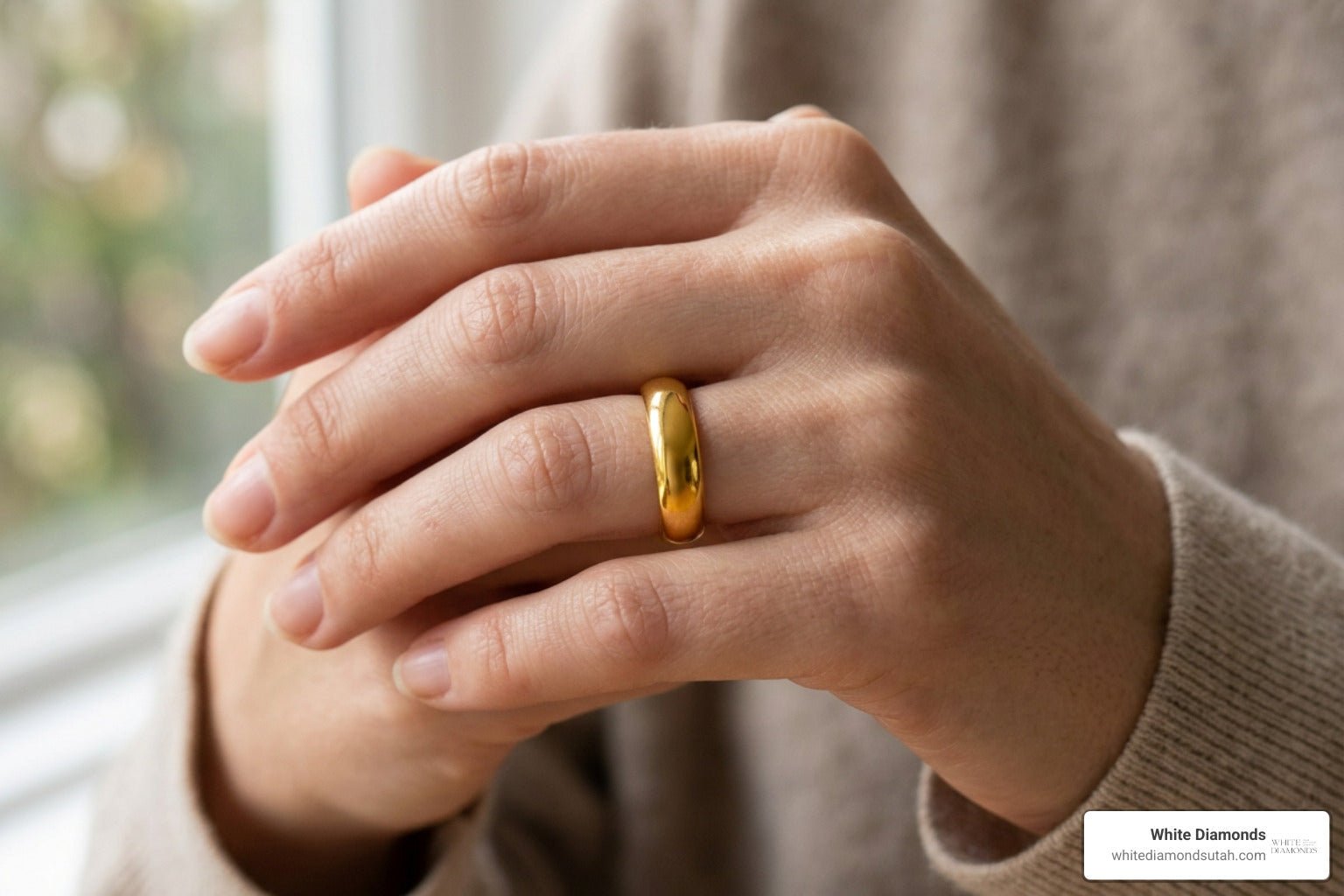
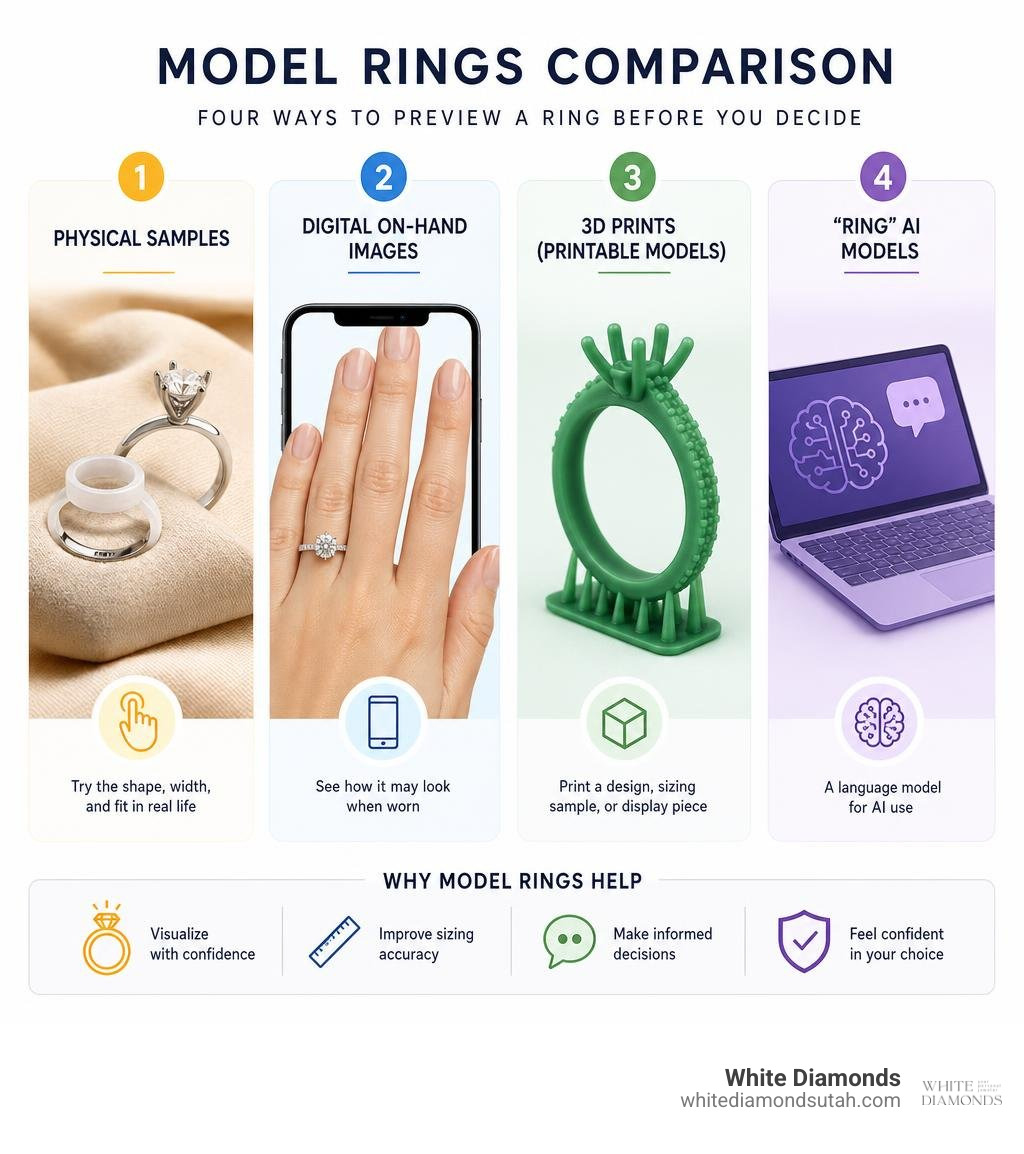
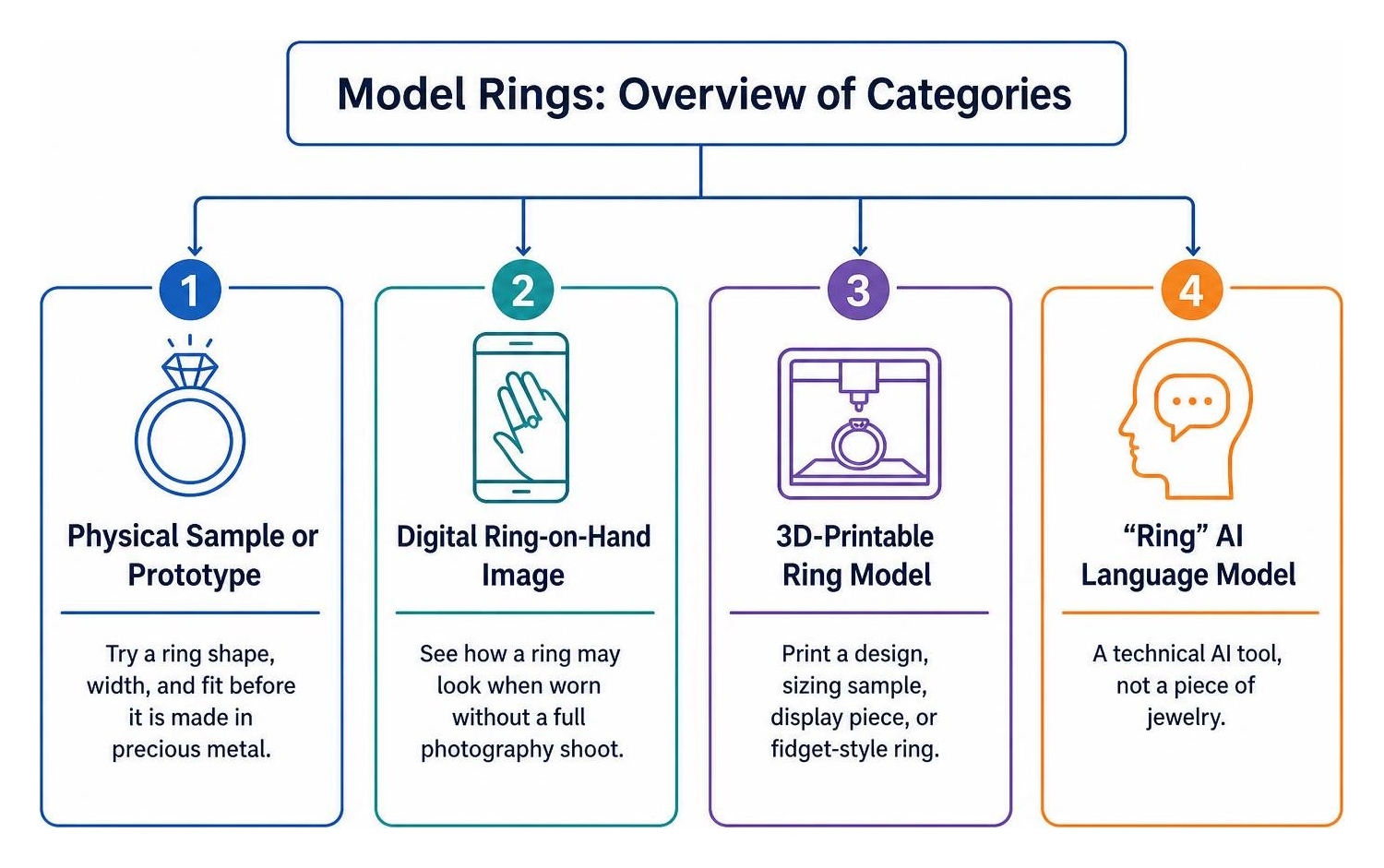
Model rings can mean several different things: physical sample rings for trying on a design, digital ring-on-hand images used in online stores, 3D-printable ring files, or even unrelated AI language models with "Ring" in their names. For an engagement or wedding ring purchase, the most useful meaning is usually a physical or digital preview that helps you see the ring's size, shape, setting height, and overall look before making a final decision.
| Type of model ring | What it helps you do |
|---|---|
| Physical sample or prototype | Try a ring shape, width, and fit before it is made in precious metal |
| Digital ring-on-hand image | See how a ring may look when worn without a full photography shoot |
| 3D-printable ring model | Print a design, sizing sample, display piece, or fidget-style ring |
| "Ring" AI language model | A technical AI tool, not a piece of jewelry |
For couples weighing many choices, model rings can make the process feel less abstract and less pressured. They turn details that are hard to picture - such as band thickness, stone presence, or finger coverage - into something you can see and discuss.
At White Diamonds, we craft custom rings and wedding bands and help clients care for the pieces they wear every day. Our experience with model rings centers on making custom jewelry choices clearer, from early design conversations through fitting and final ring care.
Navigating the Diverse World of Model Rings
When exploring the term model rings, context is everything. Depending on whether you are a jewelry client looking for an engagement ring, an e-commerce merchant building a digital catalog, a maker working with 3D printers, or an artificial intelligence researcher, the phrase takes on distinctly different definitions.
E-Commerce AI Ring Generators
In the digital retail sector, an AI ring model generator acts as a virtual studio. E-commerce sellers frequently possess clean product photos shot on plain white backgrounds, but shoppers want to see visual context—specifically how a band sits on an actual hand. AI ring model generators take a single flat product photo and synthesize a photorealistic ring-on-hand image in under a minute without requiring a traditional photography session. Using tools like an AI Ring Model Generator, brands maintain catalog consistency across hundreds of stock-keeping units (SKUs) while drastically lowering media production costs.
Physical Sample and 3D Printable Model Rings
In custom jewelry production and rapid prototyping, model rings refer to physical representations of fine jewelry pieces. Before pouring gold or platinum, jewelers create wax prototypes, resin prints, or brass samples. These physical prototypes allow clients to test band widths, feel setting heights, and judge stone proportions on their own fingers.
Simultaneously, the Maker movement uses desktop additive manufacturing (3D printing) to create wearable ring designs. Online model repositories host downloadable STL files for everything from functional sizing bands to intricate sensory toys. Whether exploring Couple Rings Models for custom designs or downloading novelty rings, physical and printable models serve as bridges between conceptual art and tactile reality.
Open-Source AI Thinking Models Named Ring
In modern computer science, "Ring" refers to a state-of-the-art family of open-source artificial intelligence language models developed by InclusionAI. Designed for complex math, coding, and logical reasoning, these deep-learning systems bear no relation to physical jewelry. Their connection lies purely in naming nomenclature, representing breakthrough research in hybrid linear attention architectures and trillion-parameter intelligence models.
AI Ring Model Generators in Jewelry E-Commerce
For online jewelry retailers, standard flat product photos often fail to communicate essential visual details. A solitary ring resting against an isolated background does not tell a buyer how far a center stone elevates above the finger, how much surface area the band covers, or how the metal tone pairs with realistic skin tones.
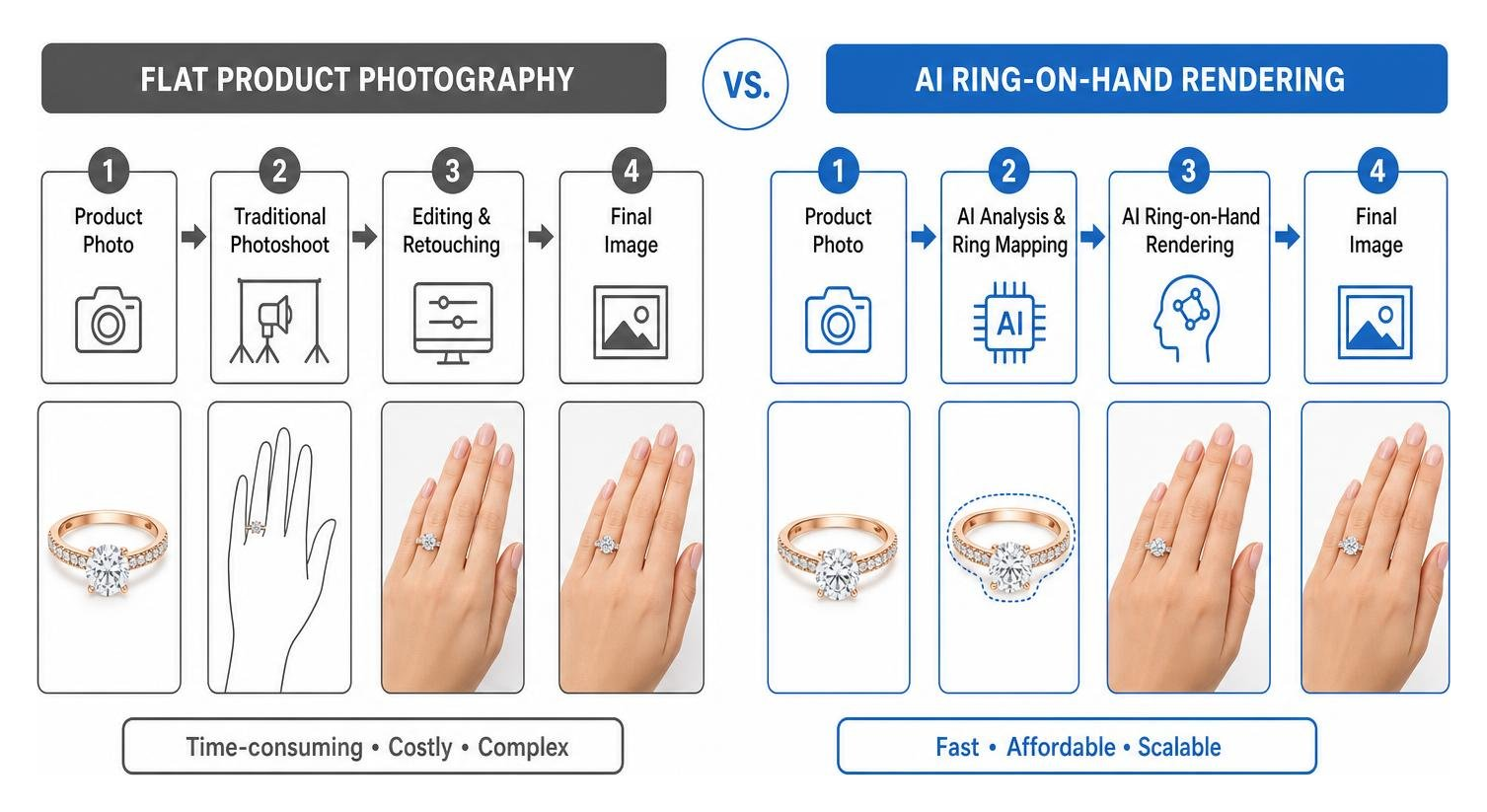
AI ring model generators solve this problem by transforming isolated product photography into context-rich lifestyle visuals. Traditional hand-model photoshoots require hiring talent, renting studio space, scheduling photographers, and shipping delicate inventory. AI generators streamline this pipeline entirely. The platform processes a single high-resolution image, maps the ring's geometry, and embeds it seamlessly onto a digitally generated hand model in under 60 seconds.
Optimizing Product Photos for AI Model Rings Generation
To achieve photorealistic results when using AI image synthesis, input photo quality is paramount. AI algorithms need precise visual information to isolate the jewelry piece and re-project light accurately across skin textures.
- High-Resolution Input: Use high-definition files (JPG, PNG, or WebP up to 5MB) where gem facets, prongs, and metal luster remain sharp under zooming.
- Uncluttered Backgrounds: Plain white or neutral studio backgrounds help the generator distinguish metal borders from background noise.
- Optimal Angles: Straight-on three-quarter profile shots showcase both setting height and band curvature simultaneously. Uploading up to two supplementary angle photos dramatically improves final render fidelity.
- Distinct Features: Clear visibility of center stones, accent diamonds, and band contours helps the system maintain proportions when scaling the design onto virtual hands.
When showcasing intricate details—such as those found in our guide to the Best Diamond Ring Designs for Ladies—proper photo preparation ensures that delicate filigree or micro-pave detailing renders clearly on the digital model's hand.
Multi-Platform Deployment Across Etsy, Shopify, and Social Ads
Once generated, AI-created on-hand ring images enhance the entire digital sales funnel:
- Etsy Marketplaces: Etsy shoppers prioritize authentic lifestyle visuals. Replacing isolated product shots with lifestyle context increases buyer trust and visual appeal.
- Shopify Product Pages: E-commerce stores maintain higher conversion rates when listing galleries include both close-up detail photos and on-hand scale imagery.
- Paid Social Campaigns: Ad platforms thrive on lifestyle imagery. Social media users interact far more readily with worn jewelry imagery than static retail shots.
- New Arrival Launches: Jewelers can list new inventory immediately upon receiving studio product shots, bypassing photography delays and accelerating time-to-market.
3D Printable Ring Models and Fidget Toys
Beyond e-commerce and fine jewelry design, the phrase model rings plays a central role in desktop 3D printing communities. Online file repositories like Printables.com host extensive directories of printable ring designs, ranging from display holders to wearable mechanical toys.

Popular Designs From Rotating Rings to Fidget Gears
3D printed sensory and fidget rings have gained widespread popularity due to their mechanical features and ease of printing on consumer FDM (Fused Deposition Modeling) and SLA (Stereolithography) desktop printers.
- Rotating Rings Toy: A premier design on Printables boasting over 21.9K downloads and 154.7K views, this model features concentric rings that spin smoothly along central axes.
- Fidget Gear Ring: Garnering over 5K downloads and 40.6K views, this intricate model incorporates functional interlocking gear teeth that rotate continuously around the finger band.
- Pull Copter Finger Ring: Recording 6.3K downloads, this novelty design blends wearable jewelry styling with a launcher mechanism.
These mechanical designs rely on tight manufacturing tolerances. Designers engineer deliberate spatial gaps (typically 0.2mm to 0.3mm) between moving parts within the 3D model, allowing print-in-place mechanisms to break free and rotate cleanly right off the build plate without requiring secondary assembly.
Custom Jewelry Prototyping and Sizing Models
In professional fine jewelry design, 3D printable ring models serve as an essential communication tool between master jewelers and clients. Through our Bespoke Jewellery Design services, we utilize precision 3D resin printing to convert digital CAD drawings into tangible physical prototypes.
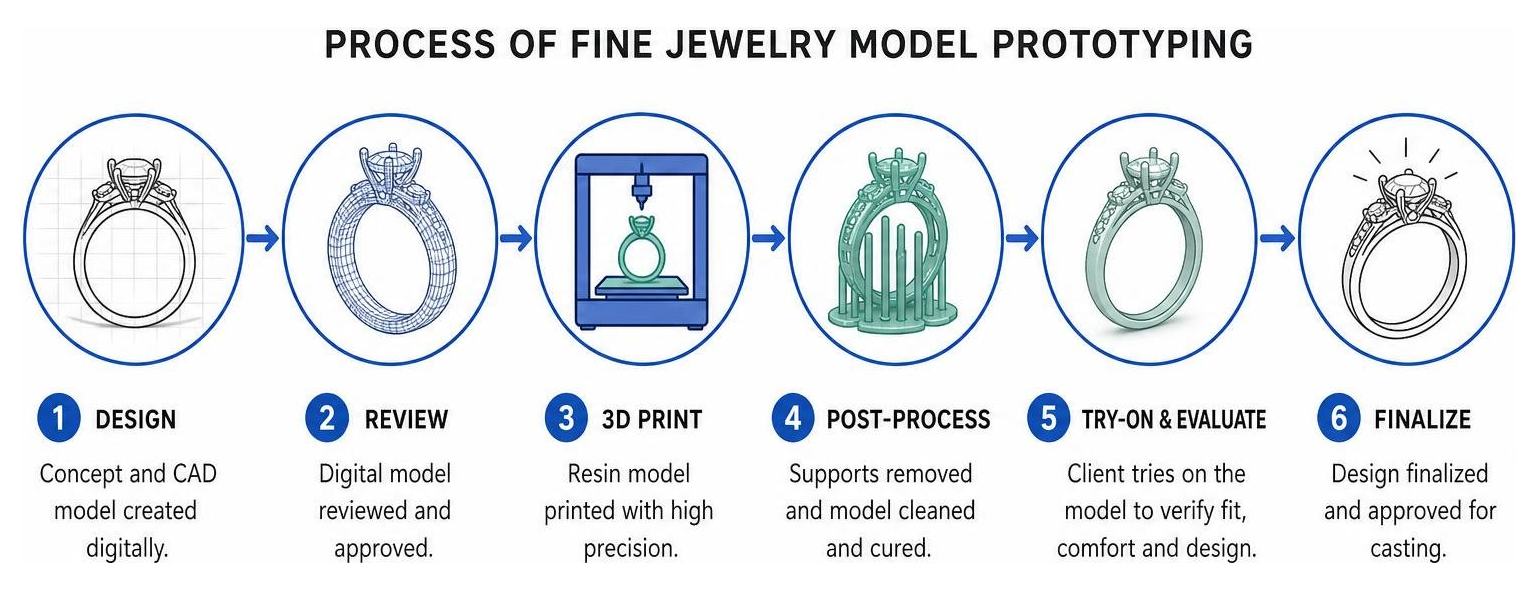
Clients can slip these resin model rings onto their fingers during private consultations to evaluate comfortable finger sizing, verify center stone height relative to daily activities, and inspect band contours from every perspective. If a customer prefers a wider band or a lower basket setting, adjustments are made directly in the digital file before casting the piece in gold or platinum. This practical step eliminates guesswork and guarantees full satisfaction before metalwork begins.
Unpacking InclusionAI's Ring-2.5-1T and Ring-V2 Architectures
In modern machine learning literature, "Ring" denotes a series of landmark artificial intelligence models developed by InclusionAI. These computational frameworks have advanced research in open-source reasoning models.
Architectural Evolution From Ring-V2 to Ring-2.5-1T
InclusionAI's model series represents a clear technological evolution in artificial intelligence architectures:
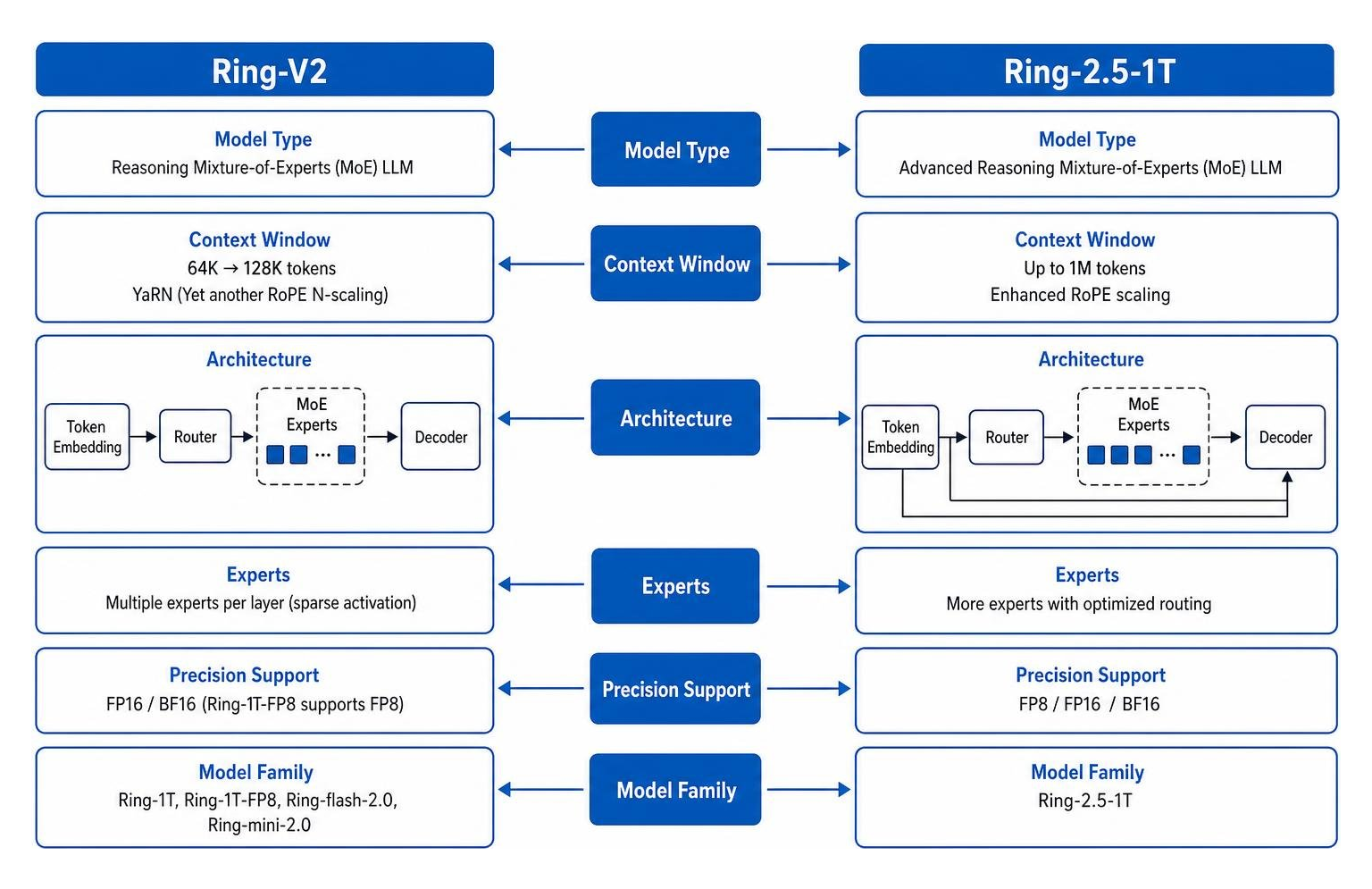
- Ring-V2: Introduced as a reasoning Mixture-of-Experts (MoE) Large Language Model (LLM). It introduced context window scaling from 64K to 128K tokens utilizing YaRN (Yet another RoPE N-scaling) context expansion. The family included models such as Ring-1T, Ring-1T-FP8, Ring-flash-2.0, and Ring-mini-2.0. Explore its code base via the official InclusionAI Ring-V2 GitHub repository.
- Ring-2.5-1T: A open-source trillion-parameter thinking model based on a hybrid linear attention architecture. Ring-2.5-1T combines Multi-head Linear Attention (MLA) with Lightning Linear Attention in a 1:7 ratio. This hybrid construction increases activated parameter counts from 51 billion to 63 billion, expanding context capacity from 128K up to 256K tokens.
By combining attention mechanisms, Ring-2.5-1T drastically reduces Key-Value (KV) cache memory footprints. This structural shift reduces memory access overhead by more than 10x and boosts generation throughput by over 3x for sequence lengths exceeding 32,000 tokens. To inspect model weights and technical deployment instructions, developers access the InclusionAI Ring-2.5-1T Hugging Face repository and the open code framework on InclusionAI Ring-V2.5 GitHub.
Mathematical Benchmarks and Long-Horizon Thinking
The Ring-2.5-1T architecture excels at deep thinking and long-horizon execution tasks, demonstrating remarkable scores across benchmark mathematical competitions and software engineering challenges:
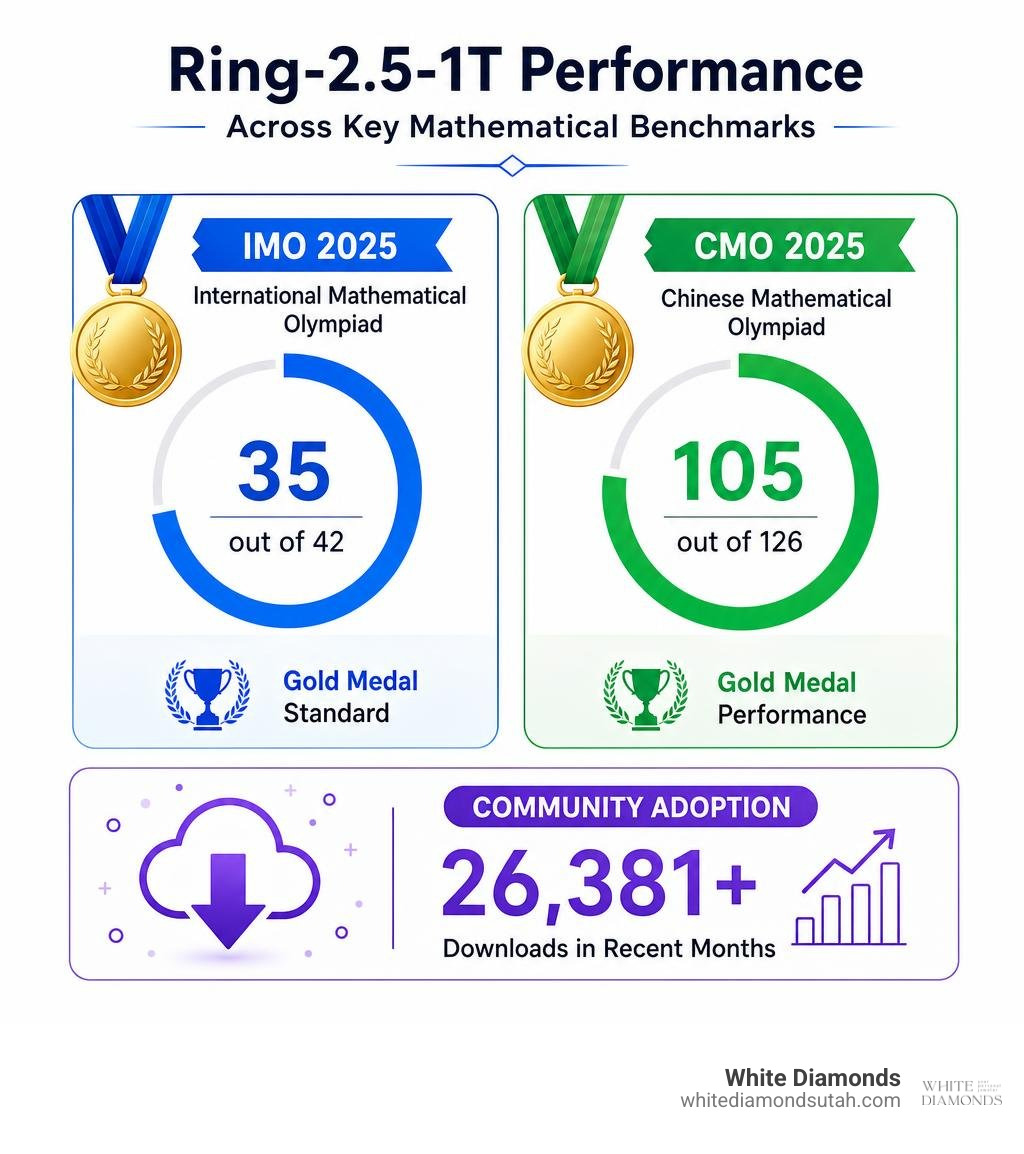
- IMO 2025 (International Mathematical Olympiad): Reached gold medal standard, scoring 35 out of 42.
- CMO 2025 (Chinese Mathematical Olympiad): Achieved gold medal performance, scoring 105 out of 126.
- Community Adoption: Downloaded over 26,381 times in recent months, demonstrating strong adoption across academic and industrial research communities.
Frequently Asked Questions About Model Rings
To summarize the broad spectrum of topics surrounding model rings, the comparative table below contrasts the main categories discussed in this guide:
| Feature / Aspect | AI Ring Model Generators | 3D Printable Ring Models | AI Language Models (Ring Series) | Physical Jewelry Sample Models |
|---|---|---|---|---|
| Primary Domain | E-commerce photo production | Desktop manufacturing & toys | Deep learning & artificial intelligence | Fine jewelry custom design |
| Output Type | Photorealistic 2D lifestyle photos | Physical plastic/resin objects | Text, code, & logical reasoning | Physical brass, wax, or resin samples |
| Primary Audience | Online jewelry retailers & marketers | 3D printing enthusiasts & makers | AI developers & researchers | Custom jewelry shoppers & buyers |
| Core Technology | Computer vision & generative AI | FDM/SLA 3D printing & CAD modeling | Trillion-parameter hybrid linear attention | Investment casting & precision wax printing |
| Main Benefit | Eliminates expensive photoshoots | Tangible sensory play & utility | Solves complex reasoning tasks | Guarantees exact fit & visual confidence |
How do AI ring model generators ensure accurate scale, setting height, and finger placement?
AI ring generators utilize specialized spatial alignment algorithms trained on vast databases of hands and jewelry geometry. When a product photo is submitted, the vision model identifies anatomical landmarks across the digital hand—such as knuckles, finger joints, and skin surfaces.
Simultaneously, the algorithm extracts the ring's geometric structural contours, isolating the band width, bezel edge, basket elevation, and main stone boundaries. The system then casts dynamic directional shadows across the skin, adjusts reflections according to environmental lighting, and scales the ring relative to standard human finger dimensions. This process yields realistic proportion, setting elevation, and natural placement on the digital hand.
What are the main differences between the Ring-V2 and Ring-2.5-1T AI models?
The primary differences stem from parameter architecture, attention mechanisms, and task execution speeds:
- Architecture: Ring-V2 relies on a standard sparse Mixture-of-Experts (MoE) design, whereas Ring-2.5-1T employs a hybrid linear attention architecture combining Multi-head Linear Attention (MLA) with Lightning Linear Attention in a 1:7 ratio.
- Memory Efficiency: Ring-2.5-1T reduces memory access overhead by over 10x compared to standard transformer baselines, enabling processing of long token sequences without memory bottlenecks.
- Throughput & Context Window: Ring-2.5-1T increases generation throughput by more than 3x on context lengths exceeding 32K tokens and scales its maximum context window up to 256K tokens via YaRN scaling.
- Parameter Scale & Performance: Ring-2.5-1T increases activated parameter scale to 63B (out of 1T total) and delivers gold-medal competitive math performance on IMO 2025 and CMO 2025 evaluations.
How do 3D printed fidget rings and rotating ring toys function mechanically?
3D printed fidget rings and gear toys function through print-in-place mechanical clearances engineered directly into the 3D model file:
- Mechanical Clearances: Designers build tiny offset gaps (typically 0.2mm to 0.3mm) between nested components within the digital 3D model.
- Layer-by-Layer Separation: During printing, the printer deposits filament layer-by-layer so that internal gears or outer bands remain structurally independent without fusing together.
- Post-Print Activation: Once the print finishes, gently twisting the concentric components snaps minimal microscopic bridge points, allowing internal gears or outer bands to rotate freely around central axes without secondary assembly.
Conclusion
Whether you are exploring digital image generators for an online store, printing sensory gadgets at home, or reviewing artificial intelligence breakthroughs, model rings offers versatile solutions across modern retail and technology.
For couples preparing to choose an engagement ring or custom wedding band, nothing replaces the confidence of holding a physical sample in your hands. Seeing a design in person removes all hesitation surrounding setting height, finger coverage, and metal styling.
At White Diamonds, we invite you to experience our relaxed, pressure-free custom ring consultations at our Ogden, Utah showroom. We walk you through every step of the custom design process using physical model rings and detailed previews tailored to your budget and ideal timeline. Explore our custom design options and browse our collections of Fashion Rings, Luxury Fashion Rings Guide 2026, Cool Men Ring, Guys Fashion Rings, and Mens Rings. If you are considering a playful style, read our tips on Bow Style Ring designs or browse our Flower Style Tips Guide 2026. Visit us today to bring your custom fine jewelry vision to life!