Don't Get Scammed When Selling Your Old Diamond Rings
What to Know Before Visiting Jewelry Stores Near Me That Buy Rings
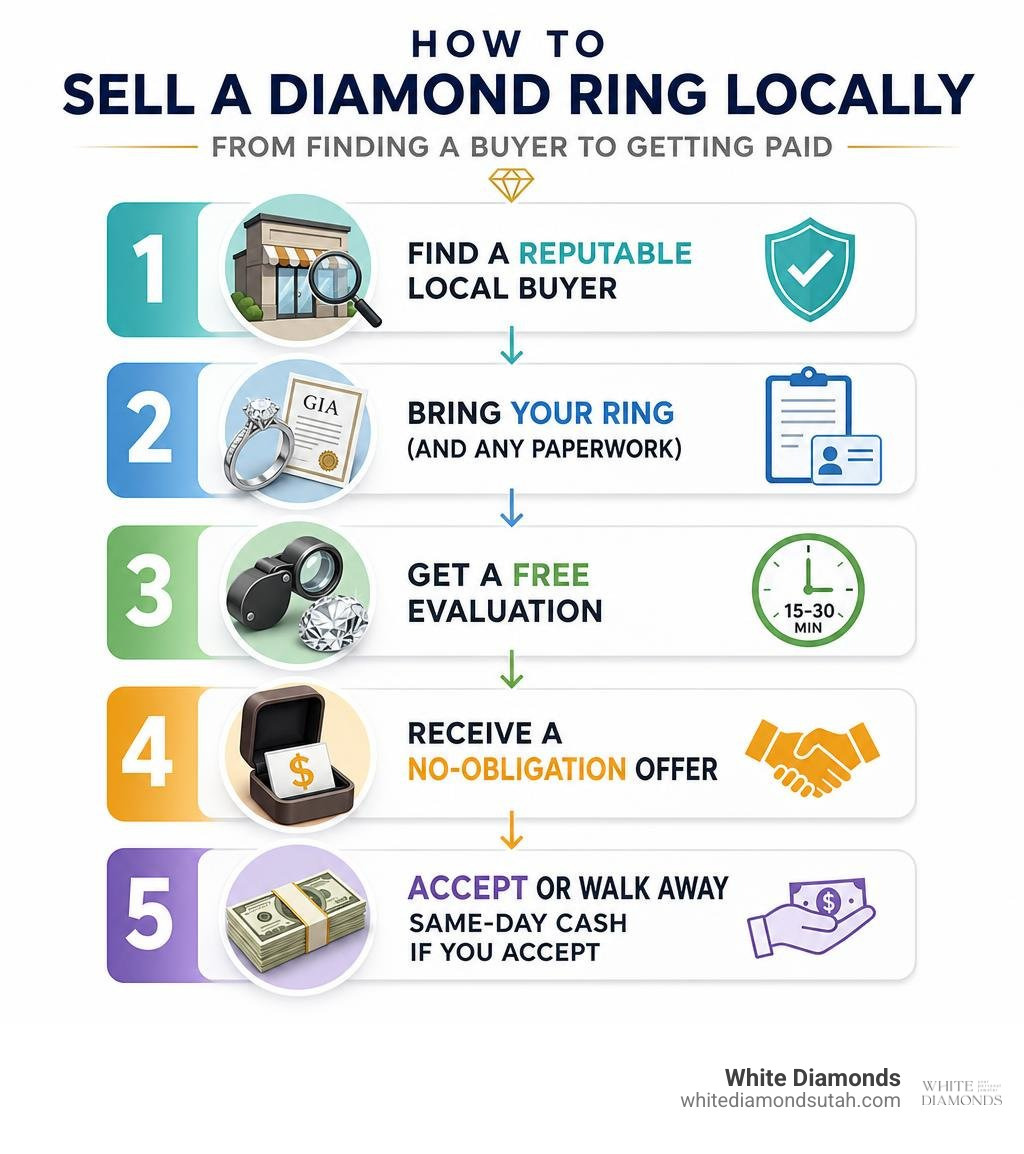
When you start looking at jewelry stores near me that buy rings, here's a quick overview of what to expect:
| Step | What Happens |
|---|---|
| 1. Find a reputable local buyer | Look for GIA-trained staff, licensing, and strong reviews |
| 2. Bring your ring (and any paperwork) | GIA certificates, government-issued ID |
| 3. Get a free evaluation | Takes roughly 15–30 minutes in person |
| 4. Receive a no-obligation offer | Based on the 4 Cs, metal, designer, and era |
| 5. Accept or walk away | Same-day cash if you accept — no pressure |
You finally decided to sell your old diamond ring. Maybe it's from a past relationship. Maybe you inherited it and it's just sitting in a drawer. Either way, you want real money for it — and you don't want to get lowballed.
The problem? Most people have no idea what their ring is actually worth on the resale market. And some buyers count on that.
Retail appraisals — the kind used for insurance — can be 2 to 3 times higher than what a resale buyer will actually pay you. That gap trips up a lot of first-time sellers. They walk in expecting one number and leave confused (or worse, taken advantage of).
The good news: once you understand how local buyers think, the process is actually pretty simple and straightforward.
At White Diamonds, we work with customers every day who are navigating the ring resale market alongside their custom jewelry needs — so we know exactly what jewelry stores near me that buy rings look for, and how to make sure you get a fair deal. Read on for everything you need to know before you walk through any buyer's door.
How to Find Reputable Jewelry Stores Near Me That Buy Rings
When you search for jewelry stores near me that buy rings in Utah, you will likely see a mix of traditional jewelry showrooms, pawn shops, and specialized estate buyers. Sorting the trustworthy experts from the predatory operations is your very first step.
To protect yourself and your assets, look for these three key indicators of a reputable buyer:
- On-Staff GIA Gemologists: The Gemological Institute of America (GIA) is the global authority on diamond grading. A store employing GIA-trained professionals has the technical expertise to accurately grade your diamond under a loupe, ensuring you receive a fair offer based on actual market value rather than a conservative guess.
- Proper Municipal Licensing: Secondhand jewelry buyers must comply with strict local municipal licensing laws. These regulations require buyers to verify identities and sometimes hold items for a short period to prevent the trade of stolen goods. A licensed dealer is a transparent dealer.
- A Proven Local Track Record: Look for established businesses with deep roots in the community. For example, some of the top-rated estate diamond buyers boast over 2,000 verified Google reviews with a 4.9-star rating. You want to find a family-owned business that has built trust over many years by offering honest, face-to-face evaluations. You want that same level of established trust here in Utah.
If you are looking for local experts in the Ogden area to guide you through your jewelry journey, check out our Best Jewelers Ogden Guide 2026 to find trusted resources near you.
Understanding How Buyers Determine Your Ring's Value
Before you step into a shop, you must understand the difference between what you paid retail (or what your insurance appraisal says) and what the secondary market will pay.
Insurance appraisals calculate "retail replacement value"—the cost to replace the ring with a brand-new equivalent at full retail price, including retail markups, marketing costs, and sales commissions. This number is typically 2 to 3 times higher than the actual resale value. The table below illustrates how these two valuation methods differ:
| Factor | Retail / Insurance Appraisal | Resale Market Value |
|---|---|---|
| Purpose | Insurance coverage & replacement cost | Immediate cash liquidation / secondary market trade |
| Markup Included | Yes (often 200% to 300% retail markup) | No (evaluates raw materials and secondary demand) |
| Focus | Cost of labor, brand premium, and retail overhead | Melt value of metal + wholesale value of certified stones |
| Evaluation Basis | Theoretical retail replacement cost | Current secondary market demand |
To get a sense of how retail pricing works on the front end, you can read our Guide to Buying Diamond Engagement Rings in Utah. When selling on the secondary market, buyers strip away those retail markups and calculate value based on raw materials, designer pedigree, and historical era.
Evaluating the 4 Cs and Precious Metals at Jewelry Stores Near Me That Buy Rings
The core value of any diamond ring rests on its physical components: the diamond itself and the precious metal setting.
First, the buyer will evaluate the diamond using the standard 4 Cs:
- Carat Weight: The physical size of the stone. Larger center stones (especially those 1.0 carat and up) command exponentially higher prices per carat.
- Cut: How well the diamond returns light. A well-cut diamond sparkles brilliantly and is much easier for a buyer to resell.
- Color: Graded on a D-to-Z scale. Colorless stones (D, E, F) command the highest premiums, while stones with noticeable yellow tints sell for less.
- Clarity: The presence of internal inclusions or surface blemishes.
Next comes the metal value. Buyers calculate this by weighing the ring and identifying the purity of the gold (e.g., 10k, 14k, 18k) or platinum. While the metal has a baseline "melt value," high-quality diamonds and accent stones can add 20% to 200% on top of the raw metal value.
The Impact of Designer Brands and Historical Eras on Resale Value
If your ring isn't a standard modern design, its origin story might net you a significant premium.
- Designer Brands: Recognized maker's marks from legacy houses like Tiffany & Co., Cartier, Van Cleef & Arpels, or Harry Winston add value far above the raw cost of the metal and stone. Buyers research secondary market demand for these specific brands because they can resell them as branded luxury pieces rather than scrap.
- Historical Eras: Rings from the Art Deco (1920s–1930s), Edwardian, or Victorian eras often carry collector premiums. These rings feature unique hand-cut diamonds (like Old European or Old Mine cuts) and intricate filigree work that cannot be easily replicated today.
If you want to understand how different styles hold their appeal over time, take a look at our Wedding Rings Utah Guide 2026.
The Step-by-Step Process of Selling Your Ring In Person
Selling a ring in person is highly recommended because it keeps you in control. Unlike online mail-in services where you must ship your jewelry away, an in-person evaluation allows you to watch the entire process.
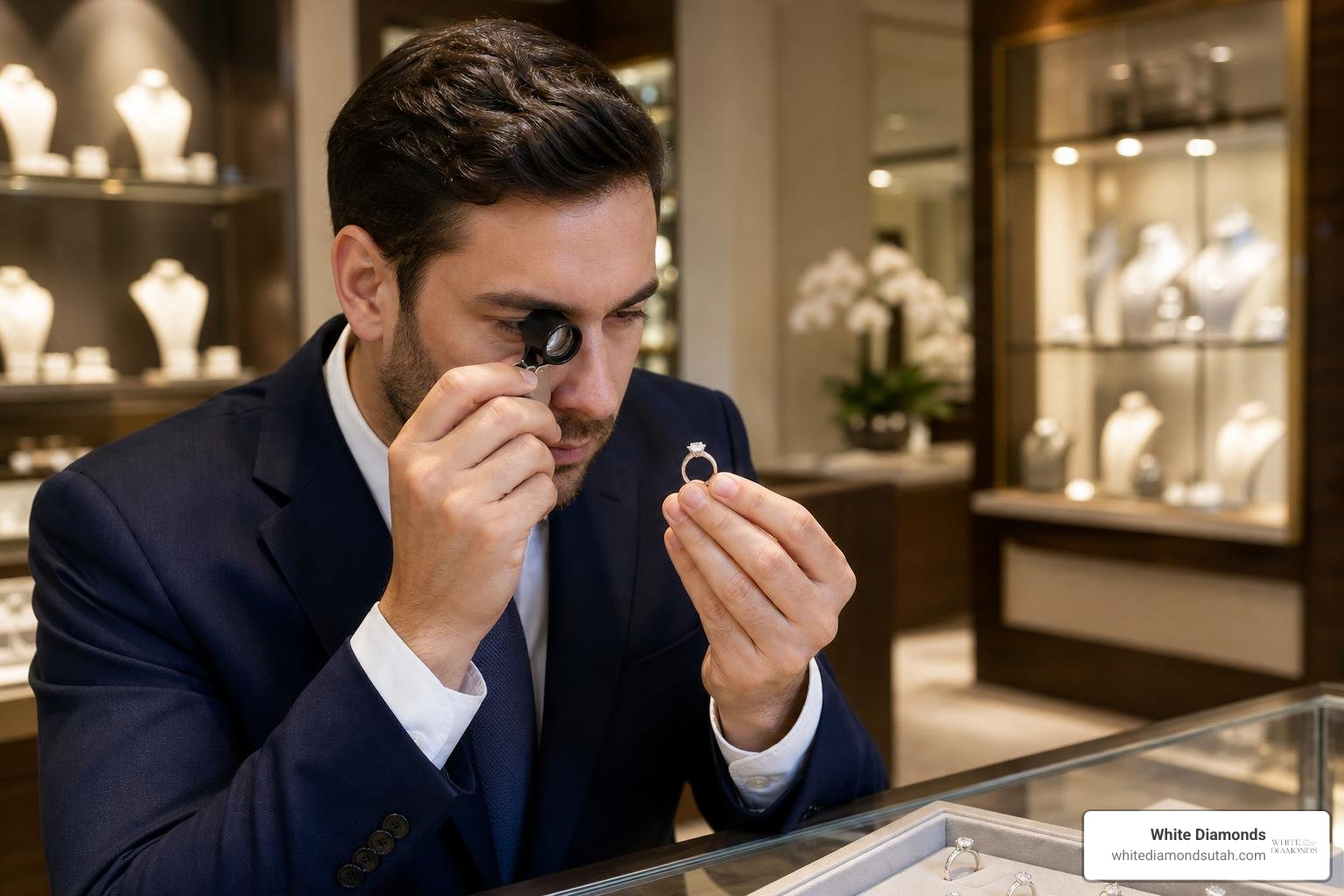
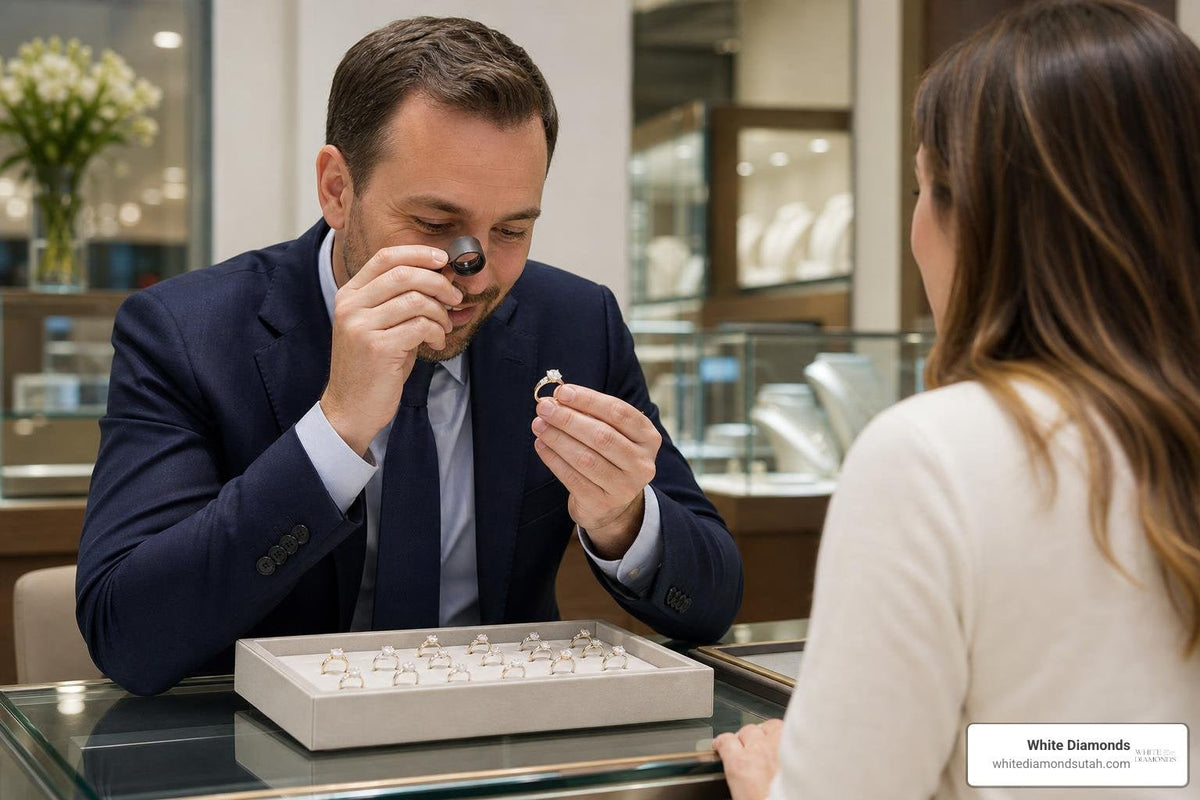
At professional establishments, a standard diamond ring evaluation takes just 15 to 30 minutes. During this time, on-staff gemologists will walk you through the testing process in real time so you can see exactly how they evaluate your piece.
Here is what you can expect during those 20 minutes:
- Inspection: The jeweler examines your ring under magnification to verify the metal stamp, inspect the stones, and check for damage.
- Testing: They will use a thermal conductivity tester to confirm the stone is a natural diamond and weigh the piece on a certified scale.
- The Offer: The buyer will present a verbal, no-obligation offer based on current market sheets.
- Payment: If you accept, you receive immediate payment—usually via cash, check, or wire transfer—before you leave the store. If you decline, you walk out with your ring. No hard feelings.
Preparing Your Paperwork and ID for Jewelry Stores Near Me That Buy Rings
To make the process as smooth as possible, bring any documentation you have.
If you have a original GIA or IGI laboratory grading report, bring it. This paperwork confirms the quality of your stone, saving the jeweler time and often resulting in a higher, more confident offer. Original purchase receipts, branded boxes, and old appraisals are also helpful.
Additionally, you must bring a government-issued photo ID (such as a driver's license or passport). State and local laws require licensed secondhand dealers to log the identity of anyone selling precious metals to deter theft. Sellers must also be at least 18 years old.
If you are looking for a trusted location to discuss your jewelry options, check out our guide on finding a reliable Diamond Retailer Near Me.
Selling Outright vs. Trading In for a Custom Design: Which is Right for You?
If you are letting go of an old ring, you have two primary paths: selling it outright for immediate cash, or trading it in to offset the cost of a beautiful new custom design.
At White Diamonds, we specialize in custom design, and we frequently help clients repurpose old jewelry into modern, sentimental pieces they actually want to wear.
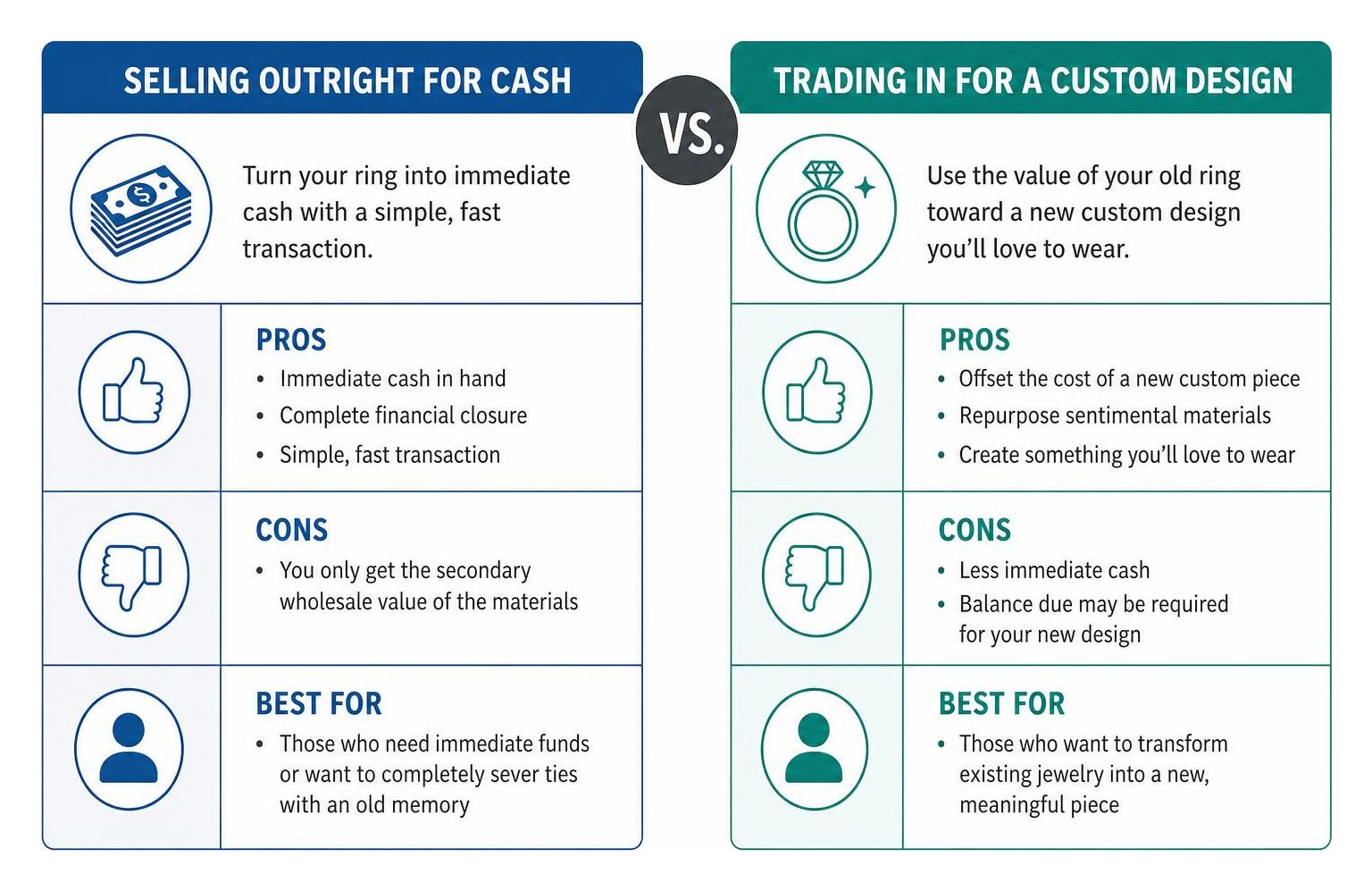
Selling Outright for Cash
- Pros: Immediate cash in hand; complete financial closure; simple, fast transaction.
- Cons: You only get the secondary wholesale value of the materials.
- Best For: Those who need immediate funds or want to completely sever ties with an old memory.
Trading In for a Custom Design
- Pros: You get maximum value for your materials because you bypass the middleman; you can reuse your original family diamond in a fresh, modern setting; highly budget-friendly way to upgrade.
- Cons: Requires a bit of time to design and manufacture the new piece.
- Best For: Anyone looking to upgrade an old engagement ring, design a custom anniversary piece, or transform inherited family heirlooms into wearable art.
If the idea of turning your old gold and gemstones into a breathtaking, personalized piece appeals to you, visit our Customize Jewelry Store page to see how we make the custom design process collaborative, pressure-free, and budget-friendly.
Frequently Asked Questions About Selling Rings
Do I need a formal appraisal or certificate before selling my diamond ring?
No, you do not need to pay for a formal written appraisal before selling. Most buyers provide a complimentary verbal evaluation on the spot. Written appraisals are meant for insurance companies and will not force a secondary buyer to pay retail prices. However, if you have an existing GIA certificate, definitely bring it along, as it verifies your stone’s exact grades.
If you are wondering about the condition of your jewelry before bringing it in, you can learn more about how jewelers evaluate settings in our guide to Diamond Jewelry Repair.
Can I sell damaged, broken, or single earrings and rings?
Yes! Broken chains, bent gold rings, and single earrings still hold significant value based on their raw metal content. A professional buyer will calculate the "melt value" of the gold or platinum. If the damaged piece contains small diamonds (melee), those can often be salvaged and purchased as well.
If you have a piece you love that is damaged, you might want to explore repairing it first. Read our comprehensive resource on Jewelry Repair in Utah: What to Expect, Where to Go to weigh your options.
Do local jewelry buyers purchase lab-grown diamond rings?
Yes, but with very different pricing structures. Lab-grown diamonds have identical physical properties to natural diamonds, but they do not hold the same rarity value. Because the cost to manufacture synthetic diamonds continues to fall, the resale market for lab-grown stones is subject to a massive discount compared to natural diamonds of the same grade. A local buyer will evaluate your lab-grown ring, but expect the offer to reflect its lower secondary market value.
For tips on maintaining your jewelry's condition to preserve whatever resale value it has, check out our Jewelry Repair Tips Guide 2026.
Conclusion
Selling an old diamond ring doesn't have to be a stressful or intimidating process. By seeking out reputable, licensed dealers with GIA-trained staff, understanding the difference between retail appraisals and resale value, and keeping your expectations rooted in current market realities, you can confidently navigate the secondary market without getting scammed.
If you are located in Utah and are ready to explore your options, we invite you to visit us at White Diamonds in Ogden. While we do not operate as a high-volume scrap pawn shop, we specialize in helping clients maximize the value of their old jewelry through our custom trade-in program.
Whether you want to sell your materials or trade them in toward a stunning, custom-designed piece within your exact budget and timeline, our team provides personalized, pressure-free consultations.
Ready to see what's possible? Read our Guide to Buying Diamond Engagement Rings in Utah and schedule an appointment with us today. Let's turn your old jewelry into something you will love forever.