Why an Alexandrite Wedding Band Might Be Your Best Decision
The Alexandrite Wedding Band: A Rare Gem Worth Knowing Before You Buy
An alexandrite wedding band is one of the most unique choices you can make for a lifelong piece of jewelry — and it's gaining real attention among couples who want something beyond the ordinary.
Quick answer: Is an alexandrite wedding band a good choice?
- Yes, if you want something rare. Alexandrite is one of the scarcest gemstones in the world — rarer than emerald or ruby at the finest grades.
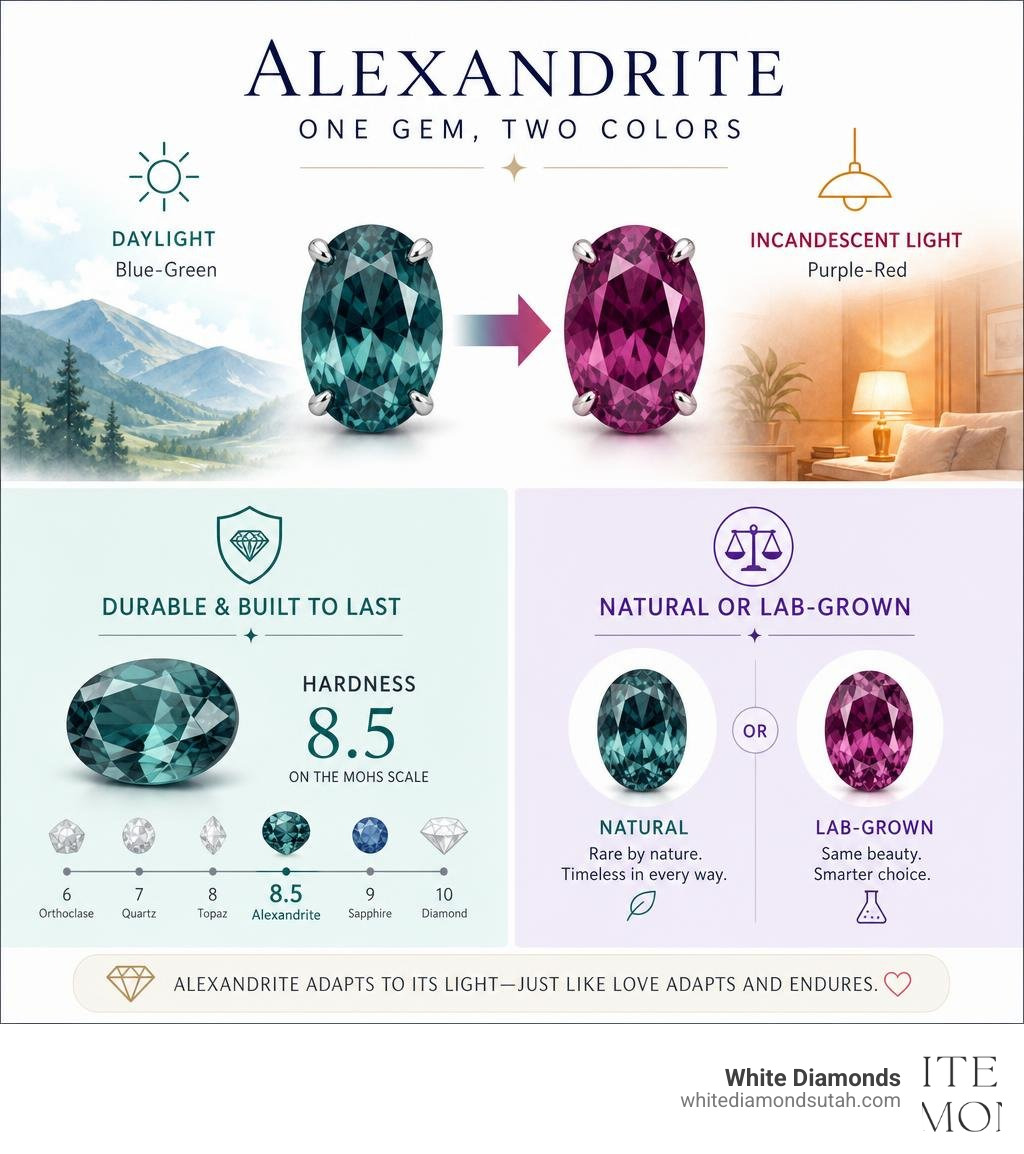
- Yes, if you love symbolism. It shifts from blue-green in daylight to purplish-red under warm light — a built-in metaphor for love that adapts and edures.
- Yes, if you're budget-aware. Lab-grown alexandrite gives you the same color-change effect at a fraction of the cost of natural stones.
- Consider carefully if durability is a top concern. At 8.5 on the Mohs scale, it's tough — but not quite as hard as sapphire (9) or diamond (10).
- Act sooner rather than later. Natural alexandrite supply is tightening fast as major mines have closed, and prices are rising each year.
The stone was discovered in 1830 in Russia's Ural Mountains and named after Tsar Alexander II — its colors happened to match the imperial Russian palette of green and red. That origin story alone gives it a romance that few gemstones can match.
Here at White Diamonds, we're a custom jewelry studio specializing in crafting personalized rings and wedding bands — including alexandrite wedding band designs tailored to your style and budget. We're here to walk you through every decision, without pressure and without rush.
Why Choose an alexandrite wedding band?
When you choose a wedding band, you are selecting a symbol of your relationship that you will look at every single day. While diamonds are the traditional default, more couples in Utah and beyond are seeking out gemstones that tell a more dynamic story. An alexandrite wedding band does exactly that.
The most captivating feature of alexandrite is its optical phenomenon: it is a true color-change gemstone. This isn't a subtle shimmer or a slight shift in tone; it is a dramatic transformation. In natural daylight, a high-quality alexandrite presents a cool, crisp bluish-green or teal hue. Step indoors under warm, incandescent lighting, and the gemstone shifts into a rich, warm purplish-red or raspberry tone.
This dramatic shift is caused by the presence of chromium impurities within the chrysoberyl crystal lattice. The chromium absorbs light in a highly specific way, balancing equally between transmitting green and red wavelengths. Whichever light source is dominant in your environment dictates the color the stone throws back to your eyes.
Beyond the fascinating physics, this color-changing property carries deep romantic symbolism. Many couples view the transition from cool daylight teal to warm evening red as a beautiful metaphor for a marriage:
- Adaptability: The ability to change and remain beautiful in different environments.
- Balance: A harmonious union of two distinct and beautiful phases.
- Growth and Passion: Green represents new beginnings, health, and growth, while red symbolizes passion, warmth, and enduring love.
Additionally, alexandrite is celebrated as the birthstone for June and the traditional gemstone for the 55th wedding anniversary. Whether you are celebrating a June wedding date, marking a birth month, or simply drawn to its mystique, it offers a level of individuality that a standard diamond band cannot replicate. To see how it compares to other unique options, you can Learn more about gemstone rings in our comprehensive guide.
Natural vs. Lab-Grown Alexandrite: Rarity and Reality in 2026
If you are shopping for an alexandrite wedding band in June 2026, the first major decision you will face is whether to go with a natural or a lab-grown gemstone. The reality of the gemstone market has shifted dramatically over the last few years, making this choice more critical than ever. For a neutral gemological overview of alexandrite, the Gemological Institute of America explains alexandrite's color-change properties and history.
To help you understand the landscape, here is a direct comparison of how natural and lab-grown options stack up today:
| Feature | Natural Alexandrite | Lab-Grown Alexandrite |
|---|---|---|
| Origin | Mined from geological deposits | Grown in a controlled laboratory environment |
| Chemical Composition | Chrysoberyl ($BeAl2O4$) with Chromium | Chemically and physically identical chrysoberyl |
| Availability | Critically scarce; virtually no new mining | Readily available and highly customizable |
| Color Change Quality | Ranges from weak to strong; highly variable | Consistently strong, vivid color change |
| Average Price (per carat) | $10,000 to over $30,000 for fine grades | $100 to $500 |
| Certification | Requires GIA certification to prove natural origin | Comes with certificate of authenticity |
The Scarcity of a Natural alexandrite wedding band
Natural alexandrite is one of the rarest commodities on Earth. The original deposits in Russia's Ural Mountains were largely depleted by the early 20th century. While small deposits were later found in Brazil, Sri Lanka, and East Africa, high-end natural specimens have remained incredibly scarce.
The supply situation reached a critical turning point recently: the last major commercial alexandrite mine closed a few months ago in early 2026. Because the mine dried up, there will be no new gem-quality large stones entering the market for the foreseeable future. Combined with global inflation, this has caused the price of natural alexandrite to skyrocket.
If you are determined to purchase a natural alexandrite wedding band, it must be treated as both a luxury purchase and a serious investment. You should always insist on a Gemological Institute of America (GIA) certificate to verify its natural origin. Because of their immense scarcity, natural alexandrites hold their value remarkably well and make incredible heirloom pieces to pass down through generations.
The Benefits of a Lab-Grown alexandrite wedding band
For couples who love the look of alexandrite but do not want to spend the equivalent of a home down payment on a ring, lab-grown alexandrite is an incredible solution.
It is important to understand that lab-grown alexandrite is not "fake." It is chemically, physically, and optically identical to mined chrysoberyl. Using advanced methods like the Czochralski puling technique or hydrothermal growth, scientists replicate the exact high-pressure, high-temperature conditions found deep in the Earth.
The benefits of choosing a lab-grown stone for your wedding band include:
- Affordability: You can purchase a stunning, multi-stone lab-grown band for a fraction of the cost of a single small natural stone.
- Color Quality: Lab-grown stones are engineered to have highly saturated, flawless color transitions, giving you that ideal teal-to-purple shift every single time.
- Ethical Sourcing: Lab-created stones have a highly transparent supply chain with minimal environmental impact.
To explore various design aesthetics, you can work with a custom jeweler to see how beautifully lab-grown gems perform in modern settings.
Designing Your Perfect Alexandrite Band: Metals and Styles
Because alexandrite is a color-shifting chameleon, the metal and the setting style you choose will play a major role in how the gemstone behaves.
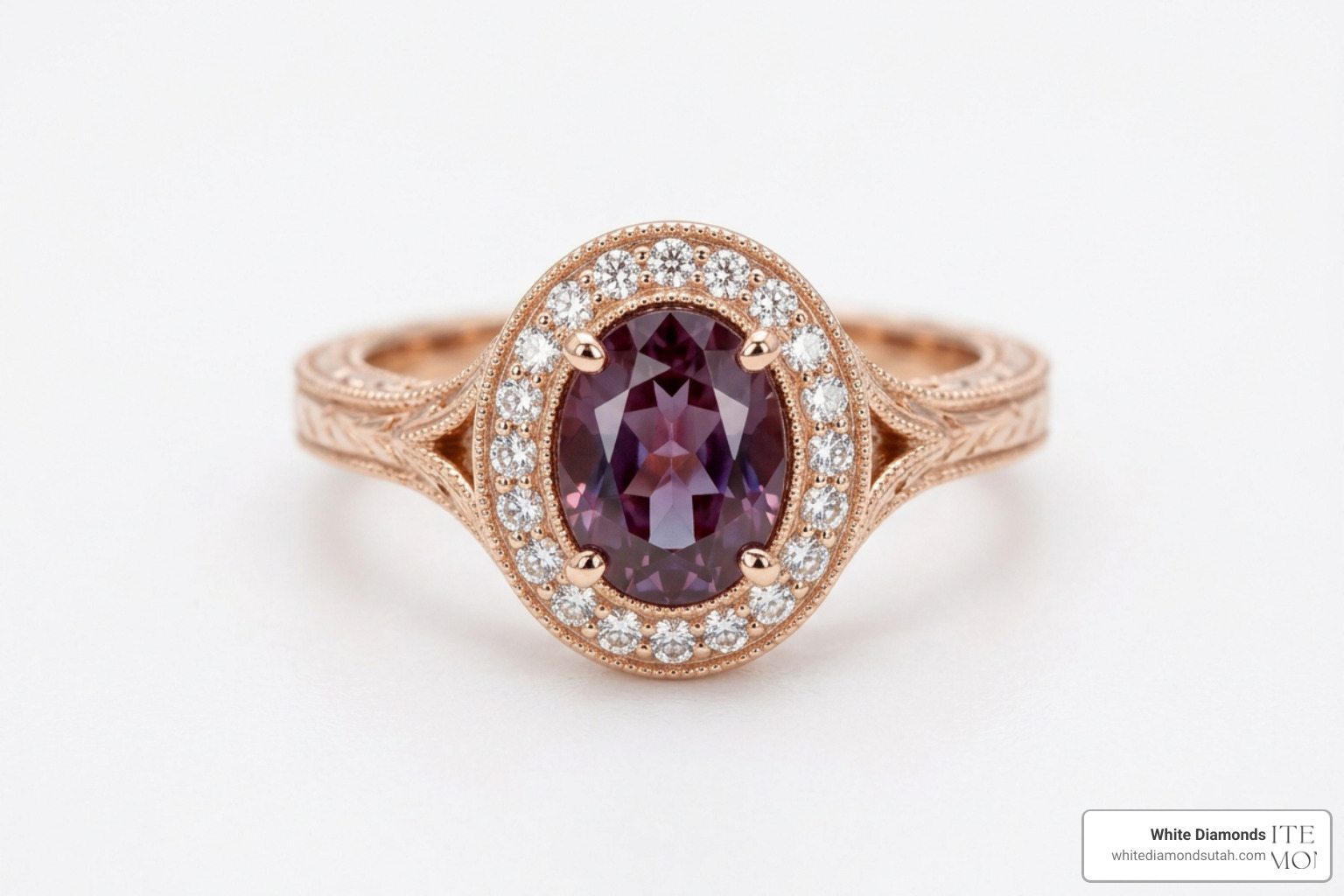
When planning your design, it helps to understand how different settings frame the stone. For a deeper dive into settings, you can Read our guide on choosing a diamond ring setting to see how various designs impact light performance and gemstone security.
Best Metal Pairings for Alexandrite
The choice of precious metal can either contrast or complement the dual color phases of your alexandrite.
- White Gold and Platinum: These cool-toned metals act as a neutral frame. They beautifully highlight the cool blue-green daylight phase of the stone, making it look crisp and modern. To explore premium options, look into how 18k Gold Wedding Rings provide a luxurious weight and lasting luster.
- Yellow Gold: Yellow gold offers a stunning vintage contrast. The warmth of the gold makes the purplish-red incandescent phase look incredibly rich, while providing a striking, earthy contrast to the green daylight phase.
- Rose Gold: Rose gold is a highly popular pairing for alexandrite. The pinkish undertones of the metal naturally harmonize with the warm raspberry and purple tones of the stone under warm light, creating a highly romantic, whimsical aesthetic.
If you prefer a contemporary, textured look rather than a high-polish shine, you can also Check out brushed wedding bands to see how matte finishes can make the colors of an alexandrite pop even more.
Popular Setting Styles and Customization
Whether you want a standalone band or a matching bridal set, there are several ways to showcase this gemstone:
- The Half-Eternity Band: A classic wedding band featuring a row of alternating alexandrites and diamonds. The brilliant white of the diamonds acts as a constant accent, making the color shifts of the alexandrite even more dramatic.
- Vintage-Inspired Sets: Curved marquise or pear-cut cluster bands that wrap around an engagement ring like a crown. Many couples love pairing a classic pear-cut center stone with a delicate, sweeping wedding band to create a cohesive, royal look.
- Tension and Bezel Settings: Modern, sleek, and highly protective. Bezel settings wrap precious metal entirely around the stone, keeping it secure for daily wear.
- Unique Inlays: For a truly custom, rugged look, some modern bands incorporate alternative materials. For example, some custom designs combine gemstones with meteorite or textured metal inlays to create a one-of-a-kind aesthetic.
How Alexandrite Compares to Other Bridal Gemstones
When selecting a gemstone for a wedding band, durability should be a key factor in your decision-making. Since your wedding band is worn daily, it will inevitably come into contact with hard surfaces, household chemicals, and accidental bumps.
Gemstone hardness is measured using the Mohs scale, which rates a mineral's resistance to scratching from 1 (softest) to 10 (hardest). Here is how alexandrite stacks up against other popular wedding band options:
- Diamond (Mohs Hardness: 10): The undisputed king of durability. Diamonds are highly resistant to scratching and chipping, making them the ultimate choice for worry-free daily wear. You can Compare with classic bridal rings to see how traditional diamond bands compare in longevity.
- Sapphire and Ruby (Mohs Hardness: 9): Part of the corundum family, sapphires and rubies are incredibly tough and highly recommended for daily-wear wedding bands.
- Alexandrite (Mohs Hardness: 8.5): Alexandrite is exceptionally durable. At 8.5, it is harder than emeralds, tanzanite, or opals. It is highly resistant to scratching and holds up beautifully to everyday wear, making it a very practical choice for a wedding ring.
- Emerald (Mohs Hardness: 7.5 to 8): While beautiful, emeralds are naturally prone to internal fractures (called jardin) and are much more brittle, making them riskier for a wedding band that sees heavy daily activity.
Essential Buying Factors and Care Tips
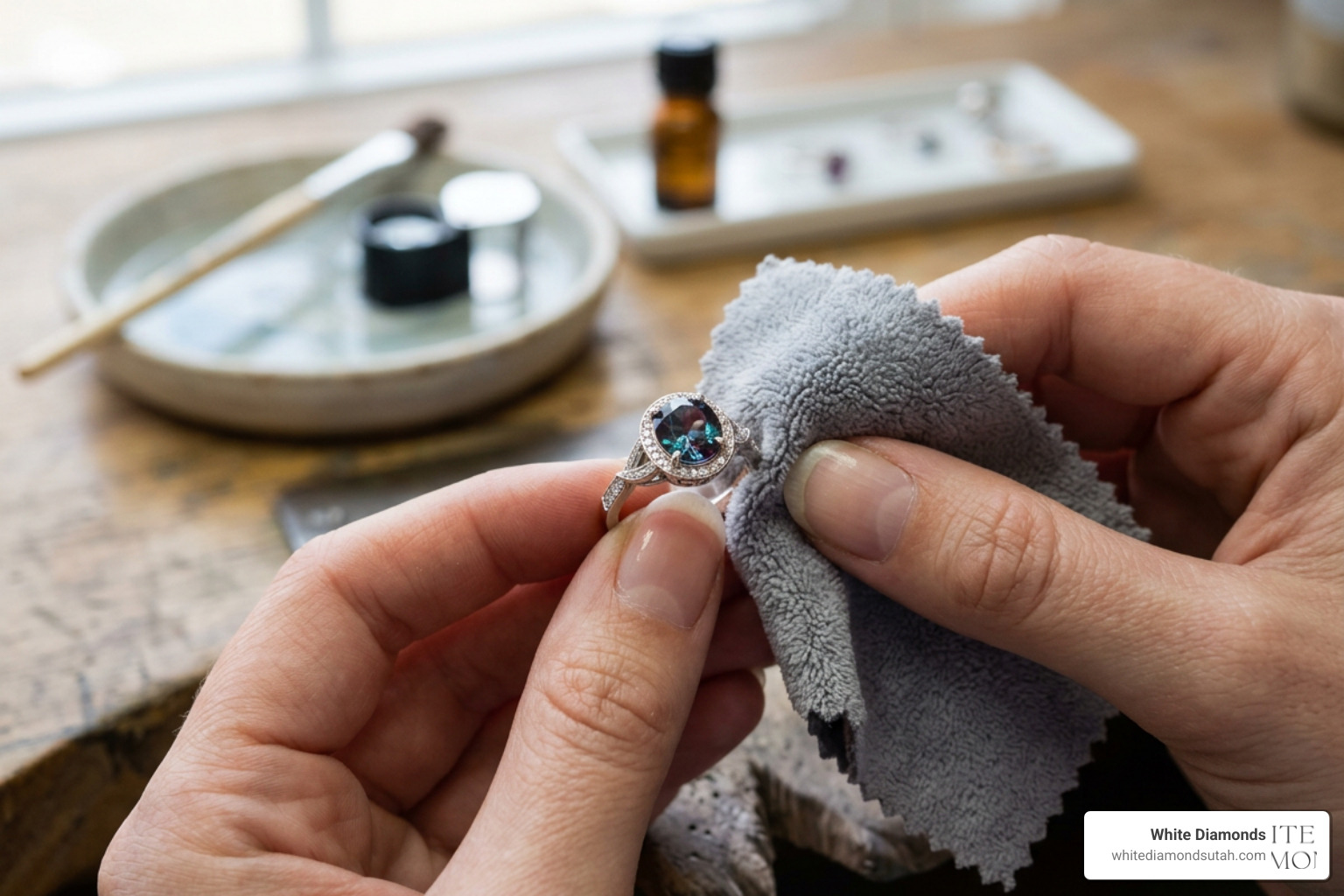
When shopping for an alexandrite wedding band, pay close attention to the following quality factors:
- Color Change Strength: This is the single most important factor. A high-quality stone should show a distinct, obvious color shift. Avoid stones that look muddy brown or grey in transitional lighting.
- Clarity: Look for eye-clean stones. Because alexandrite is so rare, minor inclusions are tolerated in natural stones, but lab-grown stones should be virtually flawless.
- Cut: A precise cut is vital to maximize the internal play of color and light return. Faceted cuts like oval, round brilliant, cushion, and marquise are excellent for showing off the color-change phenomenon.
Caring for Your Alexandrite Ring
To maintain the brilliant luster of your ring over the years, follow these simple care guidelines:
- Clean gently: Wash your ring with warm water, mild dish soap, and a very soft-bristled toothbrush.
- Avoid harsh chemicals: Remove your ring before swimming in chlorinated pools, using household cleaning agents, or applying heavy lotions.
- Skip the ultrasonic cleaner: While alexandrite is tough, repeated exposure to ultrasonic or steam cleaners can loosen stones in delicate settings over time. Stick to hand-washing.
- Store safely: Store your ring in a soft fabric pouch away from harder gemstones like diamonds, which could scratch the surface of your alexandrite.
Sizing and Resizing Considerations
Because of the unique structure of some multi-stone eternity bands, resizing can sometimes be a challenge. Before you purchase, it is highly recommended to get professionally sized. To understand what is possible down the road if your finger size changes, you can read our guide on Can Engagement Rings Be Resized.
Frequently Asked Questions about Alexandrite Rings
Is alexandrite durable enough for daily wear in a wedding band?
Yes, absolutely. With a Mohs hardness rating of 8.5, alexandrite is one of the hardest gemstones available for jewelry. It is highly resistant to scratching and can easily handle the demands of everyday wear. However, if your lifestyle involves heavy manual labor or high-impact activities, you might also want to See hammered mens wedding bands for durable alternatives or consider a highly protective bezel setting for your gemstone.
Why is natural alexandrite so expensive?
Natural alexandrite is incredibly scarce. With the closure of the last major commercial mine in early 2026, the global supply of new mined stones has completely halted. Because demand remains high and supply is fixed, high-quality, GIA-certified natural stones command premium investment-level prices.
Can I pair an alexandrite ring with a diamond band?
Yes! In fact, we highly recommend it. Pairing an alexandrite center stone with a diamond wedding band creates a stunning, high-contrast look. The classic fire of white diamonds beautifully frames and amplifies the color-shifting properties of the alexandrite, making both stones stand out.
Conclusion: Crafting Your Story in Utah
Choosing an alexandrite wedding band is a decision to embrace something rare, dynamic, and deeply personal. Whether you fall in love with the historical prestige of a natural stone or the flawless brilliance and affordability of a lab-grown gemstone, this color-changing chrysoberyl is guaranteed to turn heads and spark conversations for decades to come.
At White Diamonds in Ogden, Utah, we believe the jewelry-buying process should be just as special as the ring itself. We specialize in custom jewelry design, offering personalized, pressure-free consultations to help you design the perfect piece within your budget and timeline. We even provide physical model rings so you can see, feel, and customize your design in person before we begin crafting.
If you are ready to explore custom wedding bands or want to see how alexandrite looks in different metals, we invite you to Explore our latest wedding ring guides or book a one-on-one consultation with us today. Let’s build something beautiful together!