
Finding the Most Radiant 2 Carat Ruby for Your Budget
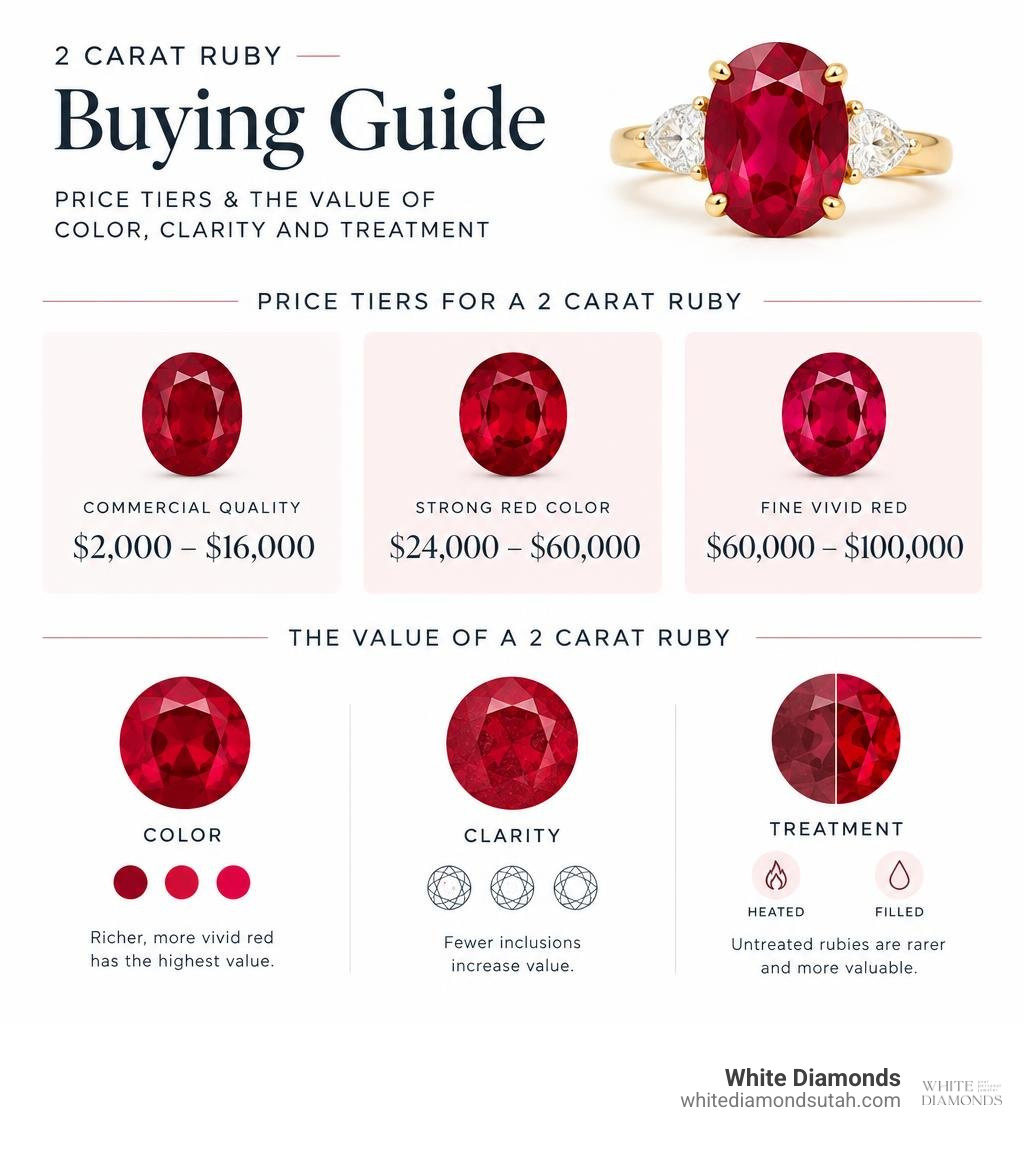
A 2 carat ruby can cost roughly $2,000–$16,000 for commercial quality, $24,000–$60,000 for strong red color, or $60,000–$100,000 for fine vivid red. These are broad loose-stone estimates, not fixed prices. To get the most color for your budget, compare rubies side by side, check for visible inclusions, and ask whether each stone has been heated or filled. A lab report matters most when a price depends on claims of no heat treatment or a prized origin.
We're White Diamonds, a Utah-based custom jeweler. We bring our experience crafting custom rings and wedding bands to helping you choose a 2 carat ruby that suits your design, budget, and timeline without pressure.
Key Factors Determining the Value of a 2 Carat Ruby
Evaluating fine colored gemstones is fundamentally different from grading white diamonds. While diamonds prioritize the absence of color and strict mathematical symmetry, rubies are judged primarily on their visual personality, saturation, and overall beauty. Ruby is the red variety of the mineral corundum, given its fiery appearance by trace amounts of chromium. That same chromium, while responsible for breathtaking red hues, also creates crystal strain during formation, making natural, high-clarity rough over one carat exceptionally scarce.
According to the GIA Ruby Buyers Guide, color is by far the most significant factor affecting a ruby's value. When selecting natural gemstones, we evaluate color through three distinct components:
- Hue: The primary red body color, along with any secondary tints like pink, purple, or orange.
- Tone: How light or dark the stone appears. The sweet spot is medium to medium-dark; if a stone is too dark, it looks muddy in dim lighting, while stones that are too light are classified by gemological laboratories as pink sapphires.
- Saturation: The intensity and purity of the red hue. Highly saturated stones command the greatest market premiums.
Clarity also plays a key role, though ruby standards differ dramatically from diamond grading. Finding a completely inclusion-free natural ruby of two carats is practically impossible. Instead, the benchmark is finding an "eye-clean" stone—one where natural inclusions are not immediately distracting to the unaided eye and do not threaten the structural integrity of the crystal. Fine needle-like rutile inclusions, known in the trade as "silk," can actually scatter light across the facets, softening the body color and giving the gem a warm, velvety glow.
The Coveted Pigeon's Blood Red Hue
In high-end colored gemstone collecting, no trade term carries more prestige than "pigeon's blood." Historically associated with the finest stones mined in Upper Burma (now Myanmar), this descriptor represents a vibrant, medium-dark, highly saturated red with a subtle, electric purplish-blue undertone.
What makes these stones look as though they are internally illuminated? It comes down to chemistry and optical physics. Burmese rubies generally have high chromium content combined with exceptionally low iron. Iron suppresses natural fluorescence, but when iron is absent, the chromium causes the ruby to fluoresce a bright crimson under ultraviolet light—including everyday sunlight. This means that instead of merely reflecting ambient light, a top-tier pigeon's blood gem literally glows from within.
Because of this unique optical property and supreme rarity, fine vivid red stones command astronomical prices. In record-breaking auction sales, exceptional rubies have yielded over one million dollars per carat. While high-grade investment pieces fetch top dollar, you do not need an auction-house budget to achieve spectacular red color in an engagement ring or custom pendant.
Origin Influence: Burma vs. Mozambique and Beyond
Geographic provenance heavily influences how collectors and dealers price a 2-carat ruby. Two stones of visually identical color and clarity can differ in price by 100% to 200% purely based on the mining country documented on an independent gemological laboratory report.
| Origin | Primary Color Characteristics | Fluorescence & Clarity | Price Multiplier Impact |
|---|---|---|---|
| Myanmar (Burma - Mogok & Möng Hsu) | Vivid pure red to purplish red ("Pigeon's Blood") | Extremely strong UV fluorescence; characteristic rutile silk | Highest premium (100%–200% above market baseline) |
| Mozambique (Montepuez) | Pure red to slightly pinkish-red, often excellent clarity | Moderate to strong fluorescence; high crystal transparency | Standard fine-gem market baseline; incredible value |
| Thailand & Cambodia | Deep red with darker garnet-like or brownish undertones | Low fluorescence due to higher iron content; high clarity | Moderate discount compared to East African or Burmese material |
| Sri Lanka (Ceylon) | Lighter, brighter red often leaning pink or raspberry | Strong fluorescence; high brilliance and luster | Accessible price point; great sparkle and transparency |
While Mogok rubies hold historical legendary status, Mozambique has revolutionized the gemstone world since deposits were uncovered in 2009. Mozambique rubies offer rich red saturation, fewer structural fractures, and outstanding transparency, allowing you to secure a larger, eye-clean stone at a significantly lower cost than historic Burmese material.
How Treatments and Rarity Drive Market Pricing
Understanding gemstone enhancements is vital when investing in a 2-carat center stone. Over 90% of the rubies in the global marketplace undergo some form of post-mining enhancement to improve color, dissolve internal rutile silk, and heal tiny microscopic fissures.
As detailed in the IGS Guide to Ruby Treatments, treatments exist on a wide spectrum, ranging from universally accepted traditional techniques to non-permanent, aggressive alterations:
- Traditional Heat Treatment (Thermal Enhancement): Gemstones are subjected to controlled high temperatures (often between 1,200°C and 1,800°C). This stable, permanent process mimics subterranean geological forces, improving clarity and removing brownish or bluish secondary tones. Heat-treated rubies are stable, durable for lifetime wear, and represent the vast majority of fine jewelry center stones.
- Flux Healing: During thermal treatment, flux materials (like borax) are introduced to help seal surface-reaching fractures. When disclosed properly, these stones remain durable, though priced lower than standard heated gems.
- Lead-Glass Filling / Fracture Filling: Low-grade, heavily fractured corundum is infused with high-refractive-index lead glass. While these stones look red and clear initially, they are fragile. Mild household acids, jewelry torches, or ultrasonic cleaners can damage or discolor the glass filling. We recommend avoiding lead-glass filled rubies for heirloom jewelry.
- Lattice Diffusion: Surface or sub-surface color is altered by introducing external chemicals (like titanium or beryllium) during high-temperature baking. If chipped or repolished, the unnatural color layer can be lost.
Full disclosure is paramount. A certified unheated 2-carat ruby with natural, vivid saturation is a rare collector's specimen, commanding anywhere from two to five times the price of a heated counterpart of similar appearance.
Understanding the Price Per Carat for a 2 Carat Ruby
In the diamond world, price curves climb steadily as carat weight increases. With natural rubies, prices increase on an aggressive, exponential curve at major weight milestones—specifically at the 1.00, 2.00, 3.00, and 5.00-carat thresholds.
To explore real-time market value trends across weights and origins, the Ruby Value Calculator illustrates how quality tiers shift pricing per carat. When budgeting for custom gemstone jewelry in Utah, consider these typical per-carat price benchmarks:
- Commercial Quality ($1,000–$8,000 per carat): Moderate to heavy inclusions, lighter or brownish-red body color, translucent rather than transparent. Total cost for a 2-carat stone ranges between $2,000 and $16,000.
- Good to Strong Red ($12,000–$30,000 per carat): Heated, eye-clean or slightly included, vivid red with attractive luster and good light return. Total stone price: $24,000 to $60,000.
- Fine Vivid Red ($30,000–$50,000+ per carat): Premium heated or entry-level unheated material with top-tier saturation, excellent eye-clean transparency, and balanced proportions. Total stone price: $60,000 to $100,000+.
- Unheated Burmese Collector Grade ($50,000–$100,000+ per carat): Fully certified unheated stones with top "pigeon's blood" saturation, exceptional crystal life, and documented heritage provenance.
Selecting the Ideal Cut and Setting for Daily Wear
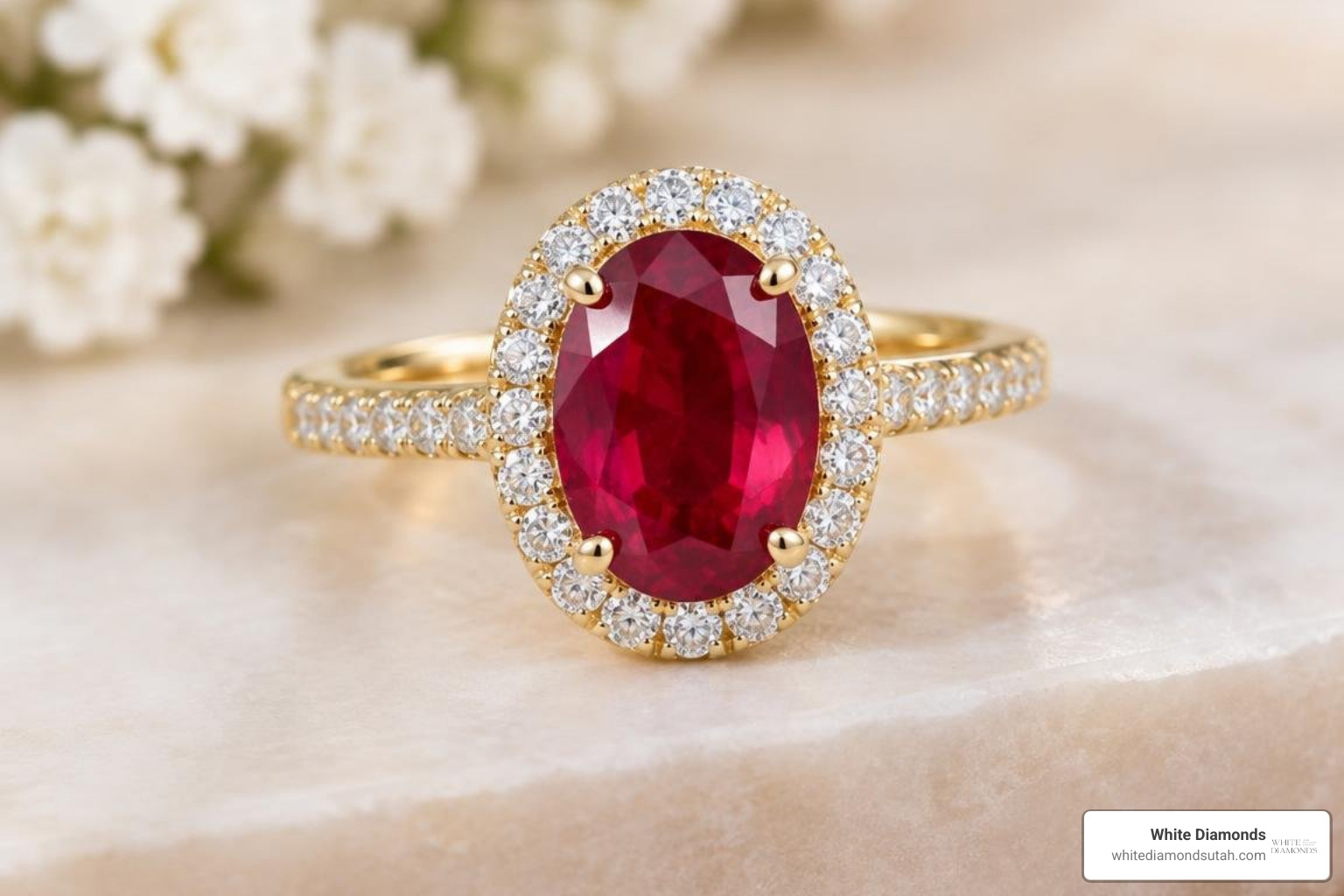
Unlike diamonds, which are cut to standardized mathematical formulas (like the Tolkowsky ideal cut), rough ruby crystals are cut natively in their country of origin. Because fine ruby rough is so precious, lapidaries focus on preserving maximum carat weight while positioning the crystal's optical axis to showcase the purest red hue.
Corundum is pleochroic, meaning it displays two distinct shades depending on the angle of view: a pure, fiery red in one direction and an orange-red or purplish-red in another. A master cutter carefully orients the table facet perpendicular to the crystal's c-axis to guarantee that the primary view displays deep red rather than diluted secondary tones. Skilled cutting also minimizes "windowing"—a washed-out clear patch in the center caused by shallow pavilion angles that allow light to leak out the back rather than bouncing toward your eye.
Collaborating on custom engagement ring design ensures your setting accommodates the exact proportions, depth, and symmetry of your center gem.
Popular Shapes and Dimensions for a 2 Carat Ruby
Because natural ruby crystals often grow in tabular, barrel-shaped hexagonal formations, specific cuts are far more common than others:
- Oval Cut: By far the most popular shape for a 2-carat ruby. Ovals maximize weight retention from the rough crystal, distribute color evenly, and offer a flattering, elongated look on the finger.
- Cushion Cut: Combining antique elegance with soft rounded corners, cushion cuts provide deep pavilion depths that intensify color saturation, making them ideal for vivid red stones.
- Round Brilliant: Rare in sizes above one carat because cutting a round stone causes significant rough weight loss (often over 50% waste). Consequently, 2-carat round rubies command an extra premium.
- Pear and Marquise: Excellent choices for showcasing vibrant color in unique, vintage-inspired jewelry layouts.
- Cabochon: Smooth, domed, non-faceted cuts reserved for stones with rich color and dense rutile silk. When illuminated, high-quality cabochon stones can display asterism—a floating six-rayed star across the surface.
Because rubies have a higher specific gravity (roughly 4.00) than diamonds (3.52), a 2-carat ruby will appear slightly more compact face-up than a 2-carat diamond. A typical 2-carat oval ruby measures around 8.0 × 6.0 mm (or up to 8.5 × 6.5 mm depending on depth), whereas a round 2-carat ruby generally measures 7.0 to 7.3 mm across.
Setting Selection and Long-Term Maintenance
With a hardness rating of 9 on the Mohs scale, ruby is second only to diamond in mineral durability. It features no structural cleavage, meaning it resists chipping and cracking during daily wear. This makes a 2-carat ruby an exceptional choice for daily heirloom rings.
To protect your stone for generations:
- Choose the Right Setting: Bezel settings wrap precious metal around the gem's girdle, offering maximum protection for active lifestyles. If you prefer prongs, a four- or six-prong platinum or 14k gold setting keeps the gem securely seated while letting light enter from the sides.
- Cleaning Routine: For natural, untreated, or standard heat-treated rubies, cleaning is simple. Soak the piece in warm water with mild dish soap, then gently scrub around and beneath the setting using a soft-bristled baby toothbrush. Rinse thoroughly with clean water and dry with a lint-free cloth.
- Avoid Harsh Chemicals: Take your ring off before applying chlorine bleach, harsh household cleaners, or gardening chemicals.
- Professional Care: If your ruby has surface-reaching fractures or uncertain treatment history, avoid ultrasonic and steam cleaners, which can shock the crystal. Instead, consult our professional jewelry cleaning guidance for safe, regular inspection and prong tightening.
Frequently Asked Questions About 2-Carat Rubies
What is the typical price range for a 2-carat ruby?
A natural 2-carat ruby spans a wide price spectrum based on treatment, clarity, and color saturation. Commercial-grade stones cost between $2,000 and $16,000 total ($1,000 to $8,000 per carat). Good to strong red, eye-clean heated gems range from $24,000 to $60,000 ($12,000 to $30,000 per carat). Fine, vivid red stones with top transparency can reach $60,000 to $100,000+, while rare unheated Burmese gems regularly exceed $100,000 to $200,000+.
What are the standard millimeter dimensions of a 2-carat ruby?
Because rubies are denser than diamonds, face-up dimensions vary based on how deep the gem was cut. An average, well-proportioned 2-carat oval ruby measures approximately 8.0 × 6.0 mm (spanning 7.8 × 5.8 mm to 8.5 × 6.5 mm). A well-cut 2-carat round ruby typically measures 7.0 mm to 7.3 mm in diameter, while cushion cuts often measure around 7.0 × 7.0 mm or 7.5 × 6.5 mm.
How can a buyer verify ruby authenticity and treatments?
Always request an independent colored gemstone identification report from an accredited gemological laboratory such as the Gemological Institute of America (GIA), American Gemological Laboratories (AGL), SSEF, or Gübelin. These reports verify that the stone is genuine natural corundum, state whether heat or fracture-filling treatments are present, and provide an expert opinion on geographic origin based on microscopic inclusion analysis and trace-element spectroscopy.
Conclusion
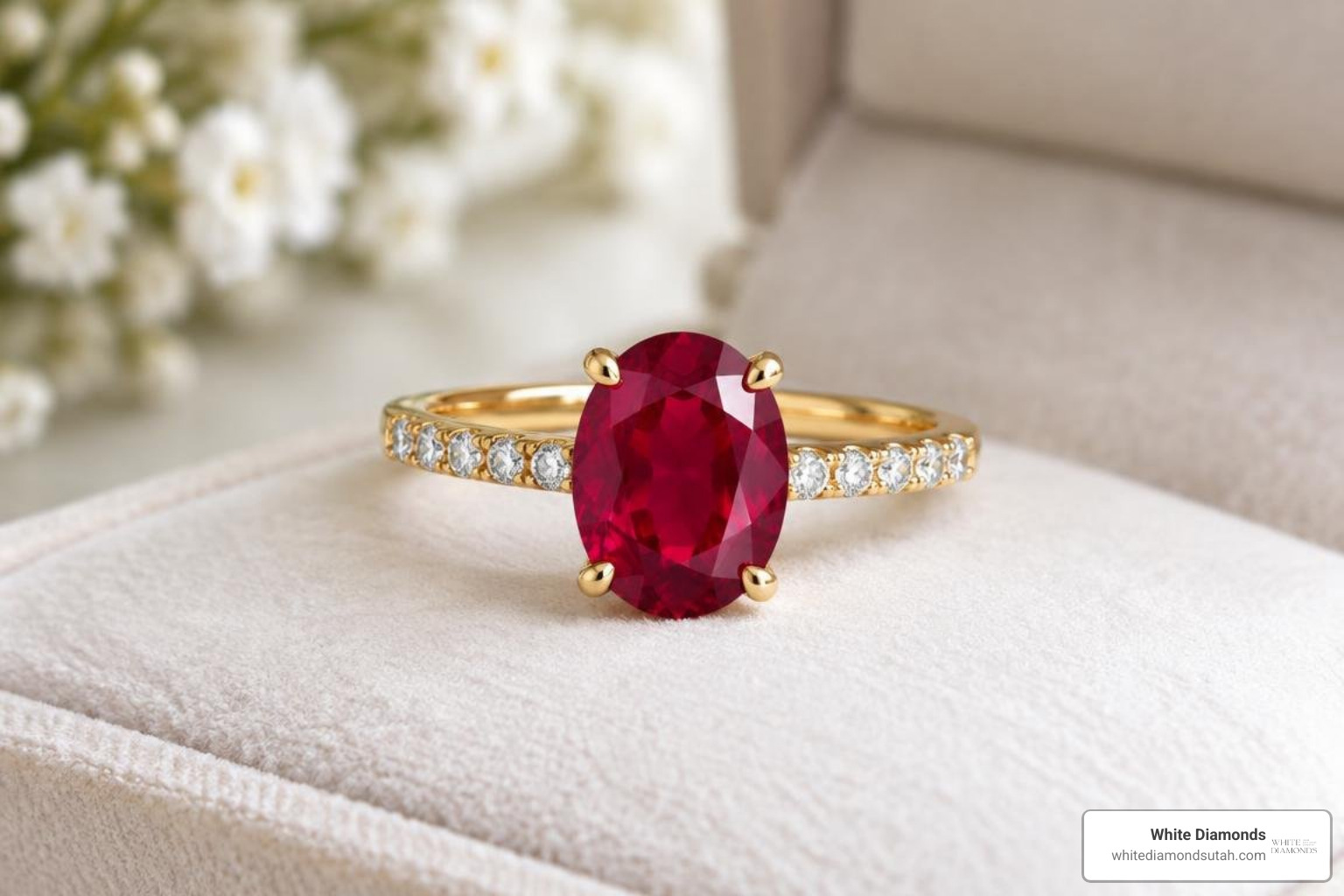
A natural 2-carat ruby combines rich history, dazzling color, and exceptional durability. Whether you fall in love with an electric pigeon's blood hue from Burma or a brilliant, crystal-clear Mozambique gem, finding the right center stone comes down to balancing color saturation, clarity, and treatment history against your personal budget.
At White Diamonds in Utah, we eliminate the stress of selecting fine colored gemstones. We invite you to sit down with our team for a personalized, pressure-free consultation where you can view loose stones, try on custom model rings, and bring your vision to life within your exact budget and timeline. Explore our expert jewelry guides and news to discover more design inspiration, or stop by our showroom to begin crafting your one-of-a-kind ruby masterpiece.