Is That a Rock or a Mountain? The 10 Carat Diamond Guide
What Does a 10 Carat Diamond Size Actually Look Like?
10 carat diamond size is one of the most searched topics in fine jewelry — and for good reason. Here's the quick answer:
| Shape | Typical Dimensions | Face-Up Size |
|---|---|---|
| Round Brilliant | ~14mm diameter | Large as a small shirt button |
| Oval | ~17.5 × 11.7mm | Covers nearly the full lower finger |
| Pear | ~18 × 11mm | Elongated, finger-slimming appearance |
| Cushion | ~13 × 13mm | Slightly smaller spread than round |
| Emerald | ~16 × 11mm | Rectangular, bold step-cut presence |
Key facts at a glance:
- A 10 carat diamond weighs exactly 2 grams (1 carat = 0.2 grams)
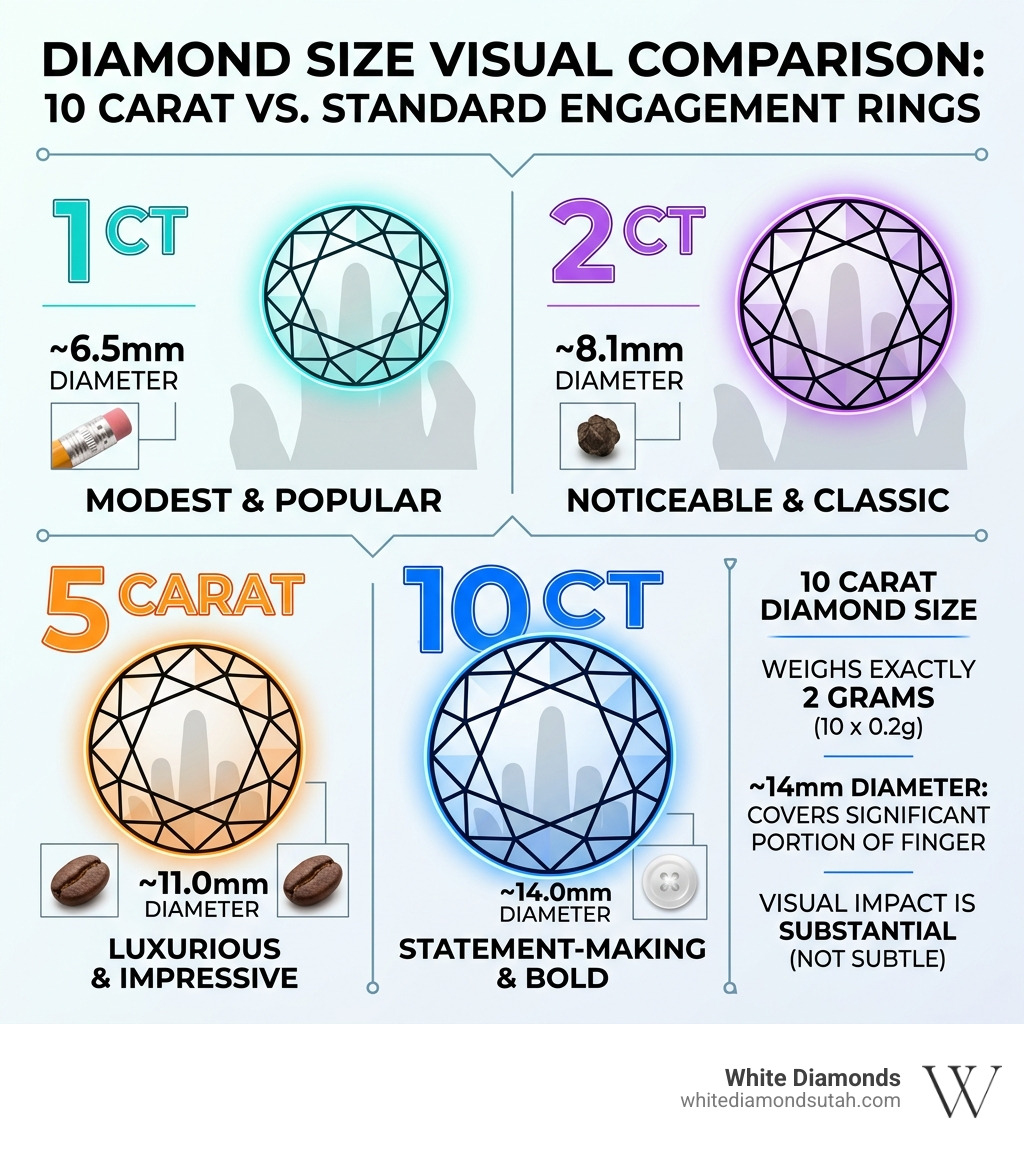
- A round 10 carat stone is roughly 14mm across — more than double the diameter of a typical 1 carat ring (6.5mm)
- The average engagement ring is around 1.5 carats, making a 10 carat stone roughly 7× larger by weight
To put that in perspective: a 10 carat round diamond covers nearly the entire space between your finger base and first knuckle. It is not subtle.
That size comes with serious visual impact — and serious decisions around cut, shape, setting, and budget.
At White Diamonds, we are a personal custom jewelry studio with hands-on experience helping clients design rings around exceptional stones, including large-carat diamonds where every millimeter of the 10 carat diamond size matters. We are here to walk you through everything, without pressure.
Understanding the 10 Carat Diamond Size and Visual Presence
When we talk about a 10 carat diamond size, we have to start with a bit of "diamond math." Many people assume that a 10 carat diamond will be ten times physically larger than a 1 carat diamond. In reality, while it is ten times the weight, the visual dimensions don't scale linearly.
A diamond is a three-dimensional object. As the weight increases, much of that mass is distributed into the depth (the bottom or "pavilion") of the stone. For example, a standard 1 carat round brilliant diamond is about 6.5mm in diameter. If you jump to a 2 carat stone, the diameter only increases to about 8.1mm—a 100% weight increase but only about a 25% increase in width. By the time we reach the 10 carat diamond size, a well-cut round brilliant typically measures 14mm or greater.
To help you visualize the "spread" of these stones, here is a comparison of millimeter dimensions by shape for a 10-carat weight:
| Diamond Shape | Approximate Millimeter Dimensions |
|---|---|
| Round Brilliant | 14.0 mm x 14.0 mm |
| Oval Cut | 17.5 mm x 11.7 mm |
| Pear Shape | 18.0 mm x 11.0 mm |
| Emerald Cut | 16.0 mm x 11.0 mm |
| Cushion Cut | 13.0 mm x 13.0 mm |
| Marquise Cut | 21.0 mm x 10.5 mm |
As you can see, the shape you choose drastically changes the "face-up" area. A 14mm round diamond is roughly the size of a standard shirt button or a large pea. It is a massive amount of "finger real estate." For more details on how these measurements translate to different weights, you can explore this Diamond Carat Size Chart & Buying Guide.
If you are still deciding which weight is best for your lifestyle and budget, check out our guide on What Diamond Carat Size is Right for You to see how 10 carats compares to more traditional sizes.
Which Shapes Make a 10 Carat Diamond Size Look Largest?
If your goal is to maximize the visual impact of your 10 carat diamond size, not all shapes are created equal. Elongated shapes are the secret weapon of the diamond world. Because they distribute their weight across a longer surface area, they often appear significantly larger than a round diamond of the exact same carat weight.
The Marquise cut is the undisputed champion of perceived size. Its long, pointed silhouette can reach over 20mm in length at 10 carats, making it look absolutely gargantuan on the hand. Similarly, the Oval cut and Pear shape offer a massive "spread." An oval diamond at this weight measures roughly 17.5mm, providing a slimming effect on the finger while covering a huge amount of skin. You can see the 10 Carat Oval Cut (17.49×11.66mm) - Actual Size On Finger to understand just how much presence these elongated stones have.
On the other end of the spectrum, "deep" cuts like the Asscher or certain Cushion cuts may look slightly smaller from the top because more of their 2-gram weight is hidden in the bottom of the stone.
Visualizing a 10 Carat Diamond Size on the Hand
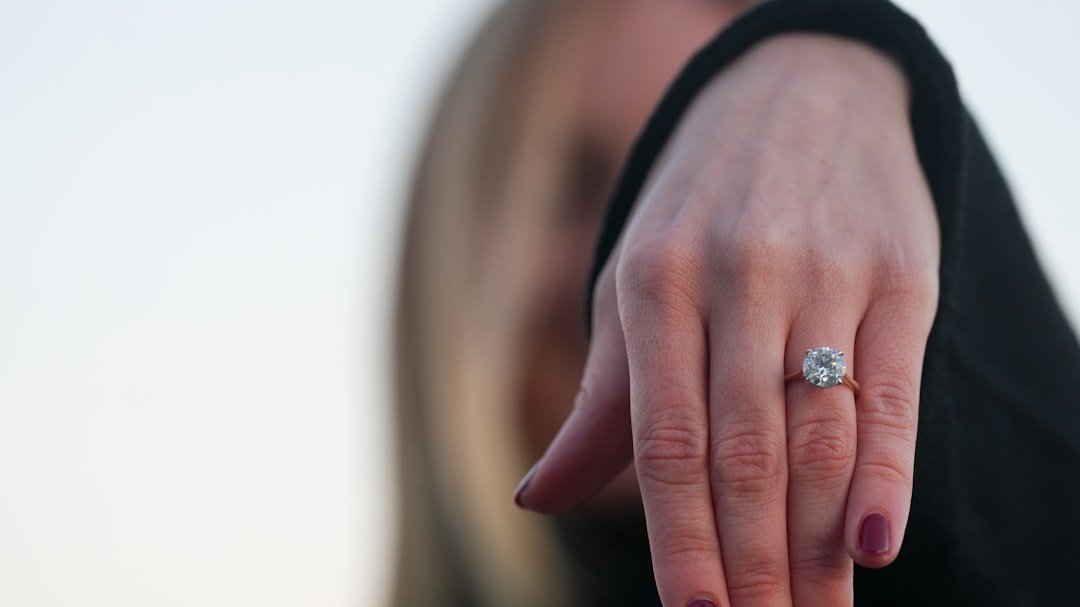
Visualizing a 10 carat diamond size on your own hand requires a shift in perspective. In the United States, the average engagement ring is between 1.0 and 1.2 carats. A 10 carat stone is essentially seven to ten times that weight.
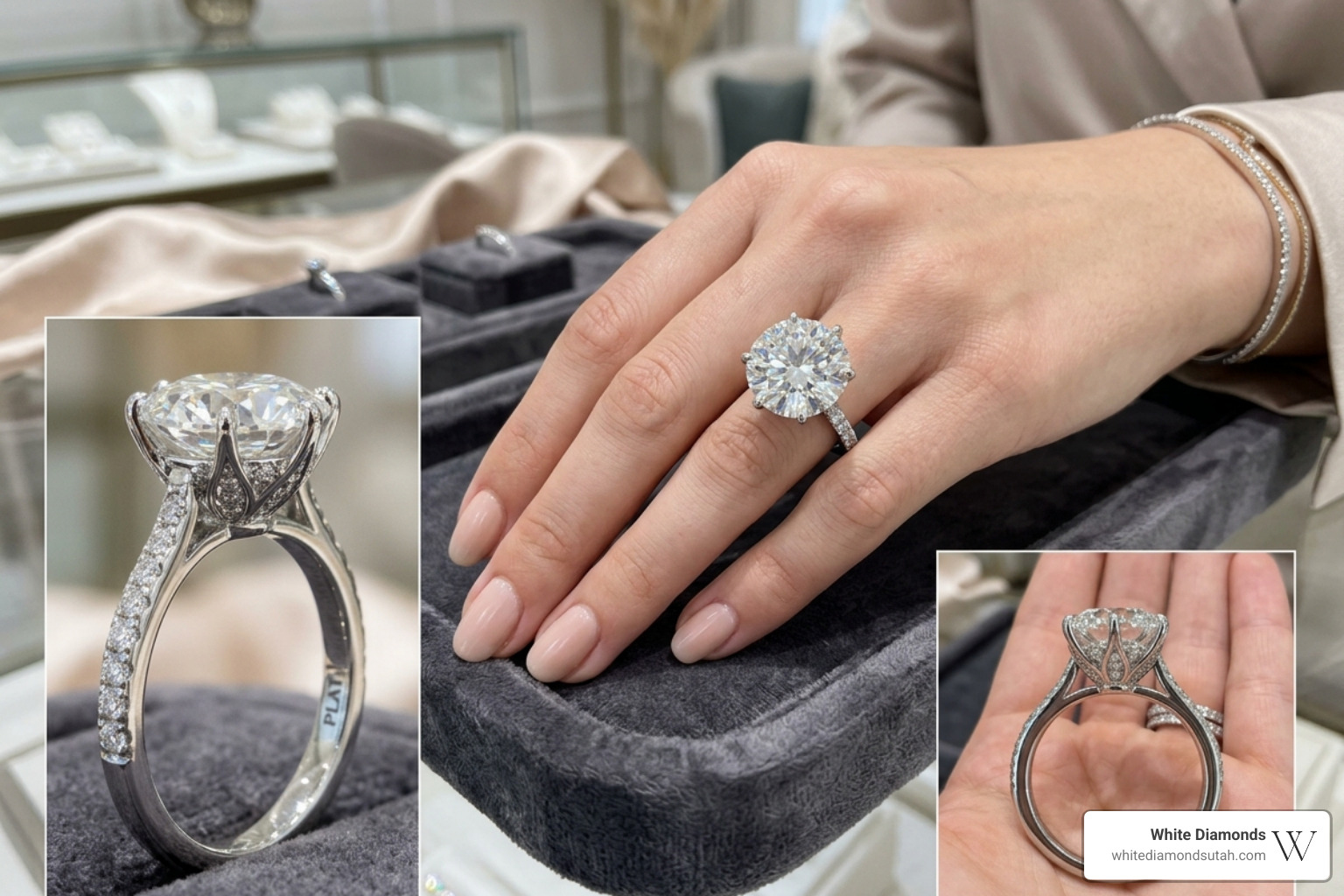
On a standard size 6 finger, a 10 carat round brilliant diamond (14mm) will cover approximately 80-90% of the width of the finger. For those with smaller hands, a stone of this magnitude will often dominate the entire space between the base of the finger and the first knuckle. It is often referred to in the industry as a "whopper" or a "statement stone" because it is impossible to ignore.
To see a side-by-side comparison of the most popular shape, look at this 10 Carat Round (14mm) - Actual Size On Finger. Most of our clients at White Diamonds find that seeing these dimensions in person—or even using a paper cutout—helps them realize that 10 carats is a truly significant physical object.
Factors That Influence the 10 Carat Diamond Size Appearance
While carat is a measure of weight, several other factors determine how "big" that diamond actually looks to the naked eye. The most critical factor is Cut Quality.
A poorly cut diamond can "hide" its weight. For example, a "deep-cut" stone has a thick middle and a heavy bottom. While it might weigh 10 carats on a scale, its diameter might only be 13mm, making it look like an 8-carat stone. Conversely, a "shallow-cut" stone might have a huge 15mm diameter, but it will lack the sparkle and "fire" that makes a diamond beautiful, often looking dull or "glassy" in the center.
The setting also plays a massive role in security and appearance. A 10-carat stone weighs 2 grams—which doesn't sound like much until you realize it's being held up by tiny metal claws. We generally recommend a 6-prong setting for stones of this size to provide maximum security. Platinum is the metal of choice here; it is denser and more durable than gold, ensuring those 2 grams of carbon stay exactly where they belong.
If you are curious about how smaller stones look in different settings, you can see how we handle These 1 Carat Rings to get a feel for our design philosophy.
The Impact of Cut on 10 Carat Diamond Size and Sparkle
We cannot stress this enough: Cut is king. When you are investing in a 10 carat diamond size, you should never sacrifice cut for weight. An "Ideal" or "Excellent" cut ensures that light enters the stone and reflects back to your eye, rather than leaking out the bottom.
In large diamonds, the facets (the tiny "windows" of the diamond) are much larger. This means any lack of symmetry or poor proportions is magnified. A well-cut 10-carat stone will have a "face-up" diameter that matches its weight class (roughly 14mm for a round) while maintaining a balanced pavilion depth. If the stone is too deep, you are paying for weight you can't see. If it's too shallow, you lose the brilliance.
For a deeper dive into how cut affects the relationship between weight and dimensions, refer back to the Diamond Carat Size Chart & Buying Guide.
Settings and Bands to Enhance Perceived Size
If a 10-carat stone isn't quite enough (hey, we don't judge!), there are ways to make it look even more substantial:
- Halo Settings: Adding a "frame" of smaller diamonds around the center stone can make the overall footprint look like a 12 or 13-carat diamond.
- Thin Bands: A delicate, thin band creates a visual contrast that makes the center stone look even more massive.
- Side Stones: Flanking a 10-carat center stone with tapered baguettes or smaller pear shapes can draw the eye horizontally, increasing the "wall-to-wall" diamond look on the finger.
- Metal Color: Setting a high-quality (D-F color) diamond in platinum or white gold enhances its icy brilliance, whereas yellow gold can sometimes make the stone's boundaries blend in with the metal.
Buying Guide: Price, Quality, and Lab-Grown Alternatives
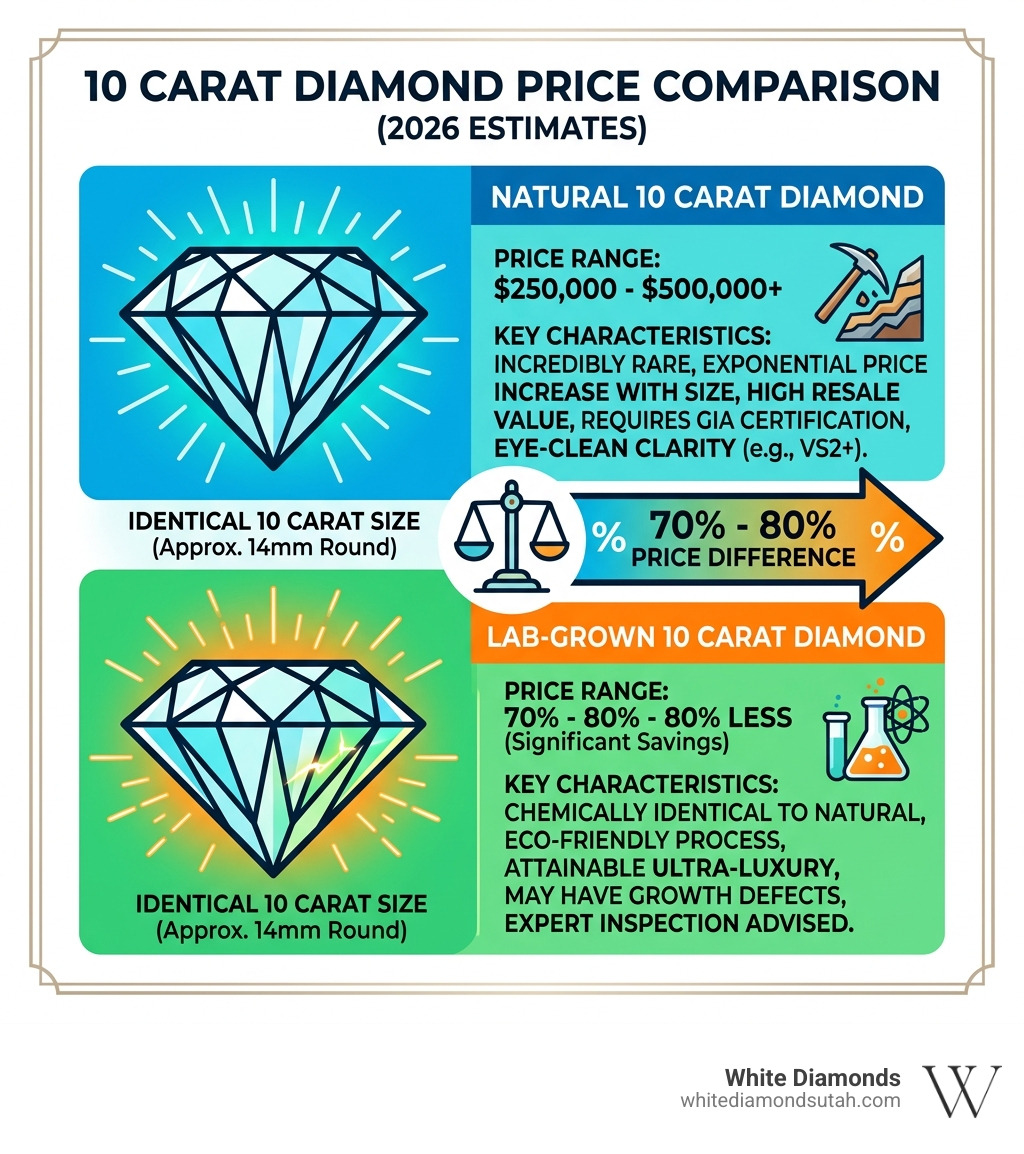
Buying a 10-carat natural diamond is an entry into ultra-luxury. Because large, gem-quality rough diamonds are incredibly rare in nature, the price does not increase linearly—it increases exponentially.
A high-quality 10-carat natural diamond (think G color, VS2 clarity) can easily range from $250,000 to over $500,000 depending on the specific "Cs." For a stone of this value, a GIA certification is non-negotiable. At this size, inclusions are much easier to see because the facets are so large, so we typically recommend a clarity grade of VS2 or higher to ensure the stone is "eye-clean."
For many, lab-grown diamonds have changed the game. A 10-carat lab-grown diamond is chemically, physically, and optically identical to a natural diamond but can cost 70% to 80% less. This allows you to achieve that "mountain" of a diamond for a fraction of the cost of a natural stone. However, be aware that growing 10-carat lab diamonds is technically difficult, and they can sometimes have "growth defects" or a "blue nuance," so expert inspection is still required.
When planning your budget, our guide on How Much to Spend on an Engagement Ring can help you navigate these big financial decisions.
Frequently Asked Questions about 10 Carat Diamonds
Is a 10 carat diamond too heavy for everyday wear?
Technically, a 10-carat diamond only weighs 2 grams—about the weight of two standard paperclips. While it isn't "heavy" in terms of physical weight, its height and volume are significant. A stone this large sits high off the finger, meaning it can catch on pockets, hair, or car doors. Most people who own a 10-carat ring treat it as a "special occasion" piece or have a very careful daily routine. Security and insurance are also major considerations for daily wear.
How rare is a high-quality 10 carat natural diamond?
Extremely rare. Only a tiny fraction of the diamonds mined globally are large enough to result in a 10-carat polished gem. Finding one with high color and clarity is even rarer. Because of this scarcity, high-quality 10-carat natural diamonds are often viewed as "investment grade" assets that hold their value well over time. They are rarely found in traditional mall jewelry stores and usually require a custom search through specialized wholesalers—something we specialize in here in Utah.
What are the recommended 4Cs for a diamond of this size?
- Cut: Ideal or Excellent. Never compromise here.
- Color: G or H is the "sweet spot." Large diamonds show color more easily than small ones, but G/H will still look white to the naked eye while saving you thousands over D/E grades.
- Clarity: VS2 or higher. The large "table" (top facet) of a 10-carat stone acts like a window; you don't want to see a black spot right in the middle.
- Carat: 10.0ct is the goal, but look for stones just above (like 10.1ct) to ensure you stay in the 10-carat bracket even if the stone ever needs a minor repair or repolish.
Conclusion
A 10 carat diamond size is more than just a piece of jewelry; it is a masterpiece of nature (or science) that commands attention. Whether you are looking for the classic brilliance of a 14mm round stone or the elongated elegance of a 17mm oval, the key is to balance that massive size with the quality that makes a diamond truly sparkle.
At White Diamonds, we pride ourselves on being Utah’s premier destination for custom jewelry. We offer pressure-free, personalized consultations in Ogden to help you navigate the complexities of large-carat diamonds. We can help you source the perfect stone—natural or lab-grown—and design a setting that ensures your "mountain" is both secure and stunning.
If you’re ready to see what's possible within your budget and timeline, read our Guide to Buying Diamond Engagement Rings in Utah or Start your custom jewelry journey with us today.