X Ways to Know if Utah Jewelry Stores Offer Diamond Size Tools
Which Utah Jewelry Stores Provide Diamond Carat by Size Comparison Tools?
When embarking on a custom ring design journey, relying solely on numbers on a grading report can lead to unexpected surprises. Several local jewelers across the state recognize this challenge and have integrated physical and digital size comparison tools into their business models.
For example, premier showrooms utilize specialized design software that allows guests to sit down at a computer and visually map out their ring, helping them see how different center stone dimensions sit within various metal mountings.
Interactive online custom ring builders powered by digital design tools are also available to help clients visualize their ring concepts from home. Other specialized custom jewelers provide a highly structured custom manufacturing process that relies on detailed CAD drawings and physical wax models built to the exact finger and center stone size of the client.
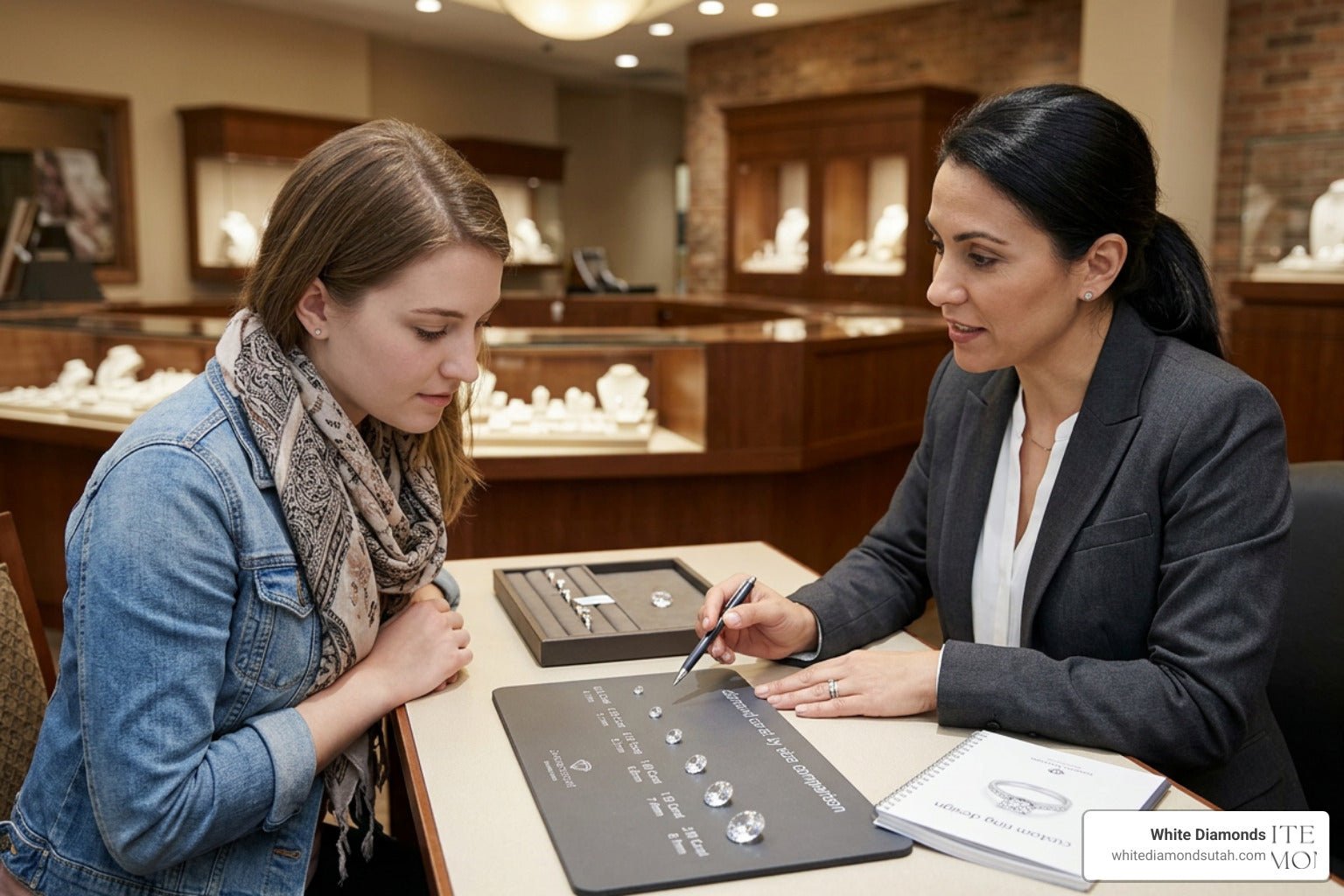
Additionally, some local showrooms emphasize highly tactile, in-store physical education. They encourage clients to examine stones under microscopes and weigh them on physical carat scales to bridge the gap between technical specifications and real-world appearance.
Using these tools is essential for understanding What Diamond Carat Size Is Right For You. Visual aids prevent the common mistake of assuming that doubling a diamond's carat weight will automatically double its visual surface area. Instead, they demonstrate how different shapes distribute their weight, allowing you to choose a diamond that matches your aesthetic expectations.
Interactive 3D Ring Builders and Online Charts
Digital tools have revolutionized the initial stages of custom ring design. Online 3D ring builders allow you to select a setting type and scale the center stone in real-time. This interactive experience gives you an immediate sense of how a 1.0-carat stone compares to a 1.5-carat or 2.0-carat stone on a virtual band.
For those who prefer to plan their design before stepping into a showroom, digital and printable carat size charts are incredibly useful. These charts display the standard millimeter dimensions of various diamond shapes at different carat weights. By printing these guides at a 100% scale, you can place them against your hand to get a baseline understanding of finger coverage. Utilizing these resources is a highly recommended first step in our Guide To Buying Diamond Engagement Rings In Utah.
In-Store Visual Aids and Gemological Tools
While digital builders and printable charts are excellent starting points, they cannot fully replicate the physical reality of a diamond's sparkle, depth, and scale. This is why visiting a local showroom that provides a Custom Ring Consultation Free is so valuable.
In-store gemological tools play a critical role in the educational process:
- Master Stone Sets: These are physical collections of cubic zirconia or non-gem-grade stones cut to precise carat weights and millimeter dimensions. Placing a 1.0-carat master stone next to a 1.5-carat master stone on a physical tray allows you to see the actual size difference in three dimensions.
- Gemological Microscopes: These instruments allow you to look deep inside a diamond to see its unique clarity characteristics, helping you understand why two physically identical-looking stones might carry different price tags.
- Carat Scales: Seeing a loose diamond weighed on a highly sensitive, calibrated scale demystifies the relationship between physical weight and visual size.
Viewing diamonds in person changes your design perspective entirely. You may find that a 1.2-carat diamond with an excellent cut grade actually has a larger visual "spread" (surface area) than a poorly cut 1.4-carat diamond, saving you money while delivering a more brilliant ring.
How Do Size Comparison Tools Help You Understand Carat Weight vs. Visual Size?
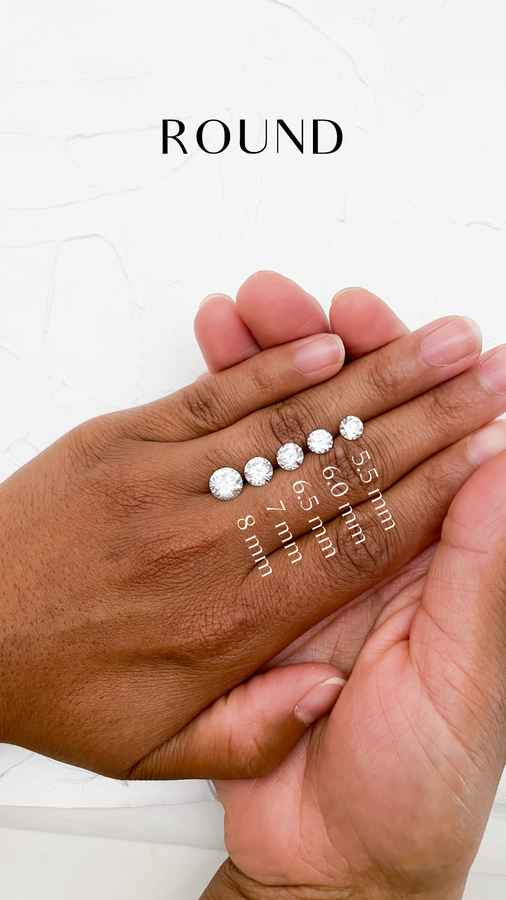
One of the most important lessons in diamond education is that carat) is a measure of weight, not physical size. One carat is equal to exactly 200 milligrams. How that weight is distributed depends entirely on the diamond's cut and shape. This is why two diamonds with the exact same carat weight can look completely different in size when viewed from above.
To illustrate this, we can look at a comparison of standard millimeter dimensions for different 1.0-carat diamond shapes:
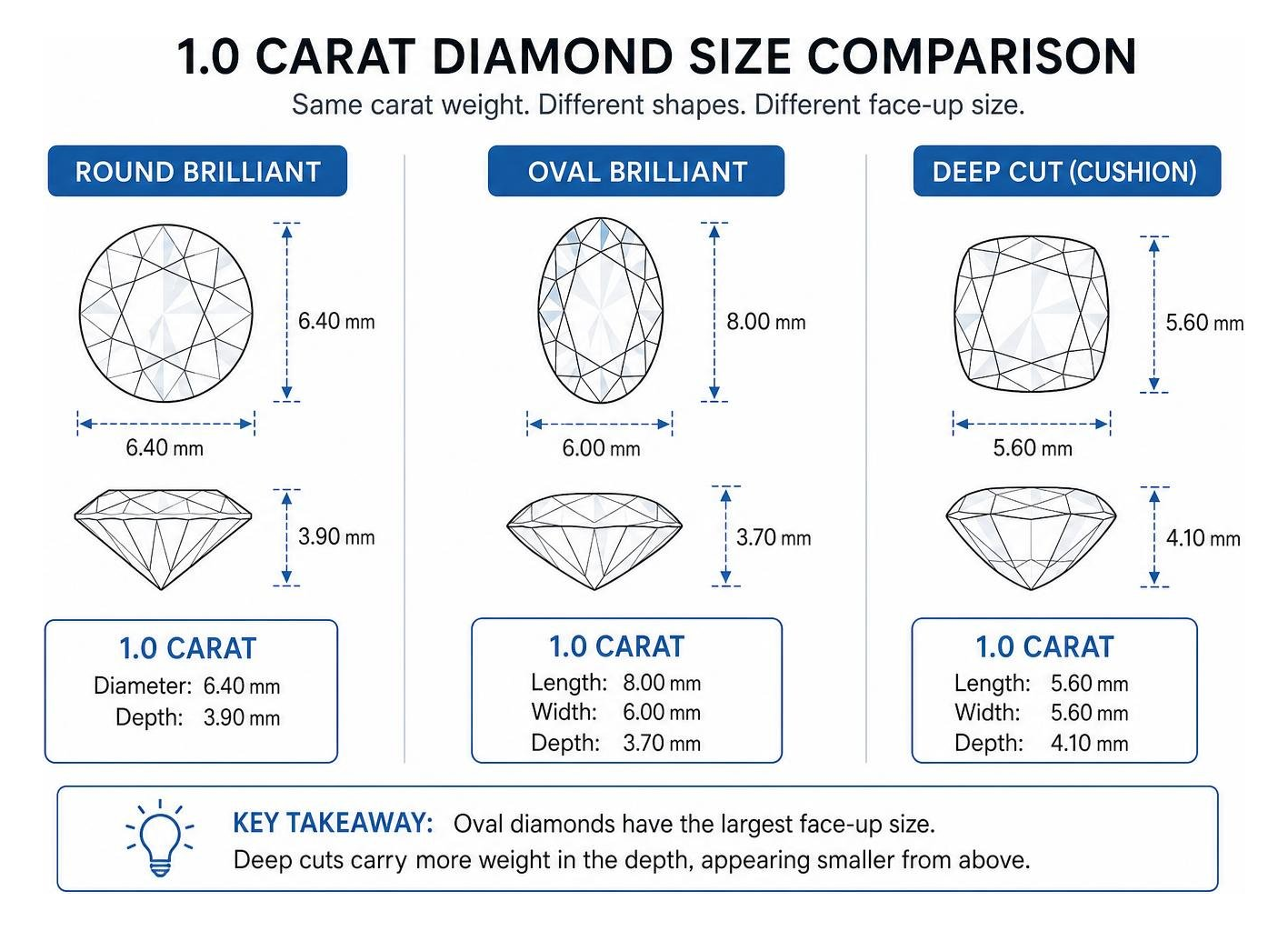
As shown above, elongated shapes like ovals, marquises, and pear cuts distribute more of their weight across the top surface (the table) of the stone. Conversely, round brilliant cuts distribute weight symmetrically, while deep cuts like cushions or Asschers carry a significant portion of their weight in the "belly" (pavilion) of the stone, making them appear smaller from a face-up view.
When planning a custom ring, relying on millimeter measurements rather than carat weight is critical. Your jeweler must use the exact length, width, and depth of your chosen stone to build a structurally sound bezel or prong setting. This precise planning is a core component of our Custom Ring Design Process.
The Impact of Diamond Cut on Perceived Size
The cut of a diamond is the single most important factor in determining its brilliance and perceived size. A poorly cut diamond can compromise both its beauty and its visual presence:
- Shallow Cuts: When a diamond is cut too shallow, light leaks out of the bottom instead of reflecting back to your eye. While this shallow profile can give the stone a larger physical footprint (making a 1.0-carat stone look like a 1.2-carat stone), it results in a dull, lifeless appearance with a dark center, often referred to as a "fish-eye" effect.
- Deep Cuts: When a diamond is cut too deep, it acts like a leaky bucket, letting light escape through the sides. This causes the stone to look dark and makes its face-up size appear significantly smaller than its actual carat weight suggests.
- Excellent or Ideal Cuts: An excellently cut diamond is proportioned to reflect maximum light back through the top. This intense brilliance makes the diamond look bright, lively, and visually larger than a poorly cut stone of the exact same weight.
By balancing the 4Cs (carat, cut, color, and clarity) with physical size tools, you can make informed trade-offs. For example, you might choose to select a slightly lower color or clarity grade to secure a stone with an ideal cut and a larger millimeter spread, maximizing both your budget and the ring's visual impact.
Which Utah Jewelers Combine Carat Size Education with Custom CAD and Wax Modeling?
For a truly successful custom ring design, educational tools must extend beyond loose stones and paper charts. The transition from a 2D size chart to a finished piece of jewelry requires sophisticated technology. Premier custom jewelers in Utah bridge this gap by utilizing Computer-Aided Design (CAD) software and 3D wax printing.
Once you select your center stone based on its millimeter dimensions, a jewelry designer will build a digital 3D model of your ring. This CAD model shows the exact proportions of the band, the height of the setting, and how the accent stones will look alongside your center diamond.
After you approve the digital renderings, the jeweler will print a physical, 3D-printed wax model of your ring. This step is highly recommended when you decide to Design Your Ring Ogden, as it allows you to physically try on the design, feel its weight on your finger, and verify that the scale of the center stone matches your hand proportions before any metal is cast.
The Custom Ring Design Journey in Utah
The custom design process is a collaborative journey that requires clear communication and realistic timelines. When you work with a local custom jeweler, the journey typically follows these milestones:
- Initial Consultation: You discuss design ideas, budget, and select your center stone using size comparison tools.
- CAD Creation: The designer builds a digital 3D model of your ring around the exact millimeter measurements of your diamond.
- Wax Model Review: A physical wax replica is printed for you to try on and approve.
- Casting and Setting: The ring is cast in your chosen precious metal, and our master jewelers hand-set your stones.
- Finishing and Polishing: The ring is polished, rhodium-plated (if white gold), and thoroughly inspected.
While some national chains offer pre-made rings that can be ready quickly, a fully custom, high-quality ring built from scratch typically takes more time. For instance, a typical custom design timeline can range from 5 to 7 weeks from initial concept to finished product, with the manufacturing phase alone taking about 3 weeks from the point of deposit, excluding the initial design consultations. Planning ahead ensures your ring is completed in time for your proposal, a timeline detail we discuss in our Best Jewelers Ogden Guide 2026.
Trying on Wax Models Before Final Casting
Trying on a physical wax model is the ultimate insurance policy for your custom ring design. It eliminates the anxiety of wondering how the digital CAD drawings will translate to real life.
During a wax try-on, you can evaluate:
- Proportion: Does the millimeter size of the center stone look balanced on your specific finger size?
- Height: Does the setting sit too high or too low for your lifestyle and daily activities?
- Band Width: Is the band as delicate or as substantial as you envisioned?
If any element feels off, the designer can easily adjust the digital CAD file and print a new wax model. Making these adjustments during the wax phase is simple and cost-free, whereas altering a ring after it has been cast in gold or platinum is difficult and expensive.
How Do Lab-Grown Diamond Size Comparisons Help Maximize Your Budget?
One of the most significant shifts in the modern jewelry industry is the widespread availability of lab-grown diamonds. For couples designing a custom ring in Utah, understanding the relationship between lab-grown and natural diamond pricing is one of the most effective ways to maximize a budget.
Lab-grown diamonds cost approximately 85% less than natural diamonds of equivalent quality. This massive price differential means that if you have a set budget, choosing a lab-grown diamond allows you to secure a significantly larger center stone than would be possible with a natural diamond.
Using size comparison tools during your consultation helps you visualize this difference clearly. You can compare a 1.0-carat natural diamond side-by-side with a 2.0-carat or even 2.5-carat lab-grown diamond on a physical model ring tray, allowing you to make a decision based on both visual preference and financial comfort.
Comparing Natural and Lab-Grown Dimensions
It is important to emphasize that lab-grown diamonds are real diamonds. They possess the exact same physical, chemical, and optical properties as naturally mined diamonds. They are composed of pure carbon crystallized in an isometric cubic structure, and they rank as a 10 on the Mohs hardness scale. Both natural and lab-grown diamonds are graded using the exact same standards by leading gemological laboratories like the GIA (Gemological Institute of America) and the IGI (International Gemological Institute).
Because they are physically identical, a 1.0-carat round brilliant lab-grown diamond will have the exact same millimeter dimensions (approximately 6.5mm) as a 1.0-carat round brilliant natural diamond. Using size charts and loose stone comparisons allows you to evaluate the price-per-carat ratios of both options side-by-side, giving you complete transparency over your purchase.
Finding the Right Balance for Your Budget
When designing a custom ring, you must decide how to allocate your budget across the 4Cs. Size comparison tools help you determine whether you want to prioritize a larger carat size or a higher color and clarity grade.
For context, the average engagement ring diamond size in the United States is between 1.08 and 1.2 carats. However, because lab-grown diamonds offer such a significant cost advantage, many local couples are choosing larger center stones while staying well within their comfortable spending limits. Whether you choose a classic natural diamond for its historic, timeless value or a lab-grown diamond to maximize your physical stone size, utilizing educational tools ensures you get the absolute best value for your investment.
Why Choose White Diamonds for Your Custom Ring Design and Sizing Education?
At White Diamonds, located in Ogden, Utah, we believe that buying an engagement ring should be an exciting, transparent, and completely stress-free experience. We don't believe in high-pressure sales tactics or commission-driven pitches. Instead, our entire business is built on a foundation of personalized education.
We specialize in custom jewelry design, helping you bring your unique vision to life from scratch. During our hands-on consultations, we guide you through the physical dimensions of different diamond shapes and carat weights. We don't just show you pictures on a screen; we provide physical model rings and loose stone comparisons so you can see exactly how different millimeter sizes look on your hand. If you are ready to start your journey, you can easily book a Custom Ring Consultation Free with our team.
Personalized, Pressure-Free Consultations
Our hands-on approach is designed to eliminate the guesswork and anxiety often associated with diamond buying. We take the time to walk you through the 4Cs, explaining how factors like cut and shape impact the physical size and brilliance of your stone.
By understanding your specific aesthetic preferences, budget, and timeline, we help you source the perfect natural or lab-grown diamond. We then build a fully custom CAD design around the exact millimeter dimensions of your chosen stone, ensuring a structurally flawless and beautiful ring. To learn more about our local reputation and services, check out our Best Jewelers Ogden Guide 2026.
Comparing Utah Custom Ring Design Experiences
To help you understand the difference between a traditional retail experience and our personalized process, we have outlined the key distinctions below:
| Feature | Traditional Utah Retailers | White Diamonds Custom Experience |
|---|---|---|
| Sizing Tools | Static paper charts or limited loose stones | Interactive digital tools, loose stone comparisons, and physical model rings |
| Design Process | Pre-made catalog settings with minor modifications | Fully custom CAD design built around your specific diamond's millimeter dimensions |
| Consultation Style | Commission-based, high-pressure sales | Educational, pressure-free, and budget-focused |
| Visual Verification | 2D sketches or digital renders only | 3D CAD rendering and physical wax model try-ons |
Frequently Asked Questions About Diamond Size Tools in Utah
What is the difference between diamond carat weight and millimeter size?
Carat refers strictly to the weight of the diamond, while millimeter size measures its physical dimensions (length, width, and depth). Because different diamond shapes and cut depths distribute weight differently, two diamonds with the exact same carat weight can have noticeably different visual sizes when viewed from the top.
Can I get a 3D wax model of my custom ring before it is made?
Yes, premier custom jewelers in Utah provide 3D-printed wax models of your custom ring design. This allows you to try on the physical model, verify the finger fit, and see exactly how the scale and millimeter size of your chosen diamond look on your hand before the ring is cast in precious metal.
Are online diamond size comparison charts accurate?
Online diamond size charts are excellent directional tools for comparing the relative scale of different shapes and carat weights. However, because screen resolutions and scaling vary, it is always recommended to pair online research with a physical, in-store consultation where you can view actual diamonds and model rings on your finger.
Conclusion
Designing a custom engagement ring is a deeply personal journey, and utilizing diamond carat by size comparison tools is essential to its success. By combining digital charts, physical master stones, and physical 3D wax models, you can eliminate the guesswork and ensure your finished ring matches your exact expectations.
Taking an educational, pressure-free approach to the 4Cs allows you to make informed decisions, whether you are choosing between natural and lab-grown diamonds or balancing cut quality with physical millimeter spread. At White Diamonds, we are proud to serve the Ogden, Utah community with the tools, technology, and transparent guidance needed to design a stunning, structurally sound ring that fits your personal style and budget perfectly.